







Question: 5. (a) Explain (in words) with examples what it means for two events A and B to be (1) independent of each other; (ii) conditionally
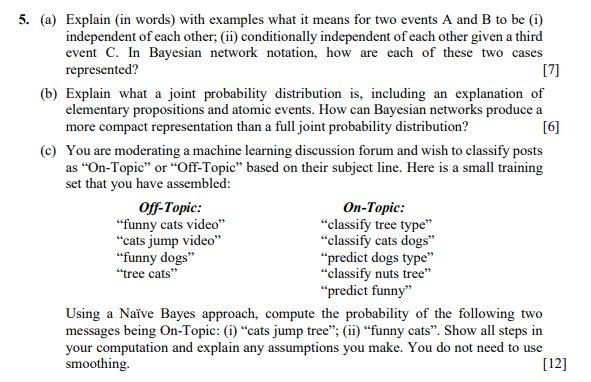
5. (a) Explain (in words) with examples what it means for two events A and B to be (1) independent of each other; (ii) conditionally independent of each other given a third event C. In Bayesian network notation, how are each of these two cases represented? [7] (b) Explain what a joint probability distribution is, including an explanation of elementary propositions and atomic events. How can Bayesian networks produce a more compact representation than a full joint probability distribution? [6] (C) You are moderating a machine learning discussion forum and wish to classify posts as "On-Topic" or "Off-Topic" based on their subject line. Here is a small training set that you have assembled: Off-Topic: On-Topic: "funny cats video" "classify tree type" "cats jump video" classify cats dogs" "funny dogs" "predict dogs type" "tree cats" classify nuts tree" "predict funny" Using a Nave Bayes approach, compute the probability of the following two messages being On-Topic: (1) cats jump tree; (ii) funny cats. Show all steps in your computation and explain any assumptions you make. You do not need to use smoothing. [12]
Step by Step Solution
There are 3 Steps involved in it

Get step-by-step solutions from verified subject matter experts
 Study Help