







Question: 5. (a) Given languages A, B, define the language MIX(A, B) by MIX(A, B) = {214122Y2 . . . InYn | n > 0, X;
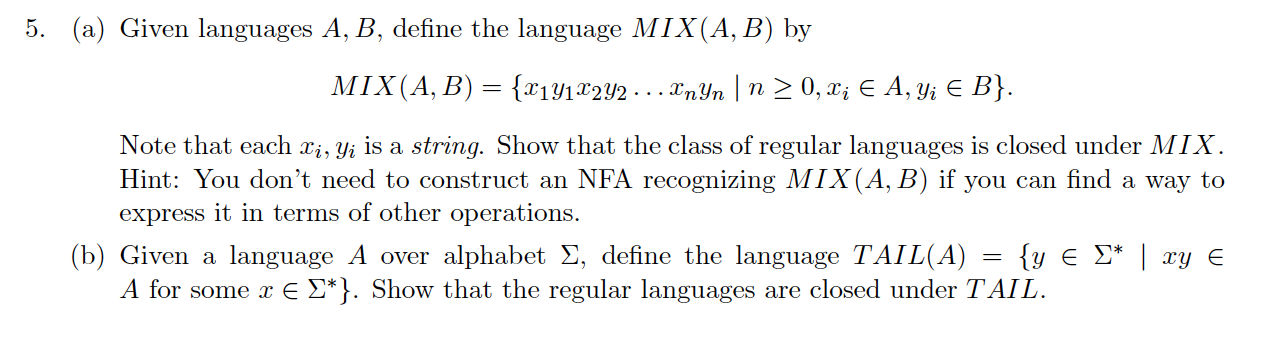
5. (a) Given languages A, B, define the language MIX(A, B) by MIX(A, B) = {214122Y2 . . . InYn | n > 0, X; E A, Yi E B}. Note that each ti, Yi is a string. Show that the class of regular languages is closed under MIX. Hint: You don't need to construct an NFA recognizing MIX (A, B) if you can find a way to express it in terms of other operations. (b) Given a language A over alphabet E, define the language TAIL(A) {y E 5* | xy E A for some x e *}. Show that the regular languages are closed under TAIL. 5. (a) Given languages A, B, define the language MIX(A, B) by MIX(A, B) = {214122Y2 . . . InYn | n > 0, X; E A, Yi E B}. Note that each ti, Yi is a string. Show that the class of regular languages is closed under MIX. Hint: You don't need to construct an NFA recognizing MIX (A, B) if you can find a way to express it in terms of other operations. (b) Given a language A over alphabet E, define the language TAIL(A) {y E 5* | xy E A for some x e *}. Show that the regular languages are closed under TAIL
Step by Step Solution
There are 3 Steps involved in it

Get step-by-step solutions from verified subject matter experts
 Study Help