







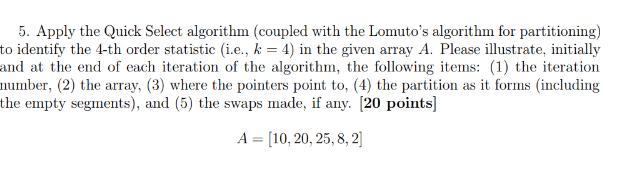
Question: 5. Apply the Quick Select algorithm (coupled with the Lomuto's algorithm for partitioning) to identify the 4-th order statistic (i.e., k = 4) in

![2. Using the Smoothness Rule and the Master Theorem, answer the following questions: [20 points] a. Show that](https://dsd5zvtm8ll6.cloudfront.net/questions/2023/10/6540c3be00698_1698743227372.jpg)
5. Apply the Quick Select algorithm (coupled with the Lomuto's algorithm for partitioning) to identify the 4-th order statistic (i.e., k = 4) in the given array A. Please illustrate, initially and at the end of each iteration of the algorithm, the following items: (1) the iteration number, (2) the array, (3) where the pointers point to, (4) the partition as it forms (including the empty segments), and (5) the swaps made, if any. [20 points] A = [10, 20, 25, 8, 2] 4. Apply the Binary Search algorithm to search for k= 38 in the given array A. Expand the given table to show how the variables I, r, and m change as the algorithm progresses. Each row represents the end of one iteration of the algorithm, while the first row (below the header) represents the values before entering the loop. Please make sure you use the Comment' column to explain any important point at each iteration. [20 points] A = [10, 12, 22, 29, 31, 38, 47, 50, 62] Iter 1 r m Comment 2. Using the Smoothness Rule and the Master Theorem, answer the following questions: [20 points] a. Show that f(x) = log (2x + 5) is a smooth function.
Step by Step Solution
3.56 Rating (156 Votes )
There are 3 Steps involved in it

Get step-by-step solutions from verified subject matter experts
 Study Help