







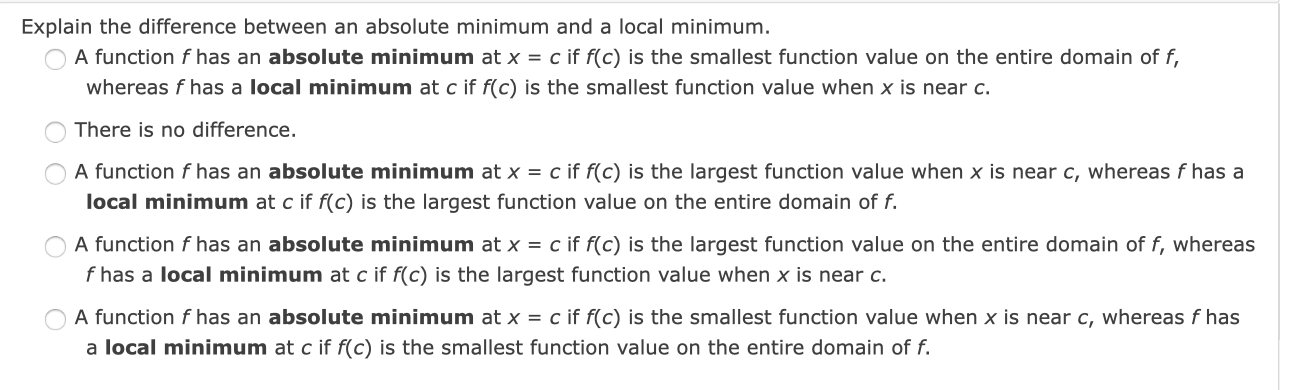
Question: 5 Calculus Questions 1. Explain the difference between an absolute minimum and a local minimum. O A function f has an absolute minimum at x



5 Calculus Questions
1.
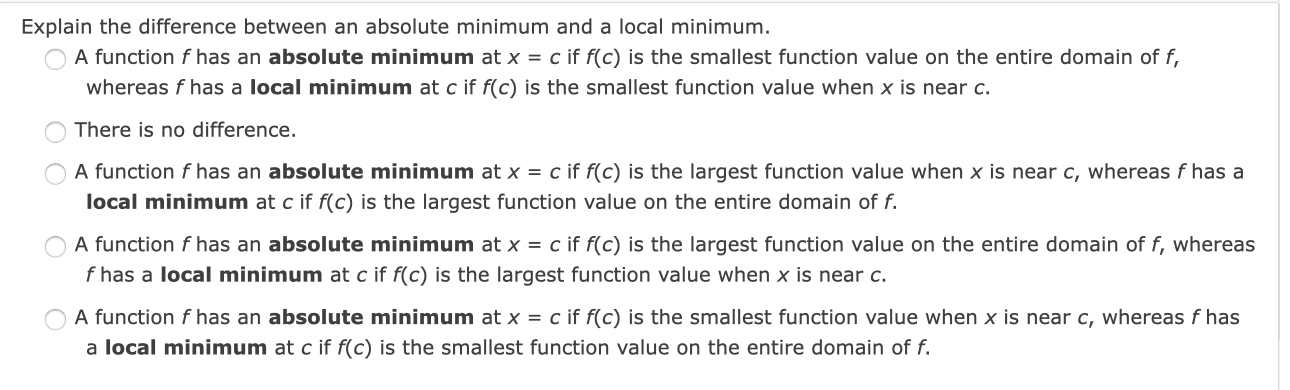
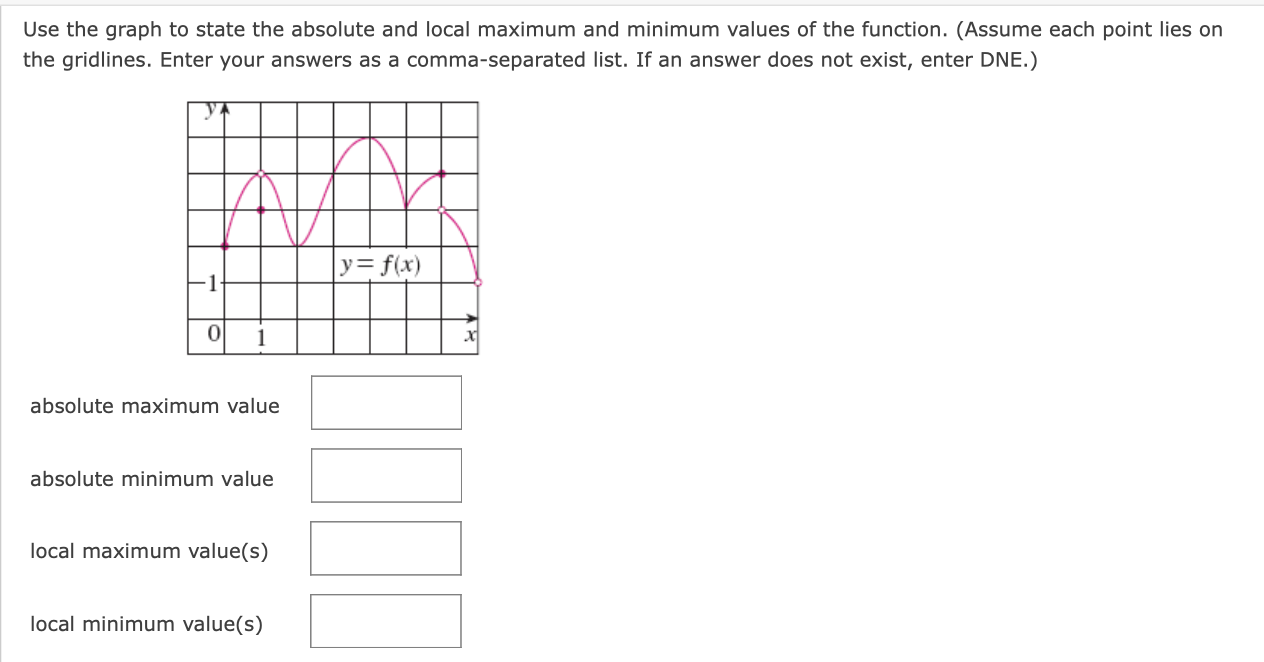



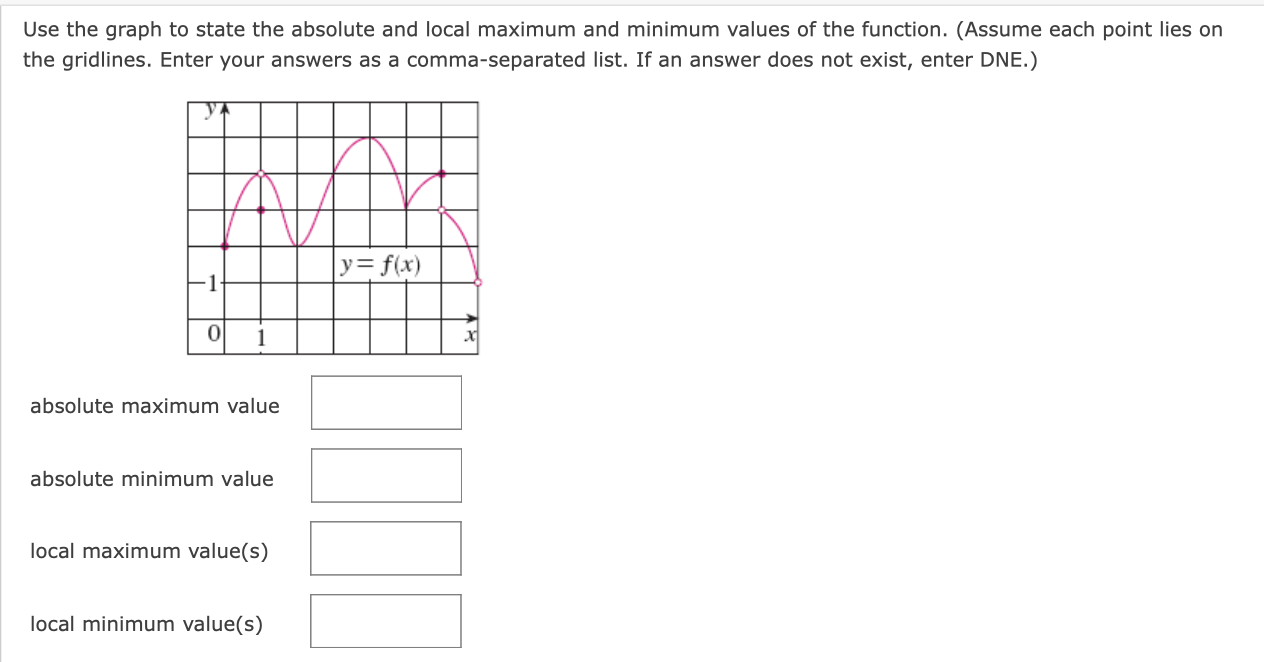
Explain the difference between an absolute minimum and a local minimum. O A function f has an absolute minimum at x = c if f(c) is the smallest function value on the entire domain of f, whereas f has a local minimum at c if f(c) is the smallest function value when x is near c. There is no difference. O A function f has an absolute minimum at x = c if f(c) is the largest function value when x is near c, whereas f has a local minimum at c if f(c) is the largest function value on the entire domain of f. A function f has an absolute minimum at x = c if f(c) is the largest function value on the entire domain of f, whereas f has a local minimum at c if f(c) is the largest function value when x is near c. A function f has an absolute minimum at x = c if f(c) is the smallest function value when x is near c, whereas f has a local minimum at c if f(c) is the smallest function value on the entire domain of f.Use the graph to state the absolute and local maximum and minimum values of the function. (Assume each point lies on the gridlines. Enter your answers as a comma-separated list. If an answer does not exist, enter DNE.) y = f(x) X absolute maximum value absolute minimum value local maximum value(s) local minimum value(s)Find the critical numbers of the function. (Enter your answers as a commaseparated list. If an answer does not exist, enter DNE.) Find the critical numbers of the function. (Enter your answers as a comma-separated list. If an answer does not exist, enter DNE.) g(t) = 15t - 21 t =Find the critical numbers of the function. (Enter your answers as a commaseparated list. If an answer does not exist, enter DNE.) f(x) = X3e_5"
Step by Step Solution
There are 3 Steps involved in it

Get step-by-step solutions from verified subject matter experts
 Study Help