







Question: 5. Consider a single processor system in which two processes, A and B, have the following sequential execution patterns: A: [cpu 4ms;1/O2ms; cpu 4ms;1/O2ms;cpu4ms ]
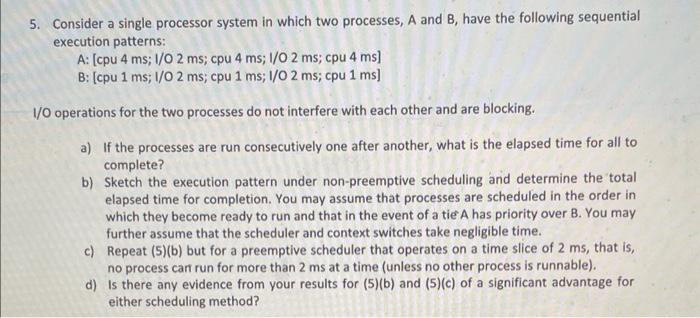
5. Consider a single processor system in which two processes, A and B, have the following sequential execution patterns: A: [cpu 4ms;1/O2ms; cpu 4ms;1/O2ms;cpu4ms ] B: [cpu 1ms;1/O2ms; cpu 1ms;1/O2ms; cpu 1ms ] 1/O operations for the two processes do not interfere with each other and are blocking. a) If the processes are run consecutively one after another, what is the elapsed time for all to complete? b) Sketch the execution pattern under non-preemptive scheduling and determine the total elapsed time for completion. You may assume that processes are scheduled in the order in which they become ready to run and that in the event of a tie A has priority over B. You may further assume that the scheduler and context switches take negligible time. c) Repeat (5)(b) but for a preemptive scheduler that operates on a time slice of 2ms, that is, no process cart run for more than 2ms at a time (unless no other process is runnable). d) Is there any evidence from your results for (5)(b) and (5)(c) of a significant advantage for either scheduling method
Step by Step Solution
There are 3 Steps involved in it

Get step-by-step solutions from verified subject matter experts
 Study Help