



Question: 5. Consider the two-period consumption-labor model. Suppose that lifetime utility of the representative household is given by: V(c1, /1, 02, 12) = u(CI, 7/1) +
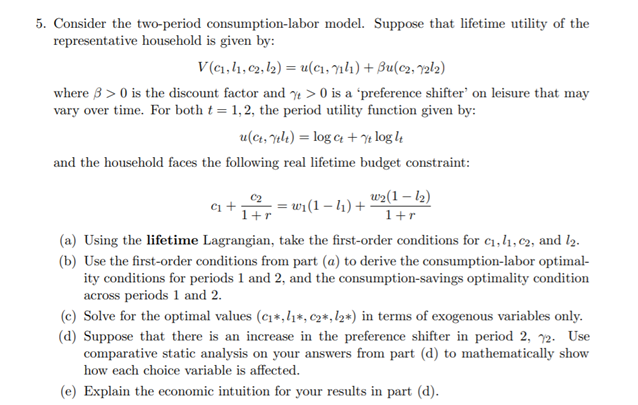
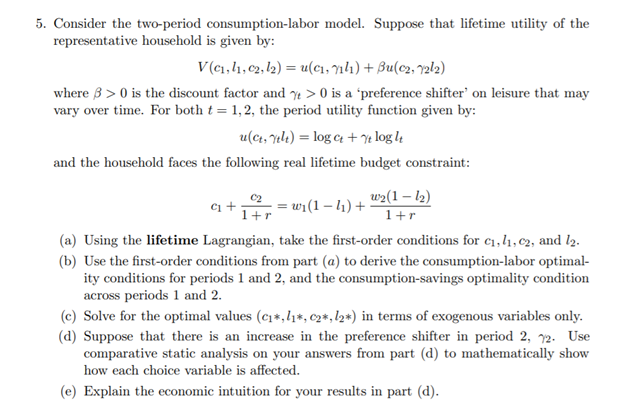
5. Consider the two-period consumption-labor model. Suppose that lifetime utility of the representative household is given by: V(c1, /1, 02, 12) = u(CI, 7/1) + Bu(c2, 72/2) where B > 0 is the discount factor and y > 0 is a 'preference shifter' on leisure that may vary over time. For both # = 1, 2, the period utility function given by: u(ct, yth) = log a + % log l and the household faces the following real lifetime budget constraint: 02 C + =w(1-)+ w2 (1 - 12) 1+r (a) Using the lifetime Lagrangian, take the first-order conditions for c1, 41, c2, and 12. (b) Use the first-order conditions from part (a) to derive the consumption-labor optimal- ity conditions for periods 1 and 2, and the consumption-savings optimality condition across periods 1 and 2. (c) Solve for the optimal values (c1*, (1*, 02*, /2*) in terms of exogenous variables only. (d) Suppose that there is an increase in the preference shifter in period 2, 72. Use comparative static analysis on your answers from part (d) to mathematically show how each choice variable is affected. (e) Explain the economic intuition for your results in part (d)
Step by Step Solution
There are 3 Steps involved in it

Get step-by-step solutions from verified subject matter experts