







Question: 5 ) Define risk aversion using utility (that is, do not use the book's definition! ). Next, consider the following graph of an optimal compensation
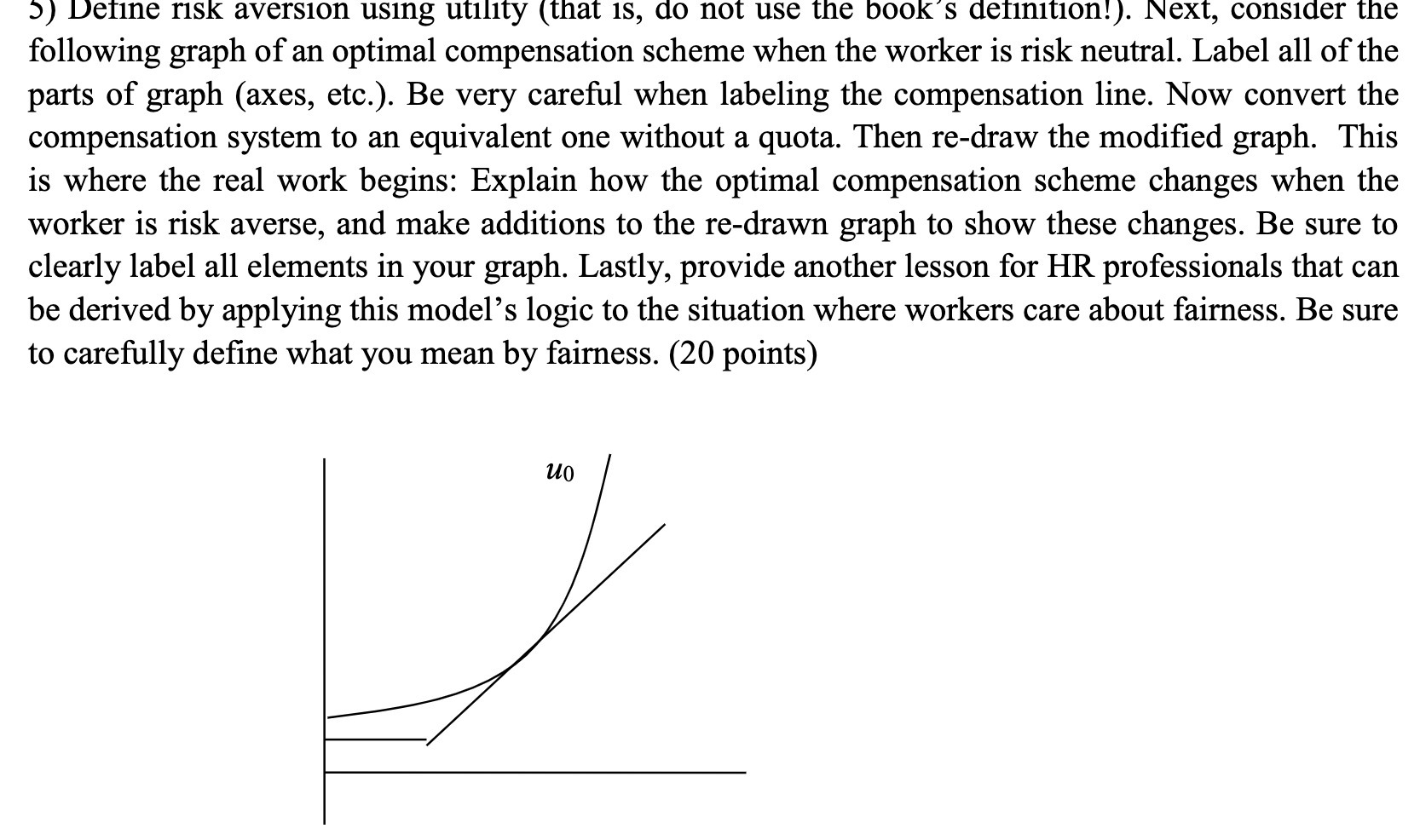
5 ) Define risk aversion using utility (that is, do not use the book's definition! ). Next, consider the following graph of an optimal compensation scheme when the worker is risk neutral. Label all of the parts of graph (axes, etc.). Be very careful when labeling the compensation line. Now convert the compensation system to an equivalent one without a quota. Then re-draw the modified graph. This is where the real work begins: Explain how the optimal compensation scheme changes when the worker is risk averse, and make additions to the re-drawn graph to show these changes. Be sure to clearly label all elements in your graph. Lastly, provide another lesson for HR professionals that can be derived by applying this model's logic to the situation where workers care about fairness. Be sure to carefully define what you mean by fairness. (20 points) uo
Step by Step Solution
There are 3 Steps involved in it

Get step-by-step solutions from verified subject matter experts
 Study Help