Question: 5. Deontological (acts-based) ethics has to do with: a. Asking whether, if everyone did this in all similar circumstances, if it would be a good
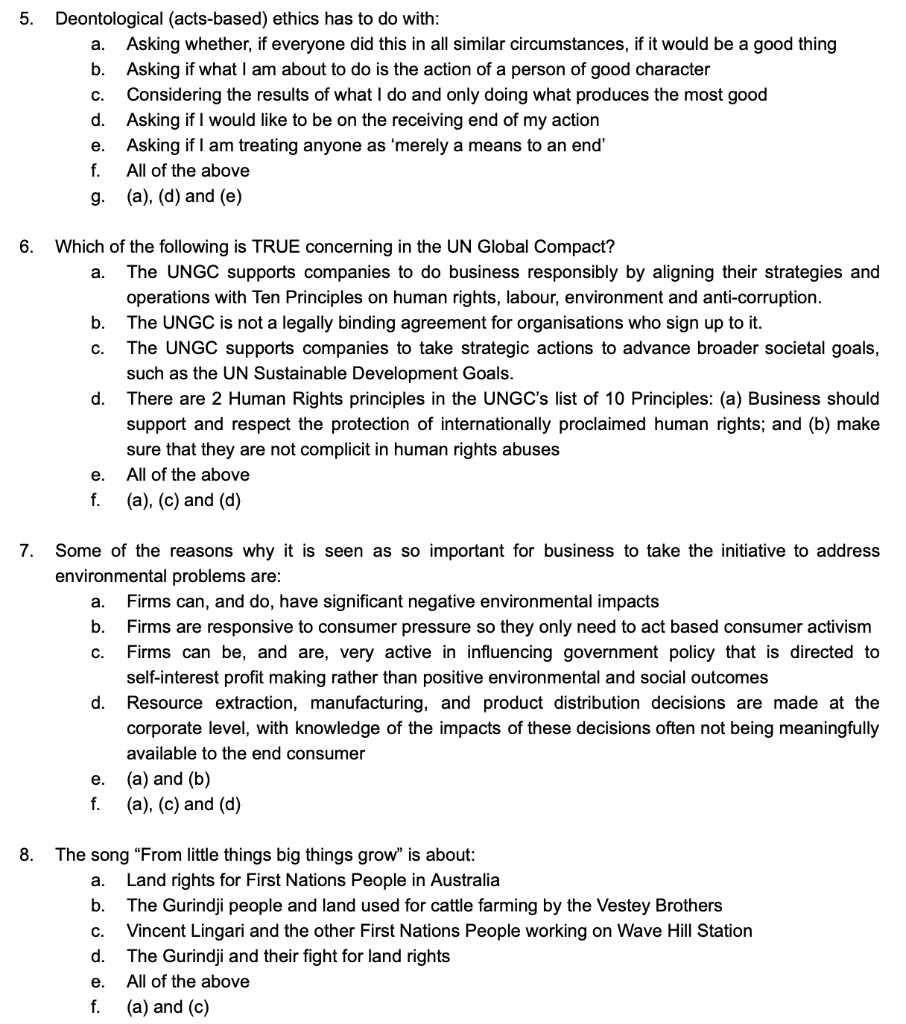
5. Deontological (acts-based) ethics has to do with: a. Asking whether, if everyone did this in all similar circumstances, if it would be a good thing b. Asking if what I am about to do is the action of a person of good character c. Considering the results of what I do and only doing what produces the most good d. Asking if I would like to be on the receiving end of my action Asking if I am treating anyone as 'merely a means to an end' f. All of the above g. (a), (d) and (e) e. 6. a. C. Which of the following is TRUE concerning in the UN Global Compact? The UNGC supports companies to do business responsibly by aligning their strategies and operations with Ten Principles on human rights, labour, environment and anti-corruption. b. The UNGC is not a legally binding agreement for organisations who sign up to it. The UNGC supports companies to take strategic actions to advance broader societal goals, such as the UN Sustainable Development Goals. d. There are 2 Human Rights principles in the UNGC's list of 10 Principles: (a) Business should support and respect the protection of internationally proclaimed human rights; and (b) make sure that they are not complicit in human rights abuses All of the above f. (a), (c) and (d) e. 7. Some of the reasons why it is seen as so important for business to take the initiative to address environmental problems are: a. Firms can, and do, have significant negative environmental impacts b. Firms are responsive to consumer pressure so they only need to act based consumer activism c. Firms can be, and are, very active in influencing government policy that is directed to self-interest profit making rather than positive environmental and social outcomes d. Resource extraction, manufacturing, and product distribution decisions are made at the corporate level, with knowledge of the impacts of these decisions often not being meaningfully available to the end consumer e. (a) and (b) f. (a), (c) and (d) 8. The song "From little things big things grow" is about: a. Land rights for First Nations People in Australia b. The Gurindji people and land used for cattle farming by the Vestey Brothers C. Vincent Lingari and the other First Nations People working on Wave Hill Station d. The Gurindji and their fight for land rights e. All of the above f. (a) and (c) 5. Deontological (acts-based) ethics has to do with: a. Asking whether, if everyone did this in all similar circumstances, if it would be a good thing b. Asking if what I am about to do is the action of a person of good character c. Considering the results of what I do and only doing what produces the most good d. Asking if I would like to be on the receiving end of my action Asking if I am treating anyone as 'merely a means to an end' f. All of the above g. (a), (d) and (e) e. 6. a. C. Which of the following is TRUE concerning in the UN Global Compact? The UNGC supports companies to do business responsibly by aligning their strategies and operations with Ten Principles on human rights, labour, environment and anti-corruption. b. The UNGC is not a legally binding agreement for organisations who sign up to it. The UNGC supports companies to take strategic actions to advance broader societal goals, such as the UN Sustainable Development Goals. d. There are 2 Human Rights principles in the UNGC's list of 10 Principles: (a) Business should support and respect the protection of internationally proclaimed human rights; and (b) make sure that they are not complicit in human rights abuses All of the above f. (a), (c) and (d) e. 7. Some of the reasons why it is seen as so important for business to take the initiative to address environmental problems are: a. Firms can, and do, have significant negative environmental impacts b. Firms are responsive to consumer pressure so they only need to act based consumer activism c. Firms can be, and are, very active in influencing government policy that is directed to self-interest profit making rather than positive environmental and social outcomes d. Resource extraction, manufacturing, and product distribution decisions are made at the corporate level, with knowledge of the impacts of these decisions often not being meaningfully available to the end consumer e. (a) and (b) f. (a), (c) and (d) 8. The song "From little things big things grow" is about: a. Land rights for First Nations People in Australia b. The Gurindji people and land used for cattle farming by the Vestey Brothers C. Vincent Lingari and the other First Nations People working on Wave Hill Station d. The Gurindji and their fight for land rights e. All of the above f. (a) and (c)









 Study Help