







Question: 5. Describe how linear functions and arithmetic sequences are similar. How are they different? Algebraic For the following exercises, find the common difference for the
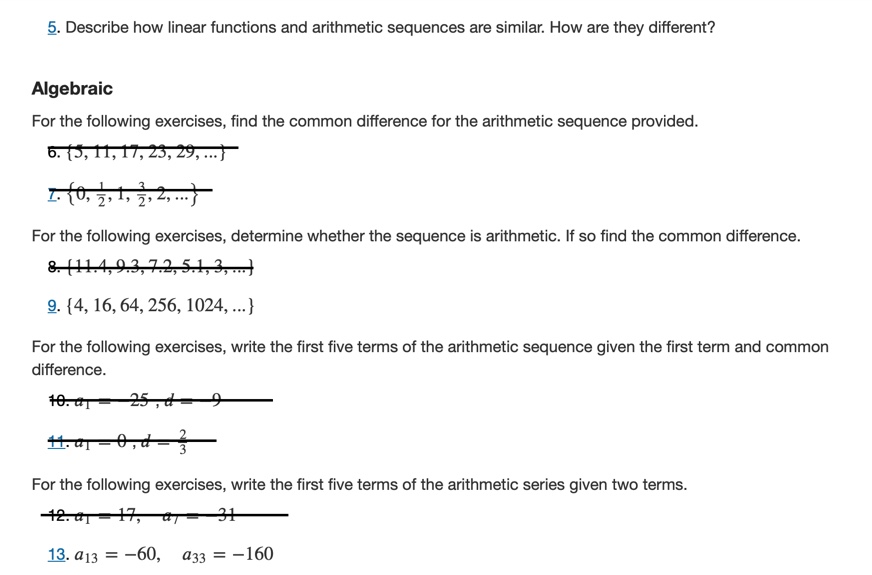
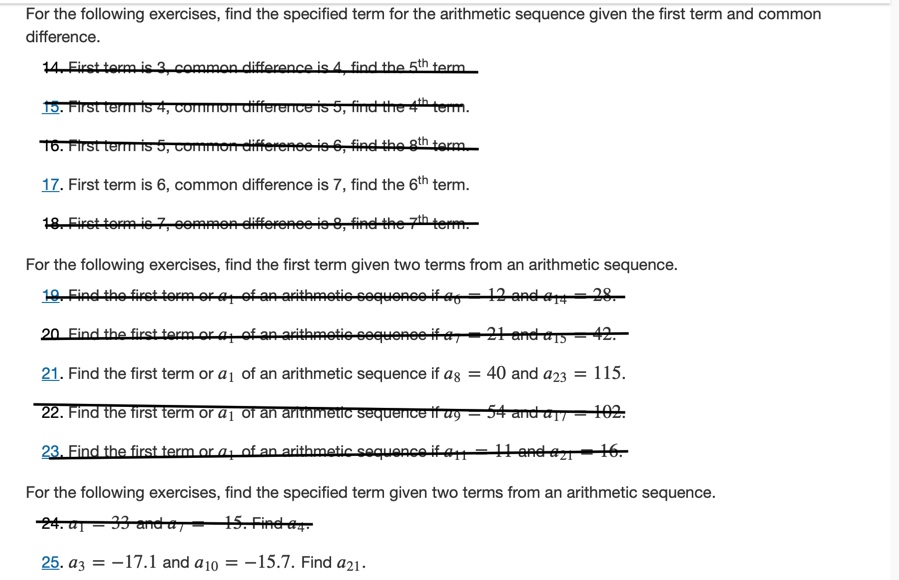
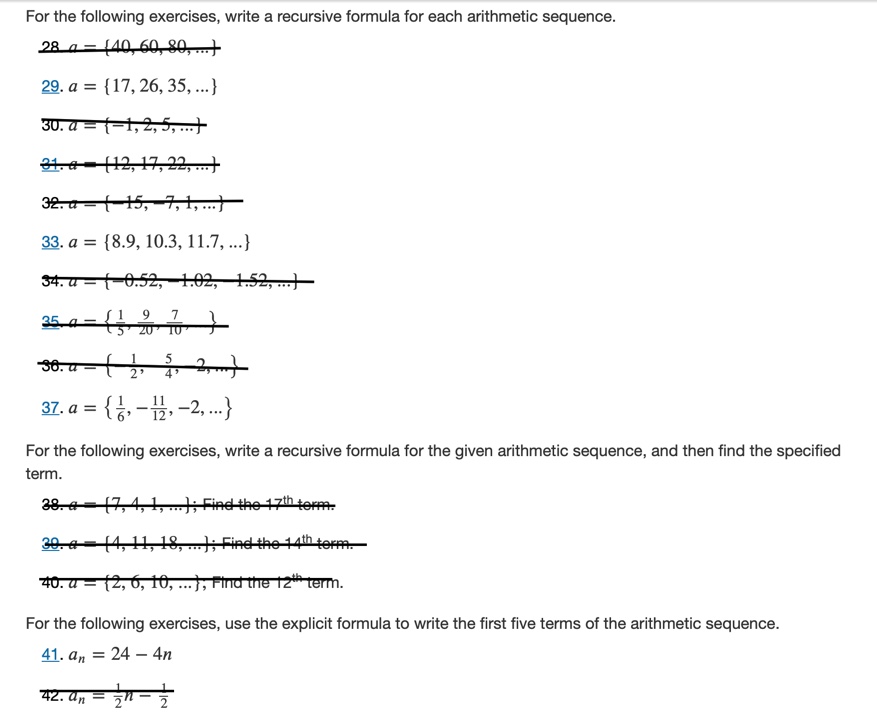
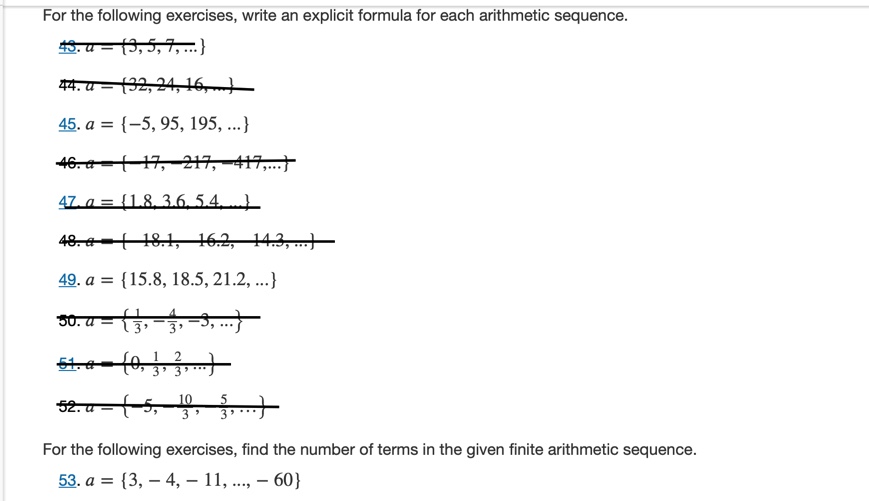
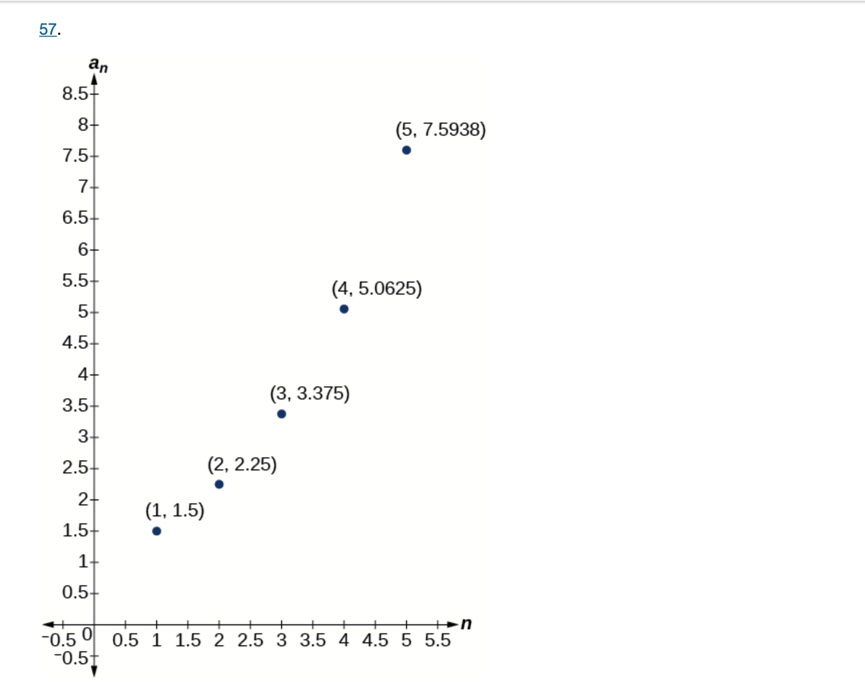

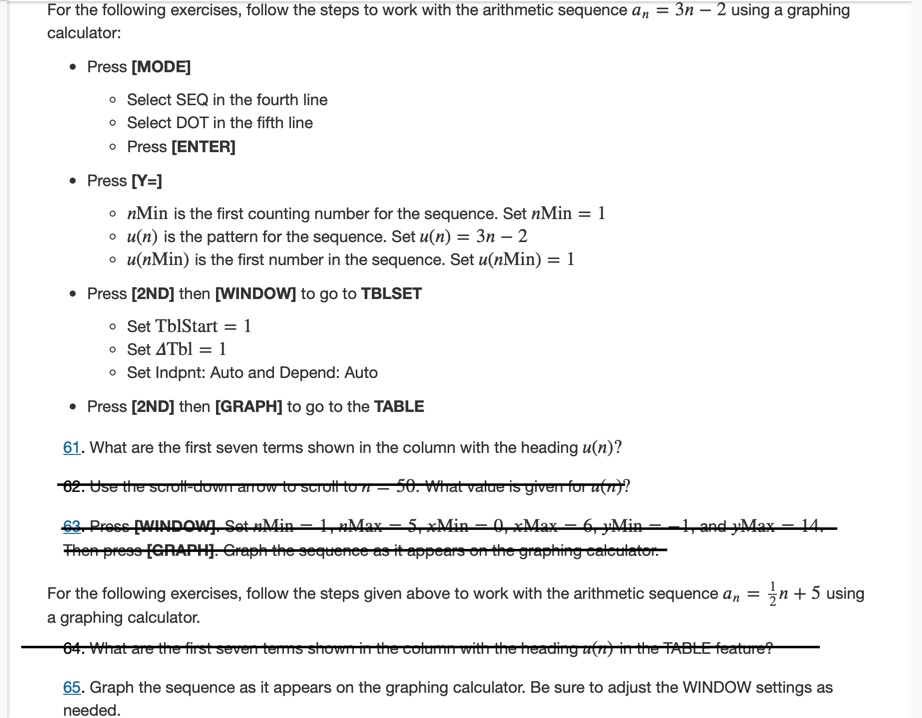
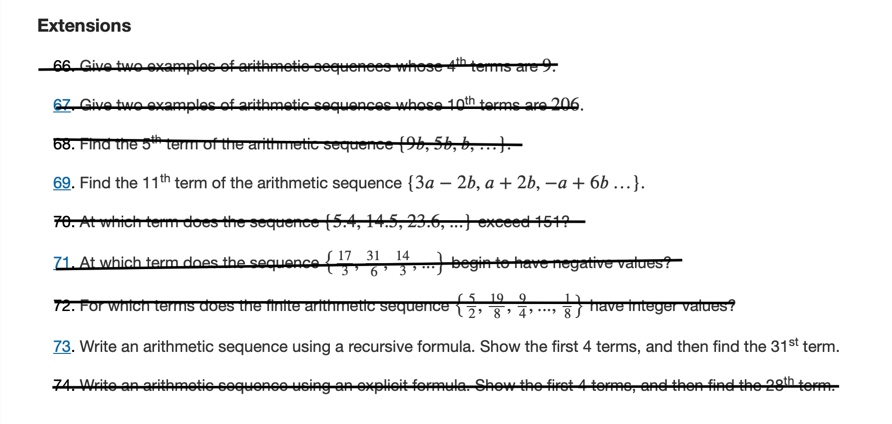
5. Describe how linear functions and arithmetic sequences are similar. How are they different? Algebraic For the following exercises, find the common difference for the arithmetic sequence provided. 6. {5, 11, 17, 23, 29, ... 10, 2, 1 , 2 1- ,... For the following exercises, determine whether the sequence is arithmetic. If so find the common difference. 8. ( 14.4, 9.3, 7.2, 5.1,3,...) 9. {4, 16, 64, 256, 1024, ...} For the following exercises, write the first five terms of the arithmetic sequence given the first term and common difference. For the following exercises, write the first five terms of the arithmetic series given two terms. 42. aT = 17, -31 13. a13 = -60, a33 = -160For the following exercises, find the specified term for the arithmetic sequence given the first term and common difference. 14. First term is 3. common difference is 4 find the 5th term_ 15. First term is 4, common difference is 5, find the 4 term. To. First term is 5, common difference is 6, find the gth term_. 17. First term is 6, common difference is 7, find the 6th term. 18. First term is 7, common differene 7th term. For the following exercises, find the first term given two terms from an arithmetic sequence. 10. Find the first torm or of of an an hmotic coquence if # - 12 and # - 28. 20 Find the first form or a, of an arithmetic sequence if a, - 21 and aT, - 42. 21. Find the first term or a, of an arithmetic sequence if ag = 40 and a23 = 115. 22. Find the first term or a j of an arithmetic sequence if ag = 3+ and aT7 - 102. 23. Find the first term or a of an arithmetic sequence if 1 - 11 end - 16. For the following exercises, find the specified term given two terms from an arithmetic sequence. 24. 0 - 33 and a, - 15. Find #4. 25. a3 = -17.1 and a10 = -15.7. Find a21.For the following exercises, write a recursive formula for each arithmetic sequence. 28 a - 140 60, 80,...} 29. a = {17, 26, 35, ...} 30. a = 1, 2,,...} 31. 4 - (12, 17, 22, ...} 32. = 45, 7, 1, ... 33. a = {8.9, 10.3, 11.7, ...} 34. a = 1 0.52, 1.02, 1.52 35 - 20 10 30. a =( 1, 5 2} 37. a = (7, -4, 12" -2, ...} For the following exercises, write a recursive formula for the given arithmetic sequence, and then find the specified term. 38. = (7, 4, 1, ... ); Find the 17th term. 30. # - (4, 11, 18, ...); Find the 14th term. 40. a = (2, 6, 10, ...), Find the 12" term. For the following exercises, use the explicit formula to write the first five terms of the arithmetic sequence. 41. an = 24 - 4n 42. On = 7/1 - 2For the following exercises, write an explicit formula for each arithmetic sequence. For the following exercises, find the number of terms in the given finite arithmetic sequence. 3. a = {3, 4, 11, 60} 57. an 8.57 8- (5, 7.5938) 7.5- 7- 6.5- 6+ 5.5- (4, 5.0625) 5+ 4.5- 4- 3.5 (3, 3.375) 3. 2.5- (2, 2.25) 2+ (1, 1.5) 1.5- 1- 0.5 -0.5 0 0.5 1 1.5 2 2.5 3 3.5 4 4.5 5 5.5 +n -0.5fFor the following exercises, determine whether the graph shown represents an arithmetic sequence. For the following exercises, follow the steps to work with the arithmetic sequence an, = 3n - 2 using a graphing calculator: . Press [MODE] o Select SEQ in the fourth line o Select DOT in the fifth line o Press [ENTER] . Press [Y=] o nMin is the first counting number for the sequence. Set nMin = 1 o u(n) is the pattern for the sequence. Set u(n) = 3n - 2 o u(nMin) is the first number in the sequence. Set u(nMin) = 1 . Press [2ND] then [WINDOW] to go to TBLSET . Set TblStart = 1 o Set ATbl = 1 o Set Indont: Auto and Depend: Auto . Press [2ND] then [GRAPH] to go to the TABLE 61. What are the first seven terms shown in the column with the heading u(n)? 02. Use the scroll-down arrow to scroll to 7 - 50. What value is given for a()? 62. Press (WINDOW. Set #Min - 1, #Max - 5, xMin - 0, *Max - 6, "Min - 1, and yMax - 14. Then press [GRAPH]. Graph the sequence as it appears on the graphing calculator. For the following exercises, follow the steps given above to work with the arithmetic sequence a, = an + 5 using a graphing calculator. 64. What are the first seven terms shownin the column with the heading a() in the TABLE feature? 65. Graph the sequence as it appears on the graphing calculator. Be sure to adjust the WINDOW settings as needed.Extensions 66 Give two examples of arithmetic sequences whose 4th terms are 9. 67 Give two examples of arithmetic coquences whose 10th terms are 206. 68. Find the 5" term of the arithmetic sequence (96, 56, b,...). 69. Find the 11th term of the arithmetic sequence {3a - 2b, a + 2b, -a + 6b ...}. 70. At which term does the sequence ( 5.4 exceed 1540 71. At which term does the sequence / 17 31 14 ) begin to have negative values 6 3 7 . 72. For which terms does the finite arithmetic sequence (7, g , 1, ...> g / have integer values? 15 19 9 73. Write an arithmetic sequence using a recursive formula. Show the first 4 terms, and then find the 31 st term. 74. Write an arithmetic coquence using an explicit formula. Show the first 4 terme, and then find the 2gth tem
Step by Step Solution
There are 3 Steps involved in it

Get step-by-step solutions from verified subject matter experts
 Study Help