







Question: 5. For each case, find any local extrema using the first derivative test. a) /(x)=x - 2x +1 b) f(x) = x (3-2x) c) f(x)
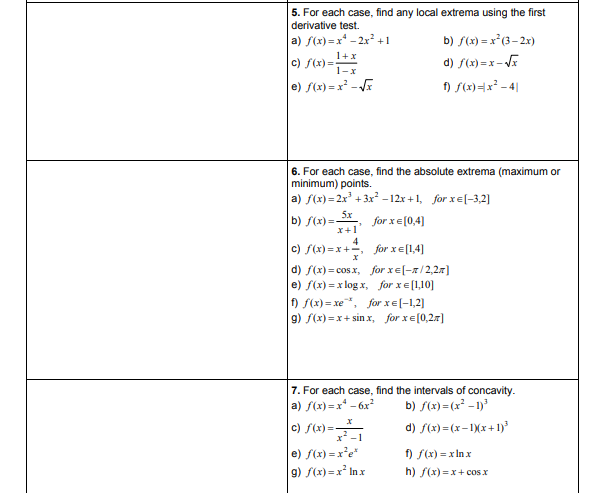
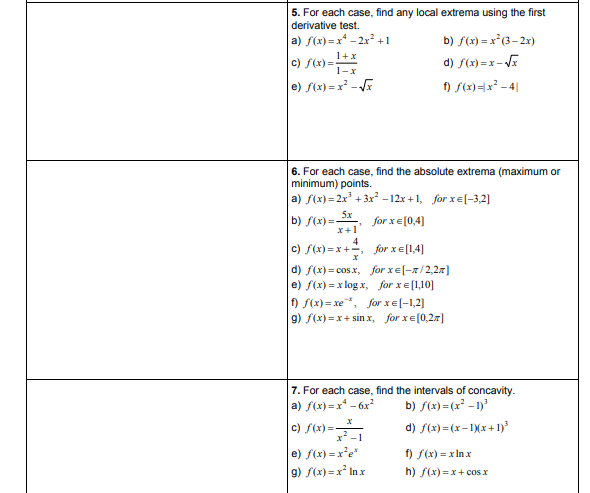
5. For each case, find any local extrema using the first derivative test. a) /(x)=x - 2x +1 b) f(x) = x (3-2x) c) f(x) = = 1+x 1 - x d) f(x) = x- Vx e) /(x)=x -x f) (x) =x] -41 6. For each case, find the absolute extrema (maximum or minimum) points. a) /(x) =2x + 3x- -12x+1, forx=[-3,2] b) /(x) = for x = [0,4] for x e [1,4] d) /(x)=cosx, forxe[-x/2,2x] e) /(x) = xlogx, for xe[1,10] () f(x)=xe *, for x=[-1,2] 9) /(x) = x+ sinx, for xe[0,2x] 7. For each case, find the intervals of concavity. a) /(x)=x - 6x- b) f(x) = (x - 1) c) f(x)=- X d) f(x) = (x-1)(x+ 1) -1 e) /(x)=re* f) /(x) = xinx 9) /(x)= x Inx h) /(x) =x+ cos.x
Step by Step Solution
There are 3 Steps involved in it
1 Expert Approved Answer
Step: 1 Unlock

Question Has Been Solved by an Expert!
Get step-by-step solutions from verified subject matter experts
Step: 2 Unlock
Step: 3 Unlock
 Study Help