





Question: 5. For small, slowly falling objects, the assumption made in Example 1 in class that the drag force is proportional to the velocity is a
5. For small, slowly falling objects, the
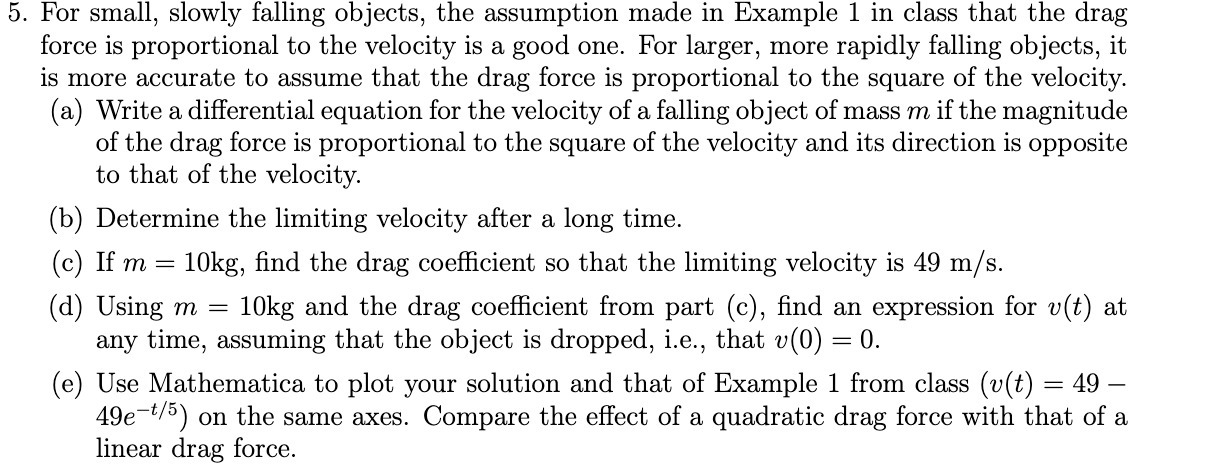
5. For small, slowly falling objects, the assumption made in Example 1 in class that the drag force is proportional to the velocity is a good one. For larger, more rapidly falling objects, it is more accurate to assume that the drag force is proportional to the square of the velocity. (a) Write a differential equation for the velocity of a falling object of mass m if the magnitude of the drag force is proportional to the square of the velocity and its direction is opposite to that of the velocity. (b) Determine the limiting velocity after a long time. (c) If m = 10kg, find the drag coefficient so that the limiting velocity is 49 m/s. (d) Using m = 10kg and the drag coefficient from part (c), find an expression for v(t) at any time, assuming that the object is dropped, i.e., that v(0) = 0. (e) Use Mathematica to plot your solution and that of Example 1 from class (v(t) = 49 - 49e-t/5) on the same axes. Compare the effect of a quadratic drag force with that of a linear drag force

Step by Step Solution

There are 3 Steps involved in it

1 Expert Approved Answer
Step: 1 Unlock blur-text-image

Question Has Been Solved by an Expert!

Get step-by-step solutions from verified subject matter experts

Step: 2 Unlock
Step: 3 Unlock

Students Have Also Explored These Related Mathematics Questions!