







Question: 5. Forecasting future exchange rates Aa Aa Business managers often need to forecast future exchange rates to hedge their risks. One method for forecasting future
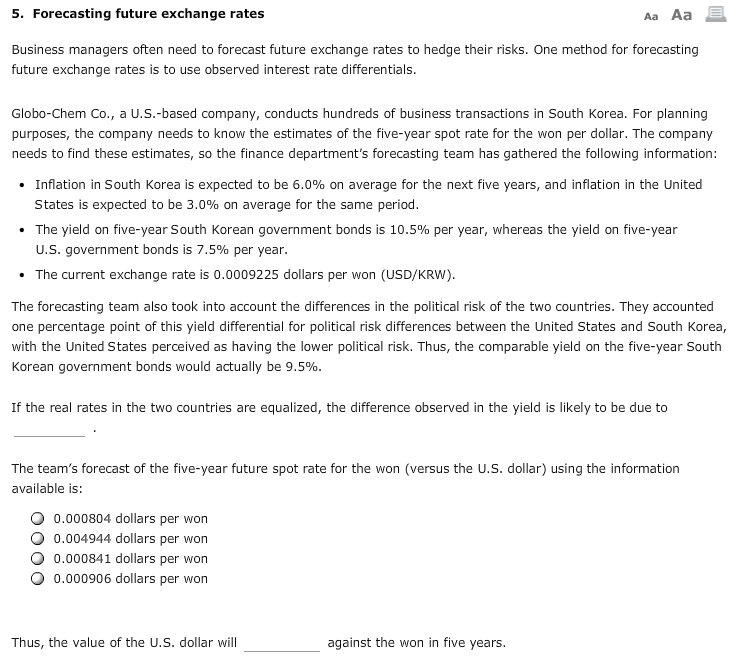
5. Forecasting future exchange rates Aa Aa Business managers often need to forecast future exchange rates to hedge their risks. One method for forecasting future exchange rates is to use observed interest rate differentials. Globo-Chem Co., a U.S.-based company, conducts hundreds of business transactions in South Korea. For planning purposes, the company needs to know the estimates of the five-year spot rate for the won per dollar. The company needs to find these estimates, so the finance departmen's forecasting team has gathered the following information: States is expected to be 3.0% on average for the same period. The yield on five-year South Korean government bonds is 10.5% per year, whereas the yield on five-year U.S. government bonds is 7.5% per year. The current exchange rate is 0.0009225 dollars per won (USD/KRW) The forecasting team also took into account the differences in the political risk of the two countries. They accounted one percentage point of this yield differential for political risk differences between the United States and South Korea, with the United States perceived as having the lower political risk. Thus, the comparable yield on the five-year South Korean government bonds would actually be 9.5%. If the real rates in the two countries are equalized, the difference observed in the yield is likely to be due to The team's forecast of the five-year future spot rate for the won (versus the U.S. dolar) using the information available is: O 0.000804 dollars per won O 0.004944 dollars per won O 0.000841 dollars per won O 0.000906 dollars per won Thus, the value of the U.S. dollar will against the won in five years. 5. Forecasting future exchange rates Aa Aa Business managers often need to forecast future exchange rates to hedge their risks. One method for forecasting future exchange rates is to use observed interest rate differentials. Globo-Chem Co., a U.S.-based company, conducts hundreds of business transactions in South Korea. For planning purposes, the company needs to know the estimates of the five-year spot rate for the won per dollar. The company needs to find these estimates, so the finance departmen's forecasting team has gathered the following information: States is expected to be 3.0% on average for the same period. The yield on five-year South Korean government bonds is 10.5% per year, whereas the yield on five-year U.S. government bonds is 7.5% per year. The current exchange rate is 0.0009225 dollars per won (USD/KRW) The forecasting team also took into account the differences in the political risk of the two countries. They accounted one percentage point of this yield differential for political risk differences between the United States and South Korea, with the United States perceived as having the lower political risk. Thus, the comparable yield on the five-year South Korean government bonds would actually be 9.5%. If the real rates in the two countries are equalized, the difference observed in the yield is likely to be due to The team's forecast of the five-year future spot rate for the won (versus the U.S. dolar) using the information available is: O 0.000804 dollars per won O 0.004944 dollars per won O 0.000841 dollars per won O 0.000906 dollars per won Thus, the value of the U.S. dollar will against the won in five years
Step by Step Solution
There are 3 Steps involved in it

Get step-by-step solutions from verified subject matter experts
 Study Help