







Question: 5 . Given a > b > c > 0, the function f(x) = x(x - a)(x+ b)(x - c) is less than or equal
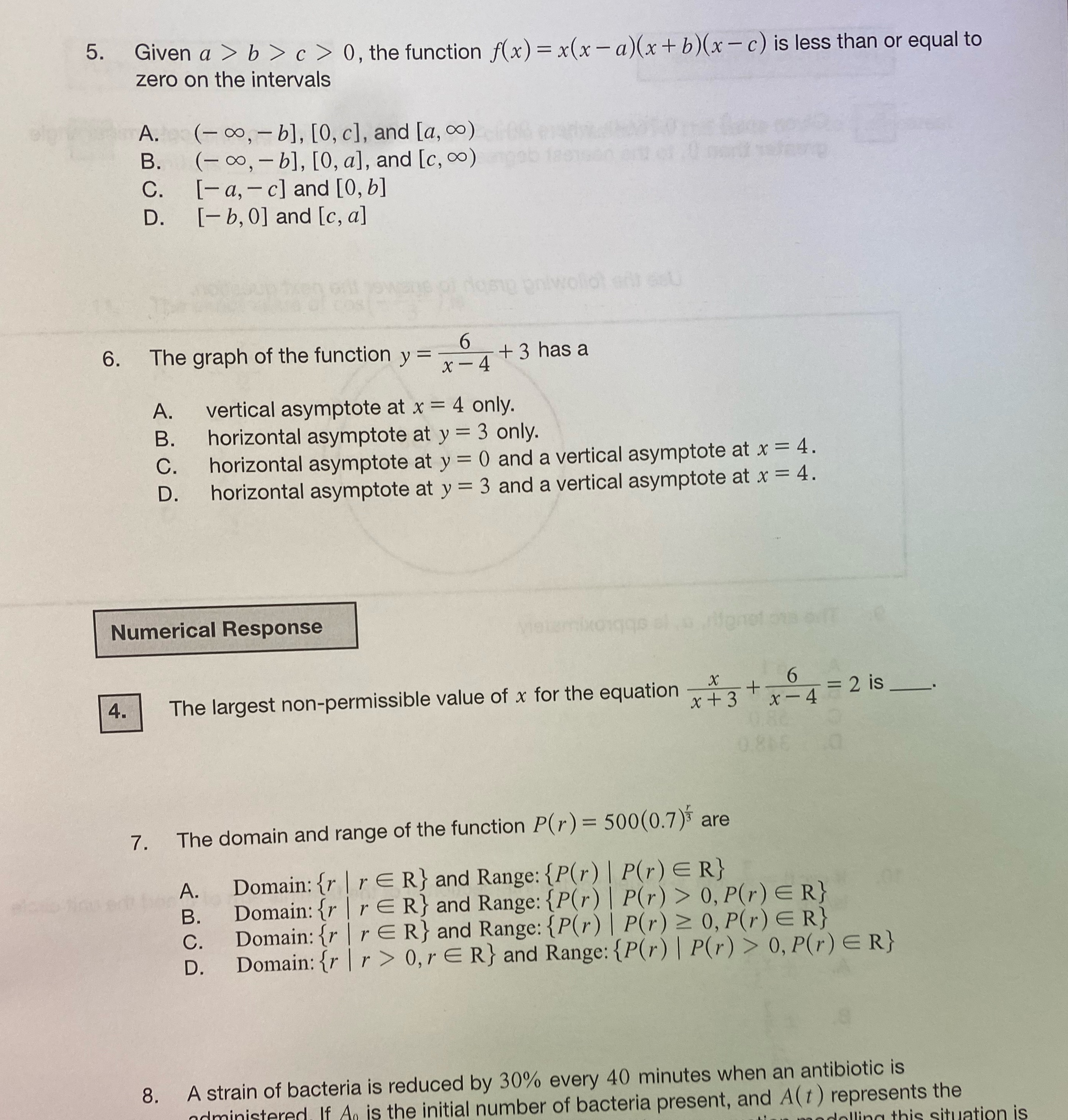
5 . Given a > b > c > 0, the function f(x) = x(x - a)(x+ b)(x - c) is less than or equal to zero on the intervals A. (- 09, - b], [0, c], and [a, co) B . (-0o, - b], [0, a], and [c, co) C. [-a, - c] and [0, b] D . [- b, 0] and [c, a] 6. The graph of the function y =- 6 + 3 has a x - 4 A. vertical asymptote at x = 4 only. B. horizontal asymptote at y = 3 only. C. horizontal asymptote at y = 0 and a vertical asymptote at x = 4. D. horizontal asymptote at y = 3 and a vertical asymptote at x = 4. Numerical Response 4. The largest non-permissible value of x for the equation * + - * + 3 x - 4 - = 2 is 7. The domain and range of the function P(r) = 500(0.7) are A. Domain: {r | r E R} and Range: {P(r) | P(r) ER} B. Domain: {r | r E R} and Range: {P(r) | P(r) > 0, P(r) E R} C. Domain: {r | r E R} and Range: {P(r) | P(r) 2 0, P(r) ER} D . Domain: {r | r > 0, r ER} and Range: {P(r) | P(r) > 0, P(r) ER} 8. A strain of bacteria is reduced by 30% every 40 minutes when an antibiotic is If Ao is the initial number of bacteria present, and A(t ) represents the
Step by Step Solution
There are 3 Steps involved in it

Get step-by-step solutions from verified subject matter experts
 Study Help