







Question: = 5. Given the new design matrix found previously, we can input a guess matrix of beta coefficients, and then perform regression to identify each
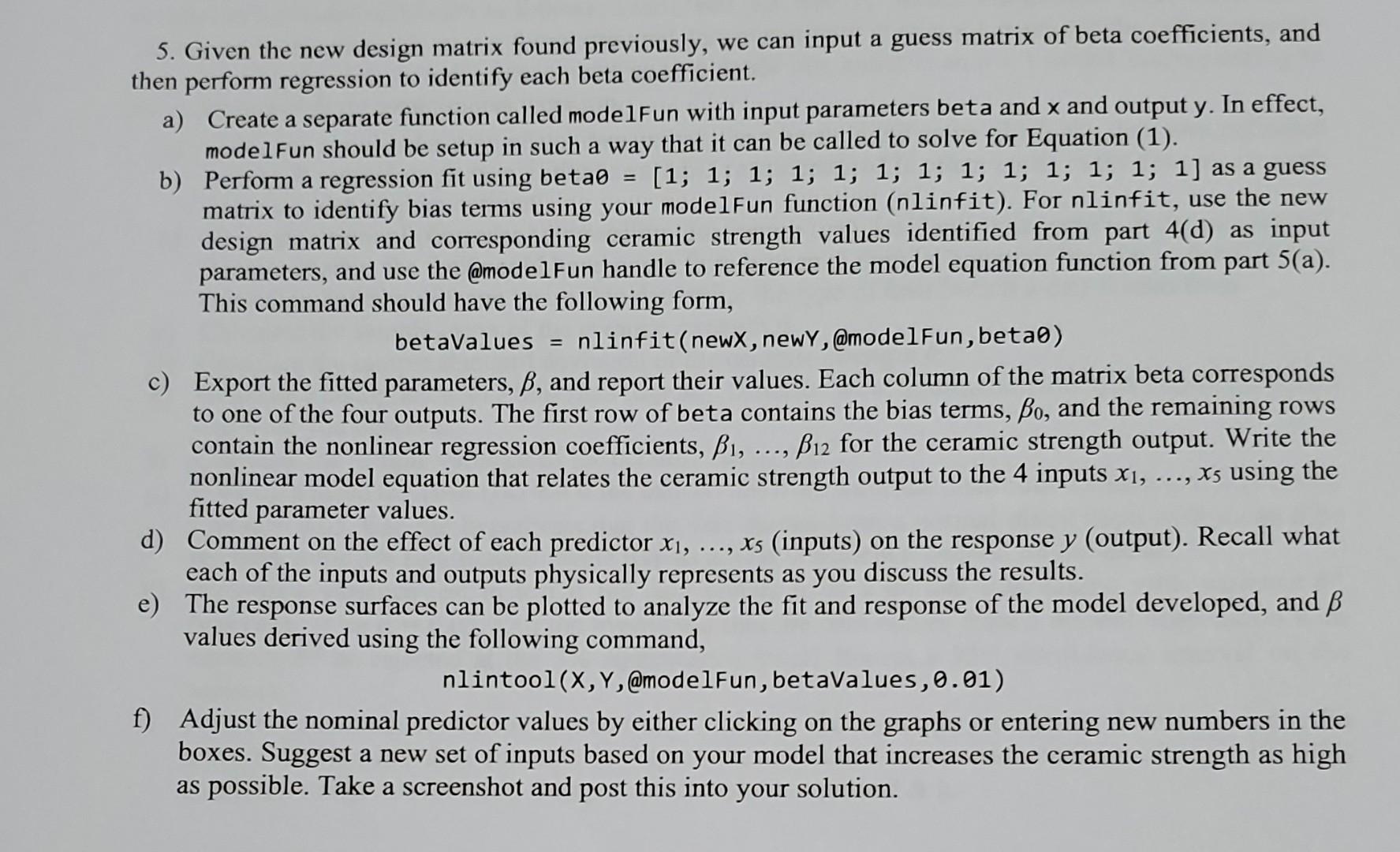
= 5. Given the new design matrix found previously, we can input a guess matrix of beta coefficients, and then perform regression to identify each beta coefficient. a) Create a separate function called modelFun with input parameters beta and x and output y. In effect, modelFun should be setup in such a way that it can be called to solve for Equation (1). b) Perform a regression fit using betao [1; 1; 1; 1; 1; 1; 1; 1; 1; 1; 1; 1; 1] as a guess matrix to identify bias terms using your modelFun function (nlinfit). For nlinfit, use the new design matrix and corresponding ceramic strength values identified from part 4(d) as input parameters, and use the @modelFun handle to reference the model equation function from part 5(a). This command should have the following form, betaValues nlinfit(newx, newy, @modelFun, betao) c) Export the fitted parameters, , and report their values. Each column of the matrix beta corresponds to one of the four outputs. The first row of beta contains the bias terms, Bo, and the remaining rows contain the nonlinear regression coefficients, B1, ..., B12 for the ceramic strength output. Write the nonlinear model equation that relates the ceramic strength output to the 4 inputs X1, x5 using the fitted parameter values. d) Comment on the effect of each predictor x1, xs (inputs) on the response y (output). Recall what each of the inputs and outputs physically represents as you discuss the results. e) The response surfaces can be plotted to analyze the fit and response of the model developed, and values derived using the following command, nlintool(X,Y,@modelFun, betaValues, 0.01) f) Adjust the nominal predictor values by either clicking on the graphs or entering new numbers in the boxes. Suggest a new set of inputs based on your model that increases the ceramic strength as high as possible. Take a screenshot and post this into your solution. ... = 5. Given the new design matrix found previously, we can input a guess matrix of beta coefficients, and then perform regression to identify each beta coefficient. a) Create a separate function called modelFun with input parameters beta and x and output y. In effect, modelFun should be setup in such a way that it can be called to solve for Equation (1). b) Perform a regression fit using betao [1; 1; 1; 1; 1; 1; 1; 1; 1; 1; 1; 1; 1] as a guess matrix to identify bias terms using your modelFun function (nlinfit). For nlinfit, use the new design matrix and corresponding ceramic strength values identified from part 4(d) as input parameters, and use the @modelFun handle to reference the model equation function from part 5(a). This command should have the following form, betaValues nlinfit(newx, newy, @modelFun, betao) c) Export the fitted parameters, , and report their values. Each column of the matrix beta corresponds to one of the four outputs. The first row of beta contains the bias terms, Bo, and the remaining rows contain the nonlinear regression coefficients, B1, ..., B12 for the ceramic strength output. Write the nonlinear model equation that relates the ceramic strength output to the 4 inputs X1, x5 using the fitted parameter values. d) Comment on the effect of each predictor x1, xs (inputs) on the response y (output). Recall what each of the inputs and outputs physically represents as you discuss the results. e) The response surfaces can be plotted to analyze the fit and response of the model developed, and values derived using the following command, nlintool(X,Y,@modelFun, betaValues, 0.01) f) Adjust the nominal predictor values by either clicking on the graphs or entering new numbers in the boxes. Suggest a new set of inputs based on your model that increases the ceramic strength as high as possible. Take a screenshot and post this into your solution
Step by Step Solution
There are 3 Steps involved in it

Get step-by-step solutions from verified subject matter experts
 Study Help