



Question: 5. (Heat transfer) The time it takes for a spherical object to cool from an initial temperature of Tiwir to a final temperature of To
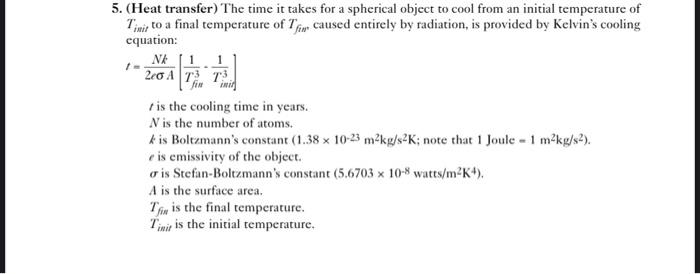
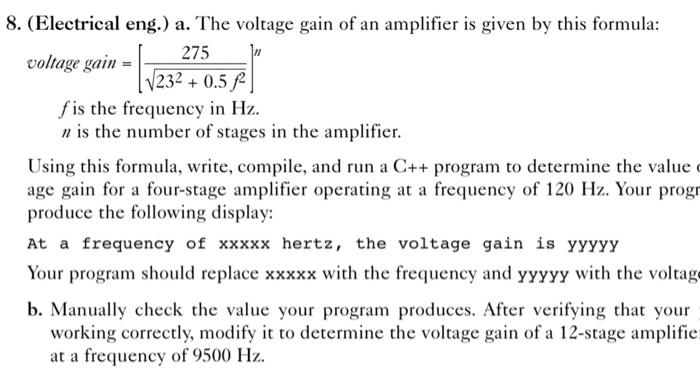
5. (Heat transfer) The time it takes for a spherical object to cool from an initial temperature of Tiwir to a final temperature of To caused entirely by radiation, is provided by Kelvin's cooling equation: NA 11 200 A T3 T is the cooling time in years. N is the number of atoms. kis Boltzmann's constant (1.38 x 10⁻²³ m?kg/s2K; note that 1 Joule - 1 m?kg/s2). is emissivity of the object. or is Stefan-Boltzmann's constant (5.6703 x 10⁻⁸ watts/m2K+). A is the surface area. Tow is the final temperature. Tinir is the initial temperature, 8. (Electrical eng.) a. The voltage gain of an amplifier is given by this formula: voltage gain = 275 Tu N232 +0.5 f is the frequency in Hz. n is the number of stages in the amplifier. Using this formula, write, compile, and run a C++ program to determine the value age gain for a four-stage amplifier operating at a frequency of 120 Hz. Your progr produce the following display: At a frequency of xxxxx hertz, the voltage gain is yyyyy Your program should replace xxxxx with the frequency and yyyyy with the voltag b. Manually check the value your program produces. After verifying that your working correctly, modify it to determine the voltage gain of a 12-stage amplifie at a frequency of 9500 Hz
Step by Step Solution
There are 3 Steps involved in it

Get step-by-step solutions from verified subject matter experts