







Question: 5. How are the photons affected by adding clouds? 1750 1. Click on the 1750 button and record the minimum temperature. 58 F 2. Record:
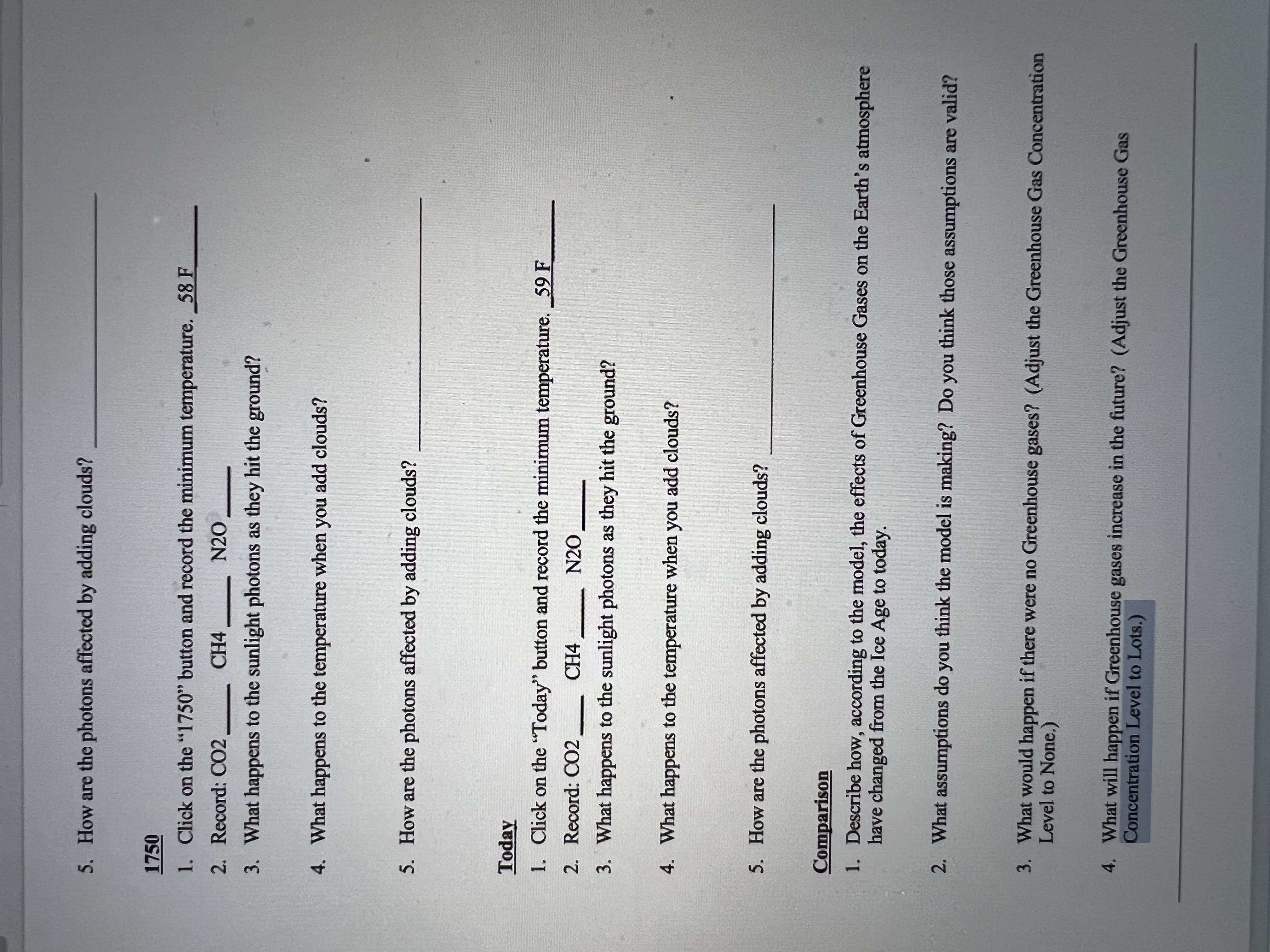
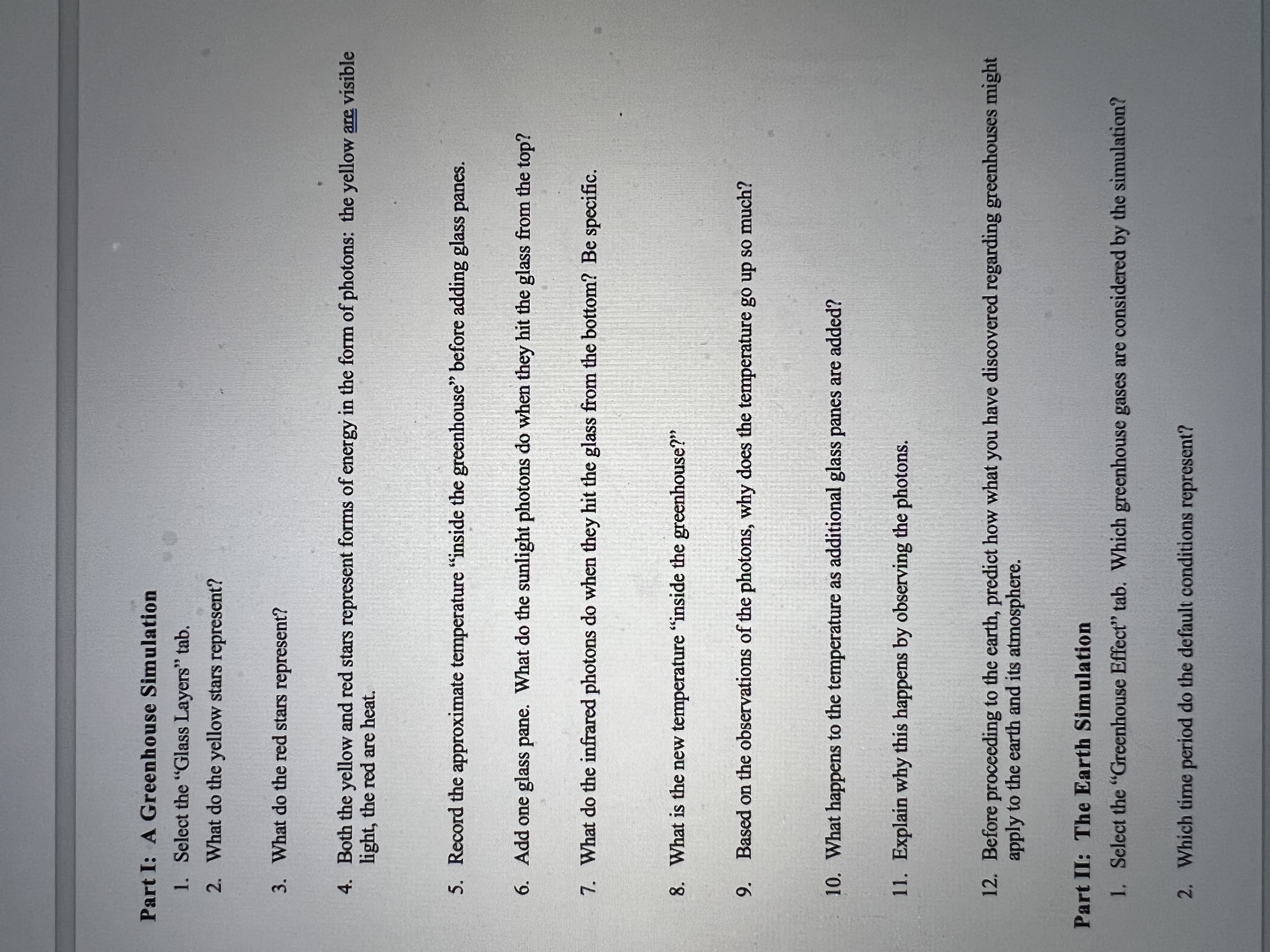
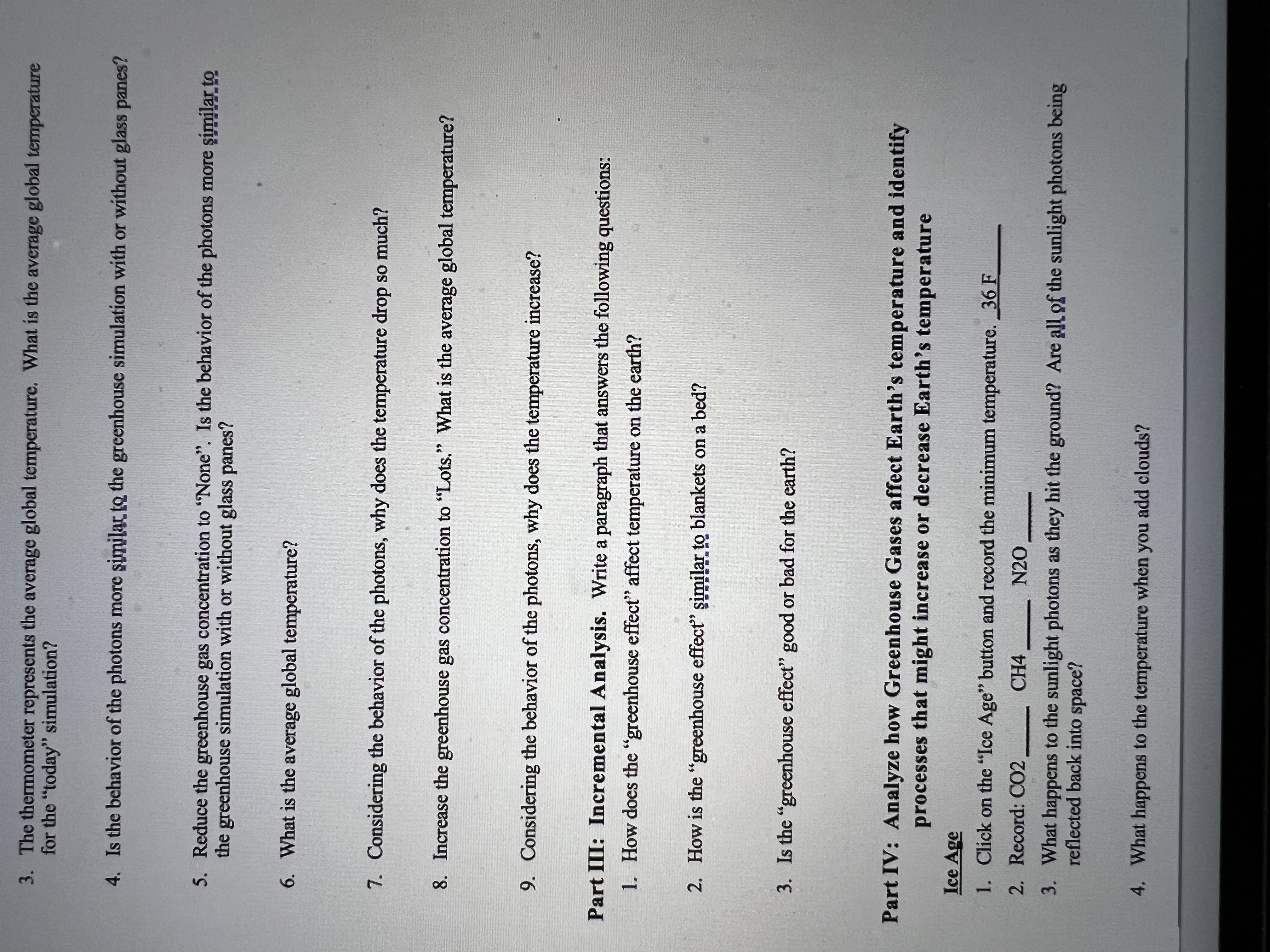

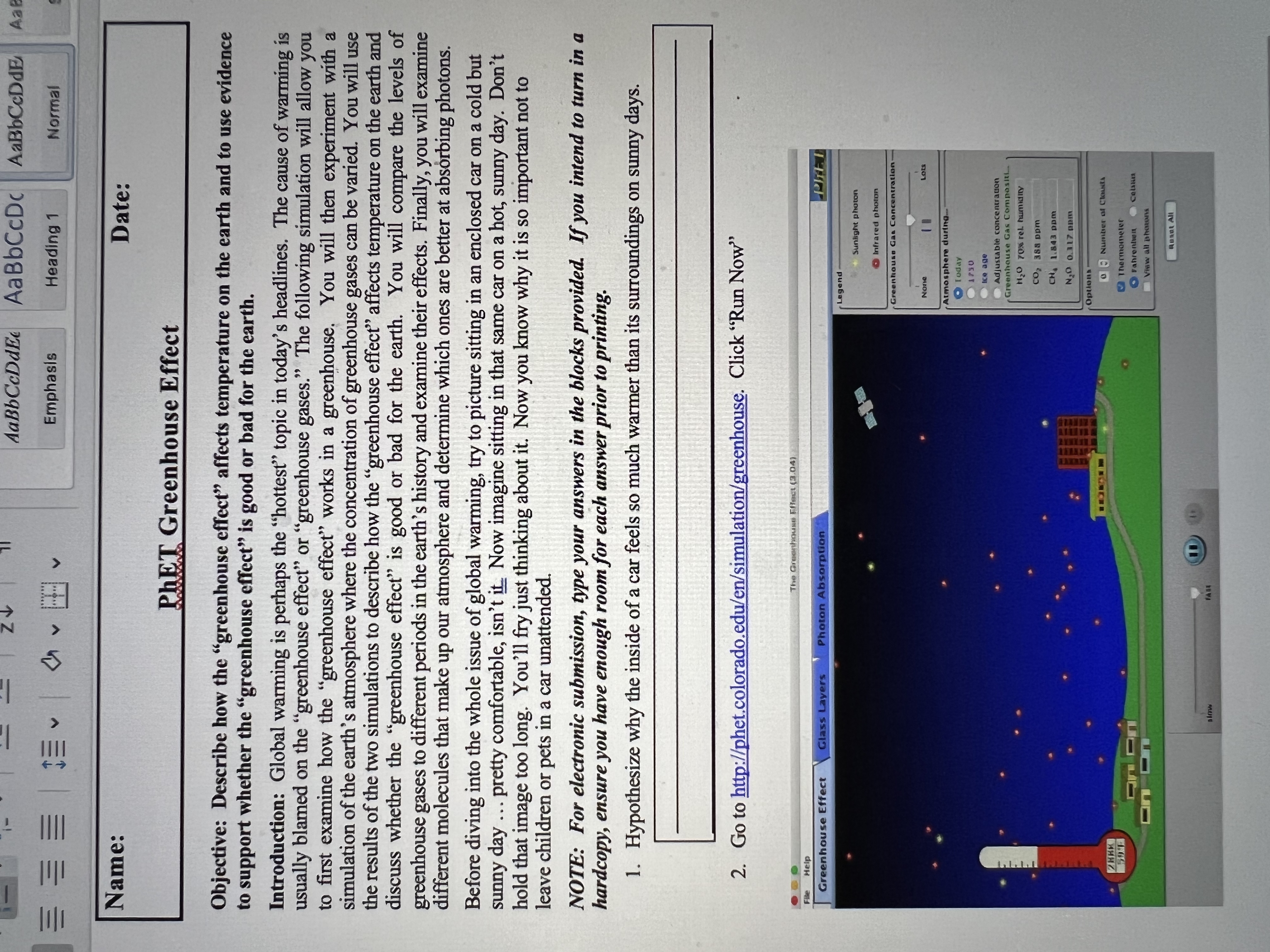
5. How are the photons affected by adding clouds? 1750 1. Click on the "1750" button and record the minimum temperature. 58 F 2. Record: CO2 CH4 N20 3. What happens to the sunlight photons as they hit the ground? 4. What happens to the temperature when you add clouds? 5. How are the photons affected by adding clouds? Today 1. Click on the "Today" button and record the minimum temperature. _59 F 2. Record: CO2 CH4_ N20 3. What happens to the sunlight photons as they hit the ground? 4. What happens to the temperature when you add clouds? 5. How are the photons affected by adding clouds? Comparison 1. Describe how, according to the model, the effects of Greenhouse Gases on the Earth's atmosphere have changed from the Ice Age to today. 2. What assumptions do you think the model is making? Do you think those assumptions are valid? 3. What would happen if there were no Greenhouse gases? (Adjust the Greenhouse Gas Concentration Level to None.) 4. What will happen if Greenhouse gases increase in the future? (Adjust the Greenhouse Gas Concentration Level to Lots.)Part I: A Greenhouse Simulation 1. Select the "Glass Layers" tab. 2. What do the yellow stars represent? 3. What do the red stars represent? 4. Both the yellow and red stars represent forms of energy in the form of photons: the yellow are visible light, the red are heat. 5. Record the approximate temperature "inside the greenhouse" before adding glass panes. 6. Add one glass pane. What do the sunlight photons do when they hit the glass from the top? 7. What do the infrared photons do when they hit the glass from the bottom? Be specific. 8. What is the new temperature "inside the greenhouse?" 9. Based on the observations of the photons, why does the temperature go up so much? 10. What happens to the temperature as additional glass panes are added? 11. Explain why this happens by observing the photons. 12. Before proceeding to the earth, predict how what you have discovered regarding greenhouses might apply to the earth and its atmosphere. Part II: The Earth Simulation 1. Select the "Greenhouse Effect" tab. Which greenhouse gases are considered by the simulation? 2. Which time period do the default conditions represent?3. The thermometer represents the average global temperature. What is the average global temperature for the "today" simulation? 4. Is the behavior of the photons more similar to the greenhouse simulation with or without glass panes? 5. Reduce the greenhouse gas concentration to "None". Is the behavior of the photons more similar to the greenhouse simulation with or without glass panes? 6. What is the average global temperature? 7. Considering the behavior of the photons, why does the temperature drop so much? 8. Increase the greenhouse gas concentration to "Lots." What is the average global temperature? 9. Considering the behavior of the photons, why does the temperature increase? Part III: Incremental Analysis. Write a paragraph that answers the following questions: 1. How does the "greenhouse effect" affect temperature on the earth? 2. How is the "greenhouse effect" similar to blankets on a bed? 3. Is the "greenhouse effect" good or bad for the earth? Part IV: Analyze how Greenhouse Gases affect Earth's temperature and identify processes that might increase or decrease Earth's temperature Ice Age 1. Click on the "Ice Age" button and record the minimum temperature. 36 F 2. Record: CO2 CH4 _N20 3. What happens to the sunlight photons as they hit the ground? Are all of the sunlight photons being reflected back into space? 4. What happens to the temperature when you add clouds?5. Identify some natural or human processes that might increase or decrease the amount of greenhouse gases in the atmosphere. Conclusion:AaBbCcDdEc AaBbCcDc|AaBbCcDdE Aa 3 E v . V Emphasis Heading 1 Normal Name: Date: PhET Greenhouse Effect Objective: Describe how the "greenhouse effect" affects temperature on the earth and to use evidence to support whether the "greenhouse effect" is good or bad for the earth. Introduction: Global warming is perhaps the "hottest" topic in today's headlines. The cause of warming is usually blamed on the "greenhouse effect" or "greenhouse gases." The following simulation will allow you to first examine how the "greenhouse effect" works in a greenhouse. You will then experiment with a simulation of the earth's atmosphere where the concentration of greenhouse gases can be varied. You will use the results of the two simulations to describe how the "greenhouse effect" affects temperature on the earth and discuss whether the "greenhouse effect" is good or bad for the earth. You will compare the levels of greenhouse gases to different periods in the earth's history and examine their effects. Finally, you will examine different molecules that make up our atmosphere and determine which ones are better at absorbing photons. Before diving into the whole issue of global warming, try to picture sitting in an enclosed car on a cold but sunny day ... pretty comfortable, isn't it. Now imagine sitting in that same car on a hot, sunny day. Don't hold that image too long. You'll fry just thinking about it. Now you know why it is so important not to leave children or pets in a car unattended. NOTE: For electronic submission, type your answers in the blocks provided. If you intend to turn in a hardcopy, ensure you have enough room for each answer prior to printing. 1. Hypothesize why the inside of a car feels so much warmer than its surroundings on sunny days. 2. Go to http://phet.colorado.edu/en/simulation/greenhouse. Click "Run Now" The Greenhouse Effect (3.04) Help Greenhouse Effect Class Layers Photon Absorption Legend Sunlight photon Infrared photon Greenhouse Gas Concentration- None Lots Atmosphere during.. kQ age Adjustable concentrauon Greenhouse Gas Composi H20 70% rel humidity CO2 388 0pm CH. 1.843 DDM N20 0.317 0em Options 0 6 Number of Chits Thermometer on on on on View all photons FA BE
Step by Step Solution
There are 3 Steps involved in it

Get step-by-step solutions from verified subject matter experts
 Study Help