





Question: 5. If someone asks you whether hot temperatures cause aggression, how might you respond based on what you learned in this activity?4. Why did you

5. If someone asks you whether hot temperatures cause aggression, how might you respond based on what you learned in this activity?4. Why did you select these two potential confounding variables: how often participants had been involved in physical fights, and their exposure to violence during childhood?? Accounting for them reduced our confidence that hot temperatures cause aggression.? Accounting for them had no effect on our confidence that hot temperatures cause aggression.? Accounting for them increased our confidence that hot temperatures cause aggression.? Accounting for them increased our confidence in our experimental manipulation of aggression.
5. If someone asks you whether hot temperatures
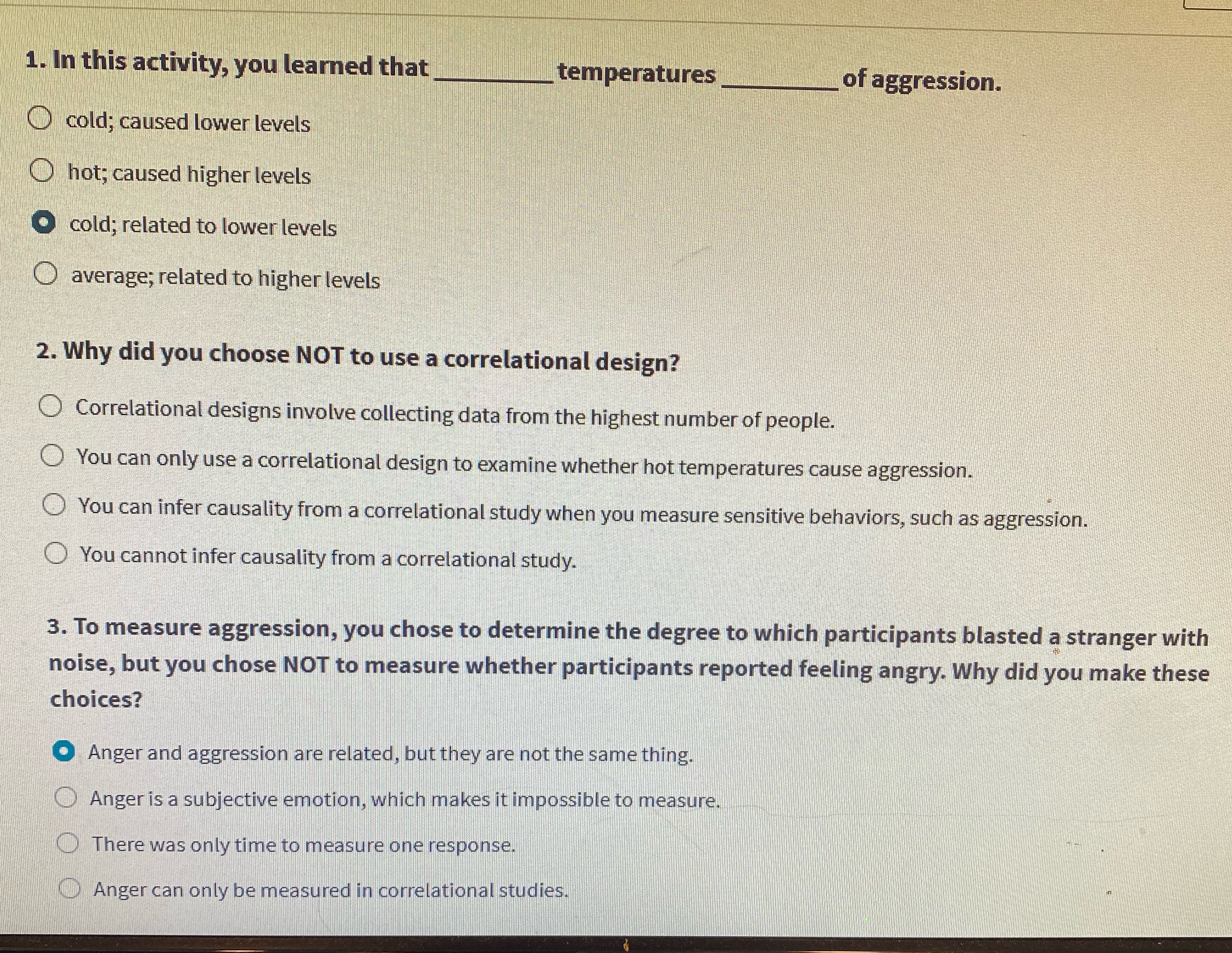
1. In this activity, you learned that temperatures of aggression. cold; caused lower levels O hot; caused higher levels " cold; related to lower levels O average; related to higher levels 2. Why did you choose NOT to use a correlational design? O Correlational designs involve collecting data from the highest number of people. O You can only use a correlational design to examine whether hot temperatures cause aggression. O You can infer causality from a correlational study when you measure sensitive behaviors, such as aggression. You cannot infer causality from a correlational study. 3. To measure aggression, you chose to determine the degree to which participants blasted a stranger with noise, but you chose NOT to measure whether participants reported feeling angry. Why did you make these choices? Anger and aggression are related, but they are not the same thing. O Anger is a subjective emotion, which makes it impossible to measure. There was only time to measure one response. O Anger can only be measured in correlational studies

Step by Step Solution

There are 3 Steps involved in it

1 Expert Approved Answer
Step: 1 Unlock blur-text-image
Question Has Been Solved by an Expert!

Get step-by-step solutions from verified subject matter experts

Step: 2 Unlock
Step: 3 Unlock

Students Have Also Explored These Related Mathematics Questions!