







Question: 5. ( ightarrow ) The Fed is an active participant in money markets mainly because of its responsibility to A. ( ightarrow )
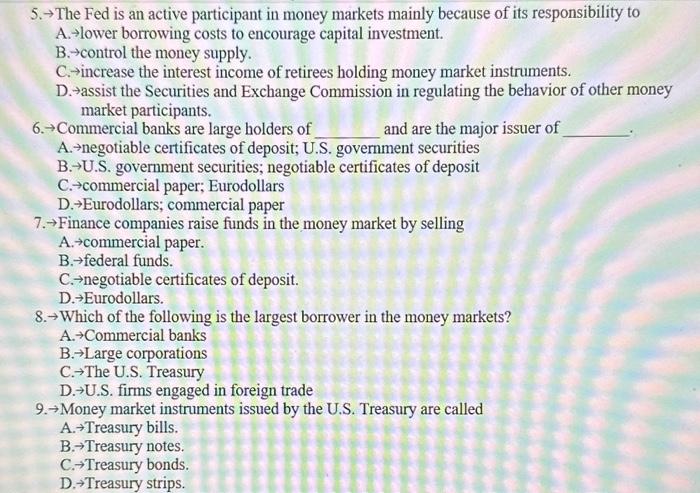
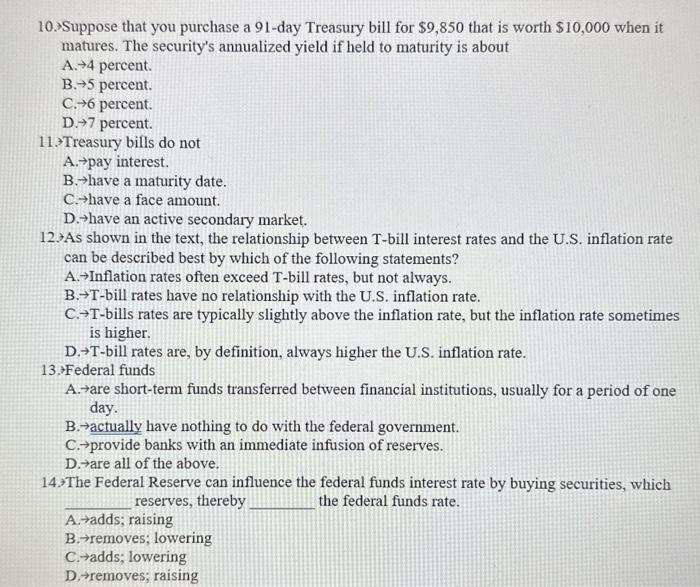
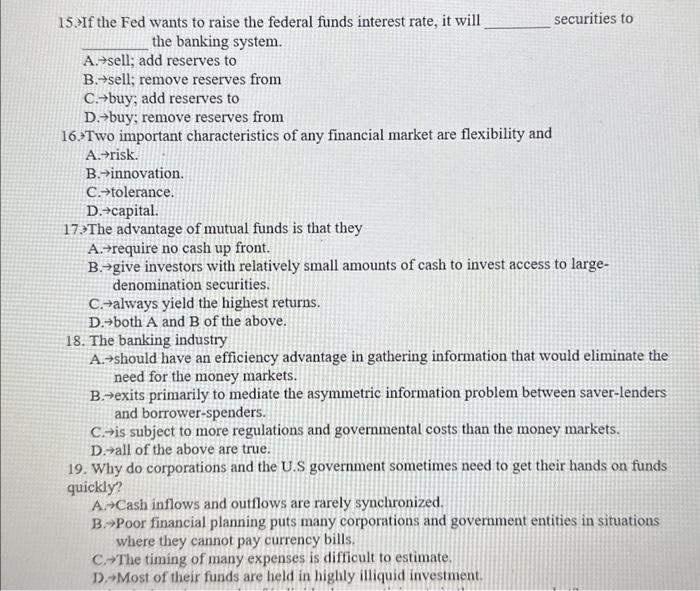

5. \\( \ ightarrow \\) The Fed is an active participant in money markets mainly because of its responsibility to A. \\( \ ightarrow \\) lower borrowing costs to encourage capital investment. B. \\( \ ightarrow \\) control the money supply. C. \\( \ ightarrow \\) increase the interest income of retirees holding money market instruments. D. \\( \ ightarrow \\) assist the Securities and Exchange Commission in regulating the behavior of other mone market participants. 6. \\( \ ightarrow \\) Commercial banks are large holders of and are the major issuer of A. \\( \ ightarrow \\) negotiable certificates of deposit; U.S. government securities B. \\( \ ightarrow \\) U.S. government securities; negotiable certificates of deposit C. \\( \ ightarrow \\) commercial paper; Eurodollars D. \\( \ ightarrow \\) Eurodollars; commercial paper 7. \\( \ ightarrow \\) Finance companies raise funds in the money market by selling A. \\( \ ightarrow \\) commercial paper. B. \\( \ ightarrow \\) federal funds. C. \\( \ ightarrow \\) negotiable certificates of deposit. D. \\( \ ightarrow \\) Eurodollars. \\( 8 . \ ightarrow \\) Which of the following is the largest borrower in the money markets? A. \\( \ ightarrow \\) Commercial banks B. \\( \ ightarrow \\) Large corporations C. \\( \ ightarrow \\) The U.S. Treasury D. \\( \ ightarrow \\) U.S. firms engaged in foreign trade 9. \\( \ ightarrow \\) Money market instruments issued by the U.S. Treasury are called A. \\( \ ightarrow \\) Treasury bills. B. \\( \ ightarrow \\) Treasury notes. C. \\( \ ightarrow \\) Treasury bonds. D. \\( \ ightarrow \\) Treasury strips. 10. 3 Suppose that you purchase a 91 -day Treasury bill for \\( \\$ 9,850 \\) that is worth \\( \\$ 10,000 \\) when it matures. The security's annualized yield if held to maturity is about A. \\( \ ightarrow 4 \\) percent. B. \\( \ ightarrow 5 \\) percent. C. \\( \ ightarrow 6 \\) percent. D. \\( \ ightarrow 7 \\) percent. 11. Treasury bills do not A. \\( \ ightarrow \\) pay interest. \\( B, \ ightarrow \\) have a maturity date. C. \\( \ ightarrow \\) have a face amount. D. \\( \ ightarrow \\) have an active secondary market. 12. As shown in the text, the relationship between T-bill interest rates and the U.S. inflation rate can be described best by which of the following statements? A. \\( \ ightarrow \\) Inflation rates often exceed T-bill rates, but not always. B. \\( \ ightarrow \\) T-bill rates have no relationship with the U.S. inflation rate. C. \\( \ ightarrow \\) T-bills rates are typically slightly above the inflation rate, but the inflation rate sometimes is higher. D. \\( \ ightarrow \\) T-bill rates are, by definition, always higher the U.S. inflation rate. 13. Federal funds A. \\( \ ightarrow \\) are short-term funds transferred between financial institutions, usually for a period of one day. B. \\( \ ightarrow \\) actually have nothing to do with the federal government. C. \\( \ ightarrow \\) provide banks with an immediate infusion of reserves. D. \\( \ ightarrow \\) are all of the above. 14. The Federal Reserve can influence the federal funds interest rate by buying securities, which reserves, thereby the federal funds rate. A. \\( \ ightarrow \\) adds; raising B. \\( \ ightarrow \\) removes; lowering C. \\( \ ightarrow \\) adds; lowering D. \\( \ ightarrow \\) removes; raising 15. If the Fed wants to raise the federal funds interest rate, it will securities to the banking system. A. \\( \ ightarrow \\) sell; add reserves to B. \\( \ ightarrow \\) sell; remove reserves from C. \\( \ ightarrow \\) buy; add reserves to D. \\( \ ightarrow \\) buy; remove reserves from 16. Two important characteristics of any financial market are flexibility and A. \\( \ ightarrow \\) risk. B. \\( \ ightarrow \\) innovation. C. \\( \ ightarrow \\) tolerance. D. \\( \ ightarrow \\) capital. 17. The advantage of mutual funds is that they A. \\( \ ightarrow \\) require no cash up front. B. \\( \ ightarrow \\) give investors with relatively small amounts of cash to invest access to largedenomination securities. C. \\( \ ightarrow \\) always yield the highest returns. D. \\( \ ightarrow \\) both \\( \\mathrm{A} \\) and \\( \\mathrm{B} \\) of the above. 18. The banking industry A. \\( \ ightarrow \\) should have an efficiency advantage in gathering information that would eliminate the need for the money markets. B. \\( \ ightarrow \\) exits primarily to mediate the asymmetric information problem between saver-lenders and borrower-spenders. \\( C \ ightarrow \\) is subject to more regulations and governmental costs than the money markets. D. \\( \ ightarrow \\) all of the above are true. 19. Why do corporations and the U.S government sometimes need to get their hands on funds quickly? A. \\( \ ightarrow \\) Cash inflows and outflows are rarely synchronized. B. \\( \ ightarrow \\) Poor financial planning puts many corporations and government entities in situations where they cannot pay currency bills. C. \\( \ ightarrow \\) The timing of many expenses is difficult to estimate. \\( D \ ightarrow \\) Most of their funds are held in highly illiquid investment. 20. What is the primary role of individuals as participants in the money market? A. \\( \ ightarrow \\) Individuals do not participate in the money market. B. \\( \ ightarrow \\) Many individuals issue money market instruments to lend excess cash. C. \\( \ ightarrow \\) Individuals often use money market instruments to finance home and auto purchases. D. \\( \ ightarrow \\) Individuals purchase money market instruments via money market mutual funds
Step by Step Solution
There are 3 Steps involved in it

Get step-by-step solutions from verified subject matter experts
 Study Help