







Question: 5. In a selective repeat (SR) protocol, if a receiver gets a duplicate copy of a packet that it has earlier acknowledged and this packet
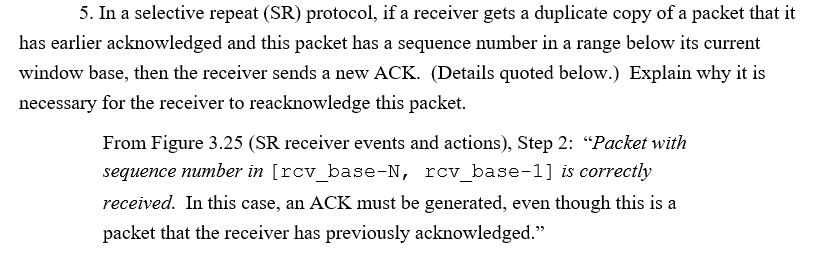
5. In a selective repeat (SR) protocol, if a receiver gets a duplicate copy of a packet that it has earlier acknowledged and this packet has a sequence number in a range below its current window base, then the receiver sends a new ACK. (Details quoted below.) Explain why it is necessary for the receiver to reacknowledge this packet. From Figure 3.25 (SR receiver events and actions), Step 2: "Packet with sequence number in (rcv_base-N, rcv_base-1] is correctly received. In this case, an ACK must be generated, even though this is a packet that the receiver has previously acknowledged." 5. In a selective repeat (SR) protocol, if a receiver gets a duplicate copy of a packet that it has earlier acknowledged and this packet has a sequence number in a range below its current window base, then the receiver sends a new ACK. (Details quoted below.) Explain why it is necessary for the receiver to reacknowledge this packet. From Figure 3.25 (SR receiver events and actions), Step 2: "Packet with sequence number in (rcv_base-N, rcv_base-1] is correctly received. In this case, an ACK must be generated, even though this is a packet that the receiver has previously acknowledged
Step by Step Solution
There are 3 Steps involved in it

Get step-by-step solutions from verified subject matter experts
 Study Help