



Question: 5. In the FRED database, find data on the personal consumption expenditure price index (PCECTPI), real GDP (GDPC1), an estimate of potential GDP (GDPPOT), and
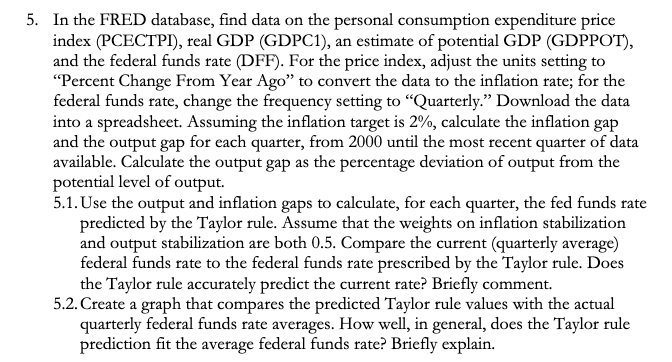
5. In the FRED database, find data on the personal consumption expenditure price index (PCECTPI), real GDP (GDPC1), an estimate of potential GDP (GDPPOT), and the federal funds rate (DFF). For the price index, adjust the units setting to "Percent Change From Year Ago" to convert the data to the inflation rate; for the federal funds rate, change the frequency setting to "Quarterly." Download the data into a spreadsheet. Assuming the inflation target is 2%, calculate the inflation gap and the output gap for each quarter, from 2000 until the most recent quarter of data available. Calculate the output gap as the percentage deviation of output from the potential level of output. 5.1. Use the output and inflation gaps to calculate, for each quarter, the fed funds rate predicted by the Taylor rule. Assume that the weights on inflation stabilization and output stabilization are both 0.5. Compare the current (quarterly average) federal funds rate to the federal funds rate prescribed by the Taylor rule. Does the Taylor rule accurately predict the current rate? Briefly comment. 5.2. Create a graph that compares the predicted Taylor rule values with the actual quarterly federal funds rate averages. How well, in general, does the Taylor rule prediction fit the average federal funds rate? Briefly explain
Step by Step Solution
There are 3 Steps involved in it

Get step-by-step solutions from verified subject matter experts