



Question: 5. In the table below, to have 8 memory addresses where each memory address holds one byte of data (byte-addressable), we need 3 bits to
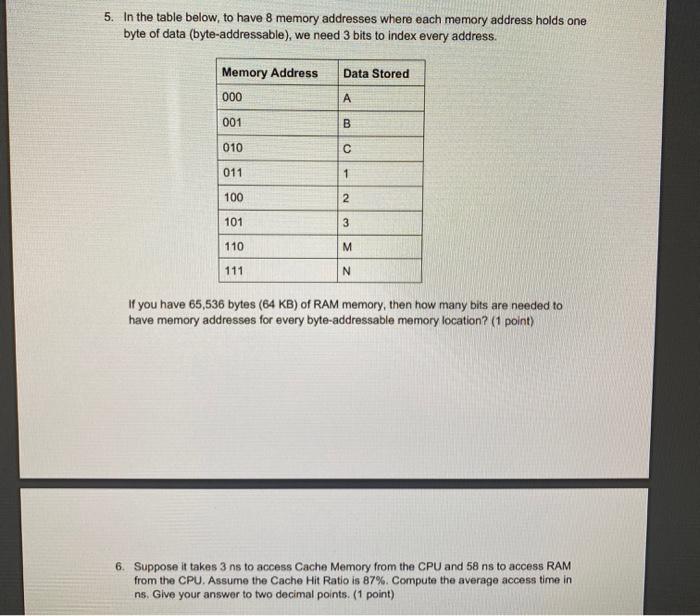
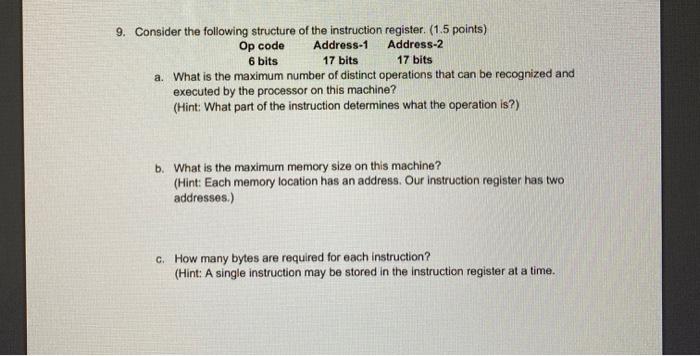
5. In the table below, to have 8 memory addresses where each memory address holds one byte of data (byte-addressable), we need 3 bits to index every address. Memory Address Data Stored 000 001 B 010 011 1 100 2 101 3 110 M 111 N If you have 65,536 bytes (64 KB) of RAM memory, then how many bits are needed to have memory addresses for every byte-addressable memory location? (1 point) 6. Suppose it takes 3 ns to access Cache Memory from the CPU and 58 ns to access RAM from the CPU. Assume the Cache Hit Ratio is 87%. Compute the average access time in ns. Give your answer to two decimal points. (1 point) 9. Consider the following structure of the instruction register. (1.5 points) Op code Address-1 Address-2 6 bits 17 bits 17 bits a. What is the maximum number of distinct operations that can be recognized and executed by the processor on this machine? (Hint: What part of the instruction determines what the operation is?) b. What is the maximum memory size on this machine? (Hint: Each memory location has an address. Our instruction register has two addresses.) C. How many bytes are required for each instruction? (Hint: A single instruction may be stored in the instruction register at a time
Step by Step Solution
There are 3 Steps involved in it

Get step-by-step solutions from verified subject matter experts