







Question: 5. IS-LM model and the value of Commitment (30 Points) This question will help you understand the IS-LM model in great detail. We derive the
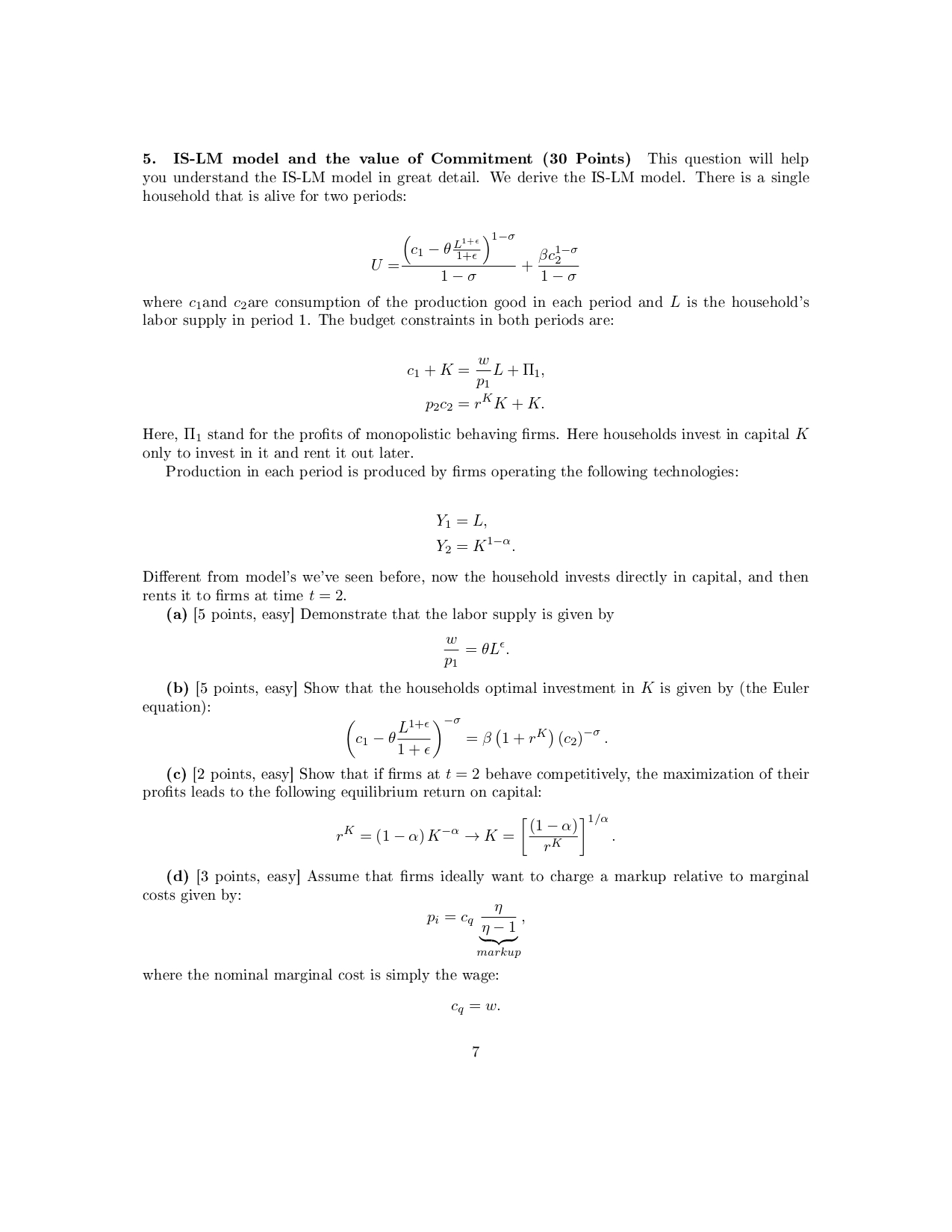
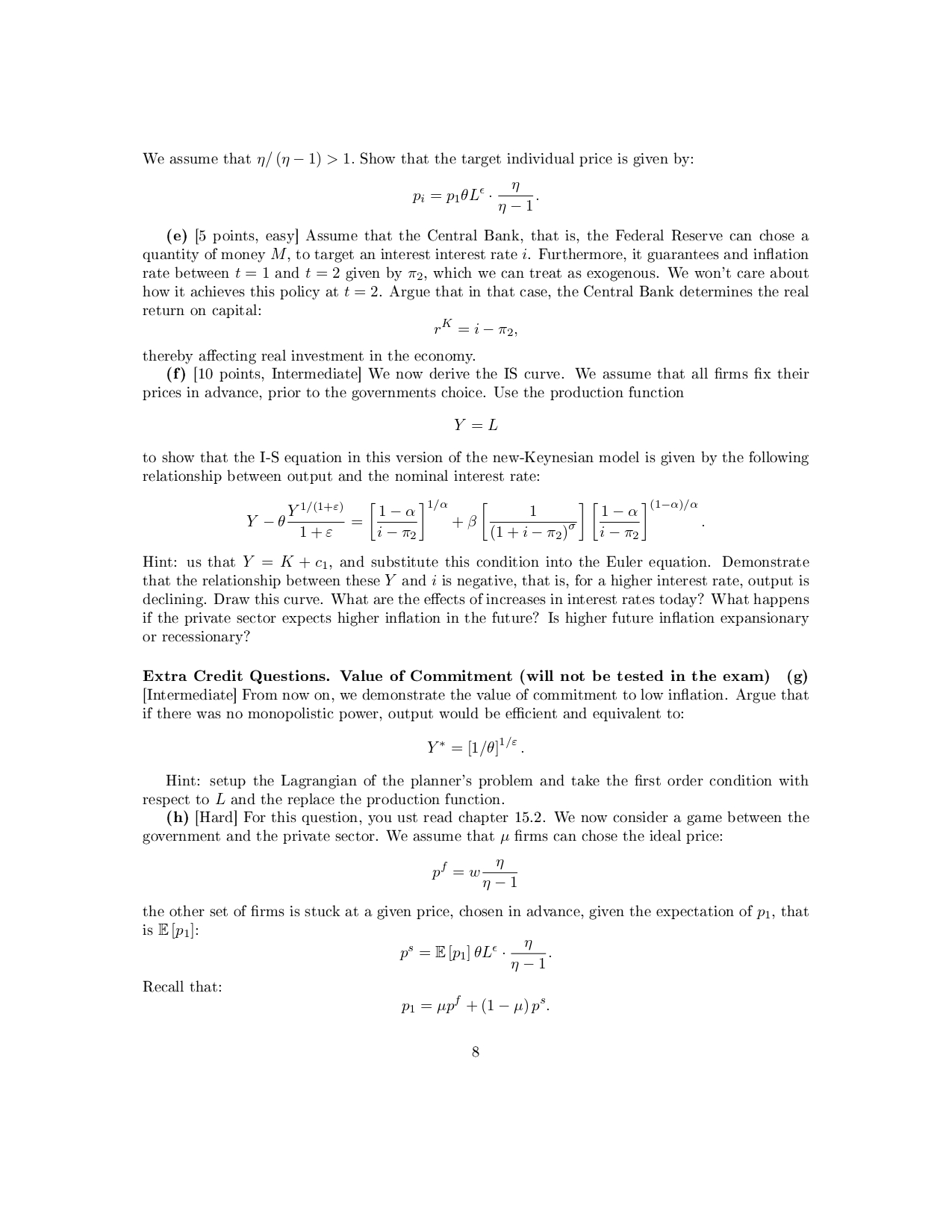
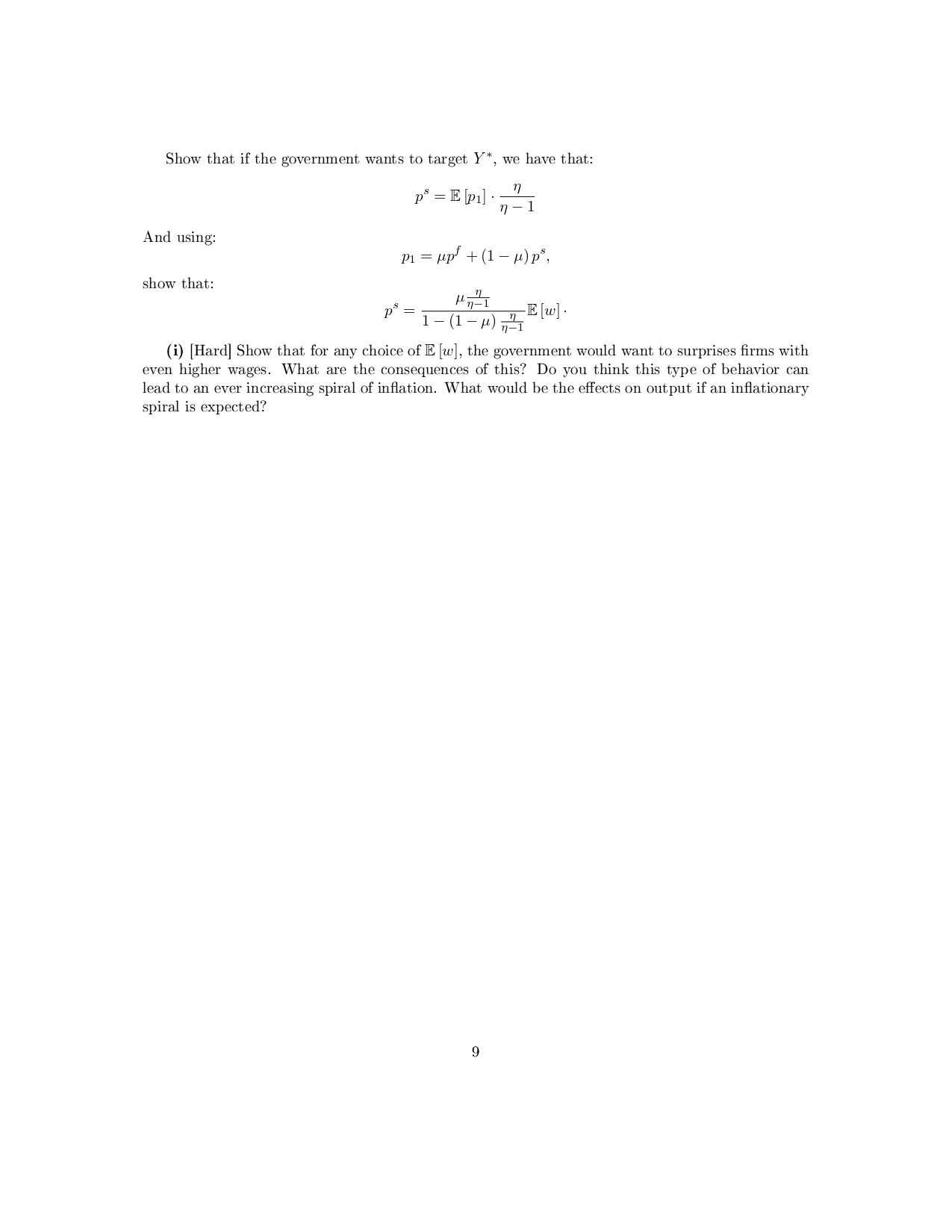
5. IS-LM model and the value of Commitment (30 Points) This question will help you understand the IS-LM model in great detail. We derive the IS-LM model. There is a single household that is alive for two periods: la' _ L1+E _ U :M + 186% a 10' 10' where cland czare consumption of the production good in each period and L is the household's labor supply in period 1. The budget constraints in both periods are: 61+K:EL+H1, P1 11262 = rKKJr K. Here, H1 stand for the prots of monopolistic behaving rms. Here households invest in capital K only to invest in it and rent it out later. Production in each period is produced by rms operating the following technologies Y1 = L, dig : K170. Different from model's we've seen before, now the household invests directly in capital, and then rents it to rms at time t : 2. (a) [5 points, easy] Demonstrate that the labor supply is given by 3 = 9L5. P1 (b) [5 points, easy] Show that the households optimal investment in K is given by (the Euler equation): 1+6 _0 (aligfse) Z'GUJFTKHCng- (c) [2 points, easy] Show that if rms at t = 2 behave competitively, the maximization of their prots leads to the following equilibrium return on capital: rK = (1 a)K'' > K = [(1r}al]l/\"_ (d) [3 points, easy] Assume that rms ideally want to charge a markup relative to marginal costs given by: i? markup where the nominal marginal cost is simply the wage: CqZ'lU. We assume that n/ (n 1) > 1. Show that the target individual price is given by: pi = plaice - i. n l (e) [5 points, easy] Assume that the Central Bank, that is, the Federal Reserve can chose a quantity of money M, to target an interest interest rate 1'. Furthermore, it guarantees and ination rate between t = 1 and t = 2 given by irg, which we can treat as exogenous. We won't care about how it achieves this policy at t = 2. Argue that in that case, the Central Bank determines the real return on capital: rK : 1' :72, thereby affecting real investment in the economy. (f) [10 points, Intermediate] We now derive the IS curve. We assume that all rms x their prices in advance, prior to the governments choice. Use the production function Y : L to show that the LS equation in this version of the new-Keynesian model is given by the following relationship between output and the nominal interest rate: lf(l+) _ 1/0: _ (1700/0: H =[1 \"J +ii 1 H16] - 1+5 ig 1+i7r2]g iTl'g Hint: us that Y = K + c1, and substitute this condition into the Euler equation. Demonstrate that the relationship between these Y and i is negative, that is, for a higher interest rate, output is declining. Draw this curve. What are the eects of increases in interest rates today? What happens if the private sector expects higher ination in the future? Is higher future ination expansionary or recessionary? Extra Credit Questions. Value of Commitment (will not be tested in the exam) (3) [Intermediate] From now on, we demonstrate the value of commitment to low ination. Argue that if there was no monopolistic power, output would be efficient and equivalent to: Y\" : [1/911/5. Hint: setup the Lagrangian of the planner's problem and take the rst order condition with respect to L and the replace the production function. (h) [Hard] For this question, you ust read chapter 15.2. We now consider a game between the government and the private sector. We assume that [1. rms can chose the ideal price: I: "'1' P wnl the other set of rms is stuck at a given price, chosen in advance, given the expectation of p1, that 13 .E [m]: p5=:E[p1]sLE-il. Recall that: in: .qu + (1 -,u)p5- Show that if the government wants to target Y\
Step by Step Solution
There are 3 Steps involved in it

Get step-by-step solutions from verified subject matter experts
 Study Help