







Question: 5) Leo decided to make a linear accelerator to do some experiments. His simple linear accelerator looked like the figure below. It works by having
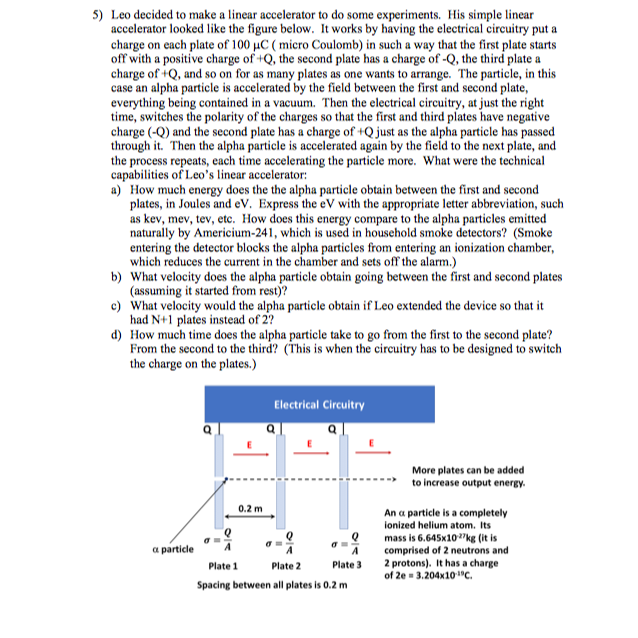
5) Leo decided to make a linear accelerator to do some experiments. His simple linear accelerator looked like the figure below. It works by having the electrical circuitry put a charge on each plate of 100 uC ( micro Coulomb) in such a way that the first plate starts off with a positive charge of +Q, the second plate has a charge of -Q, the third plate a charge of +Q, and so on for as many plates as one wants to arrange. The particle, in this case an alpha particle is accelerated by the field between the first and second plate, everything being contained in a vacuum. Then the electrical circuitry, at just the right time, switches the polarity of the charges so that the first and third plates have negative charge (-Q) and the second plate has a charge of +Q just as the alpha particle has passed through it. Then the alpha particle is accelerated again by the field to the next plate, and the process repeats, each time accelerating the particle more. What were the technical capabilities of Leo's linear accelerator: a) How much energy does the the alpha particle obtain between the first and second plates, in Joules and ev. Express the eV with the appropriate letter abbreviation, such as kev, mev, tev, etc. How does this energy compare to the alpha particles emitted naturally by Americium-241, which is used in household smoke detectors? (Smoke entering the detector blocks the alpha particles from entering an ionization chamber, which reduces the current in the chamber and sets off the alarm.) b) What velocity does the alpha particle obtain going between the first and second plates (assuming it started from rest)? c) What velocity would the alpha particle obtain if Leo extended the device so that it had N+1 plates instead of 2? d) How much time does the alpha particle take to go from the first to the second plate? From the second to the third? (This is when the circuitry has to be designed to switch the charge on the plates.) Electrical Circuitry More plates can be added to increase output energy. 0.2 m An a particle is a completely Ionized hellum atom, Its mass is 6.645x10 1/kg (It Is a particle A comprised of 2 neutrons and Plate 1 Plate 2 Plate 3 2 protons). It has a charge of Ze = 3.204x10""C Spacing between all plates is 0.2 m
Step by Step Solution
There are 3 Steps involved in it

Get step-by-step solutions from verified subject matter experts
 Study Help