







Question: . . 5. Let F be a hash function (both inputs and outputs are binary words). Consider the following algorithm that tries to identify collisions.
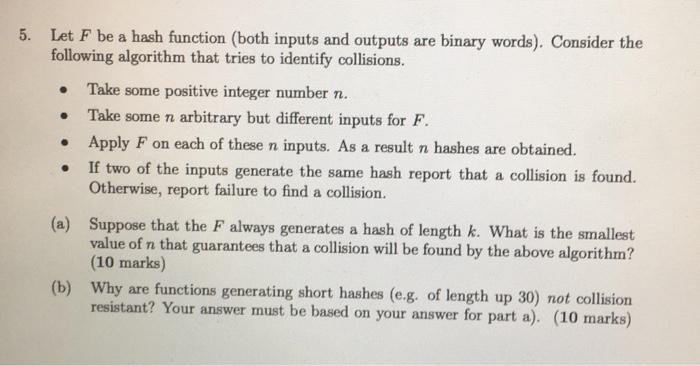
. . 5. Let F be a hash function (both inputs and outputs are binary words). Consider the following algorithm that tries to identify collisions. Take some positive integer number n. Take some n arbitrary but different inputs for F. Apply F on each of these n inputs. As a result n hashes are obtained. If two of the inputs generate the same hash report that a collision is found. Otherwise, report failure to find a collision. (a) Suppose that the F always generates a hash of length k. What is the smallest value of n that guarantees that a collision will be found by the above algorithm? (10 marks) (b) Why are functions generating short hashes (e.g. of length up 30) not collision resistant? Your answer must be based on your answer for part a). (10 marks)
Step by Step Solution
There are 3 Steps involved in it

Get step-by-step solutions from verified subject matter experts
 Study Help