







Question: 5. Let the random variable T be the time until some event occurs (e.g. time until an atom decays, time until next rainfall, etc). Suppose
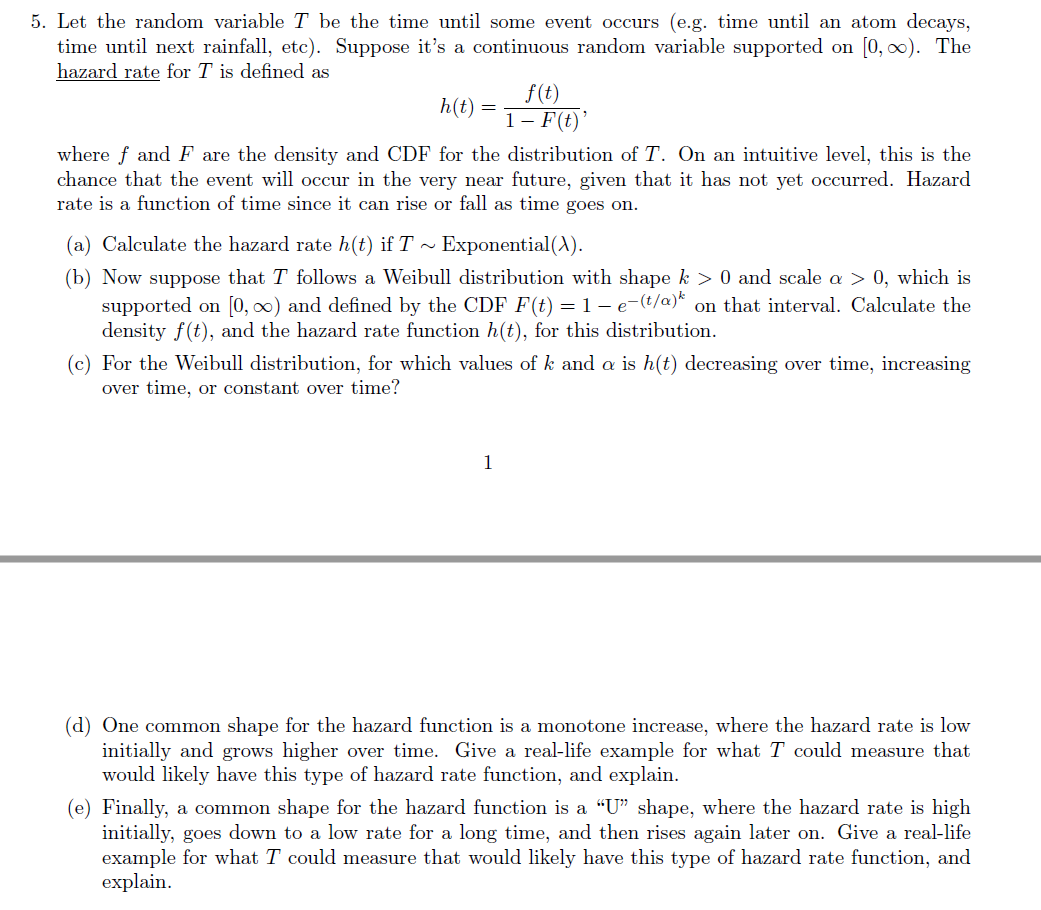
5. Let the random variable T be the time until some event occurs (e.g. time until an atom decays, time until next rainfall, etc). Suppose it's a continuous random variable supported on [0, 00). rI'he hazard rate for T is dened as fltl where f and F are the density and GDP for the distribution of T. On an intuitive level, this is the chance that the event will occur in the very near future, given that it has not yet occurred. Hazard rate is a function of time since it can rise or fall as time goes on. (a) Calculate the hazard rate Mt) if T m ExponentialUk). (b) Now suppose that T follows a Weibull distribution with shape ls: > U and scale or > 0, which is supported on [0, 00) and dened by the CDF F (t) = 1 e_('/\"}k on that interval. Calculate the density t), and the hazard rate function Mt), for this distribution. (c) For the Weibull distribution, for which values of k and o: is Mt) decreasing over time, increasing over time, or constant over time? (d) One common shape for the hazard function is a monotone increase, where the hazard rate is low initially and grows higher over time. Give a reallife example for what T could measure that would likely have this type of hazard rate function, and explain. (e) Finally, a common shape for the hazard function is a \"U\" shape, where the hazard rate is high initially, goes down to a low rate for a long time, and then rises again later on. Give a reallife example for what T could measure that would ljlcely have this type of hazard rate function, and explain
Step by Step Solution
There are 3 Steps involved in it

Get step-by-step solutions from verified subject matter experts
 Study Help