







Question: 5. Let X1, X2, ... be a sequence of identically-distributed, continuous random variables (i.e., not necessarily independent) with finite first moment. Then lim - E
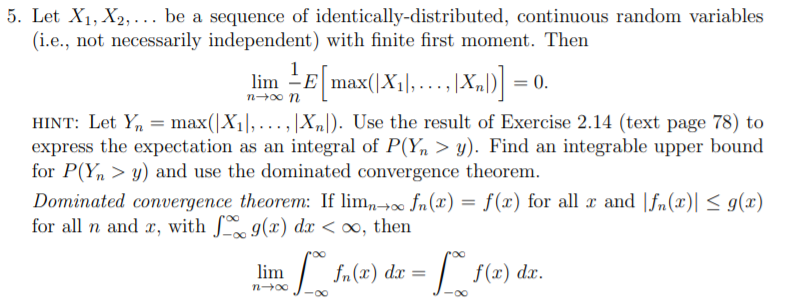
5. Let X1, X2, ... be a sequence of identically-distributed, continuous random variables (i.e., not necessarily independent) with finite first moment. Then lim - E max(|Xil, . . ., [XI) = 0. n-+0o n HINT: Let Ym = max( Xi], ..., [Xn)). Use the result of Exercise 2.14 (text page 78) to express the expectation as an integral of P(Y, > y). Find an integrable upper bound for P(Y, > y) and use the dominated convergence theorem. Dominated convergence theorem: If lim, +. fn(x) = f(x) for all a and If(x)|
Step by Step Solution
There are 3 Steps involved in it
1 Expert Approved Answer
Step: 1 Unlock

Question Has Been Solved by an Expert!
Get step-by-step solutions from verified subject matter experts
Step: 2 Unlock
Step: 3 Unlock
 Study Help