







Question: 5. (Problem 4.2.1 in Pinsky and Karlin) Consider a discrete-time periodic review inventory model, much like the one we introduced in Section 3.3 of the
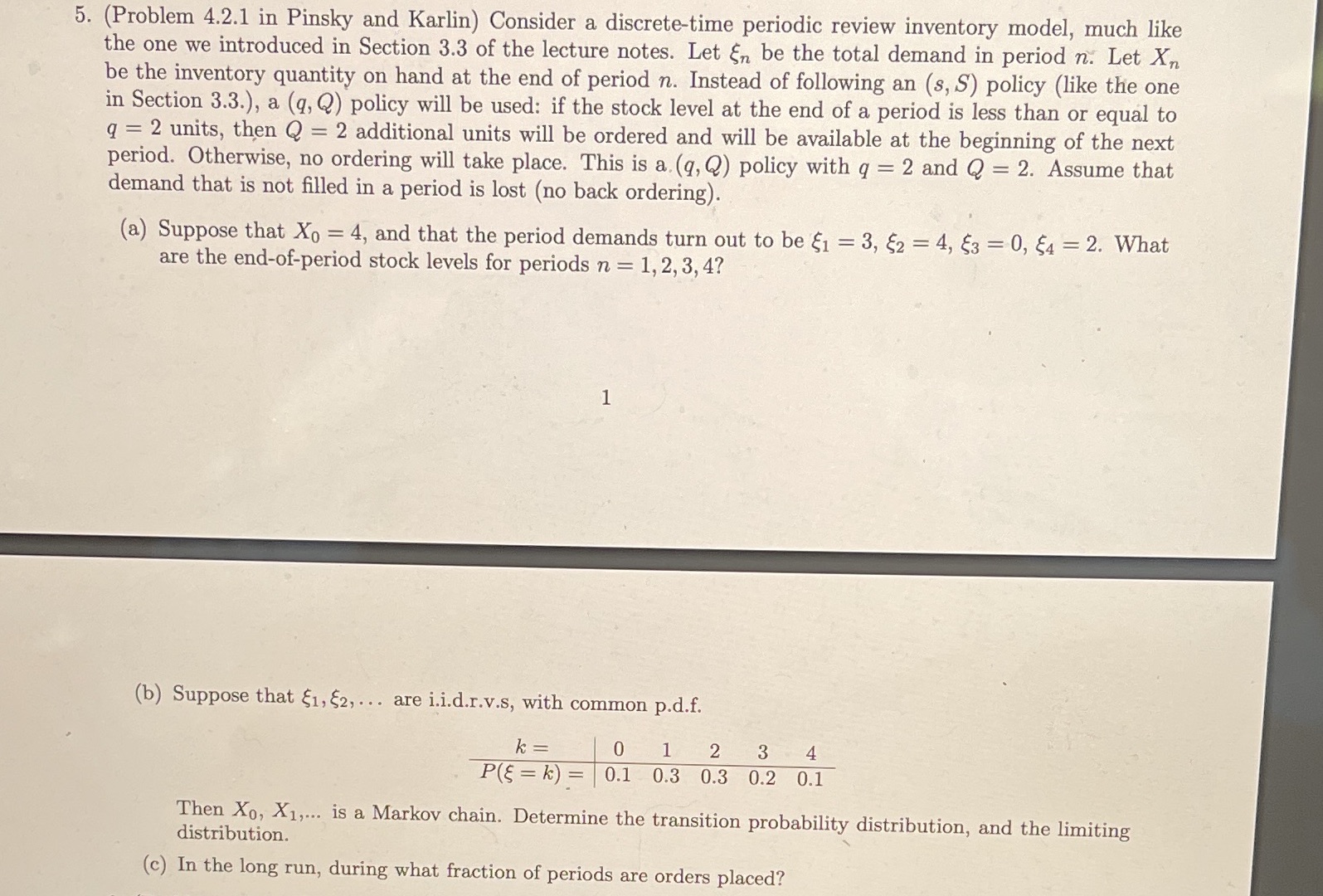
5. (Problem 4.2.1 in Pinsky and Karlin) Consider a discrete-time periodic review inventory model, much like the one we introduced in Section 3.3 of the lecture notes. Let En be the total demand in period n. Let X, be the inventory quantity on hand at the end of period n. Instead of following an (s, S) policy (like the one in Section 3.3.), a (q, Q) policy will be used: if the stock level at the end of a period is less than or equal to q = 2 units, then Q = 2 additional units will be ordered and will be available at the beginning of the next period. Otherwise, no ordering will take place. This is a. (q, Q) policy with q = 2 and Q = 2. Assume that demand that is not filled in a period is lost (no back ordering) (a) Suppose that Xo = 4, and that the period demands turn out to be $1 = 3, $2 = 4, $3 = 0, $4 = 2. What are the end-of-period stock levels for periods n = 1, 2, 3, 4? (b) Suppose that $1, $2, . .. are i.i.d.r.v.s, with common p.d.f. k = 01 2 3 4 P(5 = k) = 0.1 0.3 0.3 0.2 0.1 Then Xo, X1,... is a Markov chain. Determine the transition probability distribution, and the limiting distribution. (c) In the long run, during what fraction of periods are orders placed
Step by Step Solution
There are 3 Steps involved in it

Get step-by-step solutions from verified subject matter experts
 Study Help