







Question: 5. Recall the Binomial Theorem: For any positive integer n, ( c ty ) = ant ( ) an -butt ... + ( n
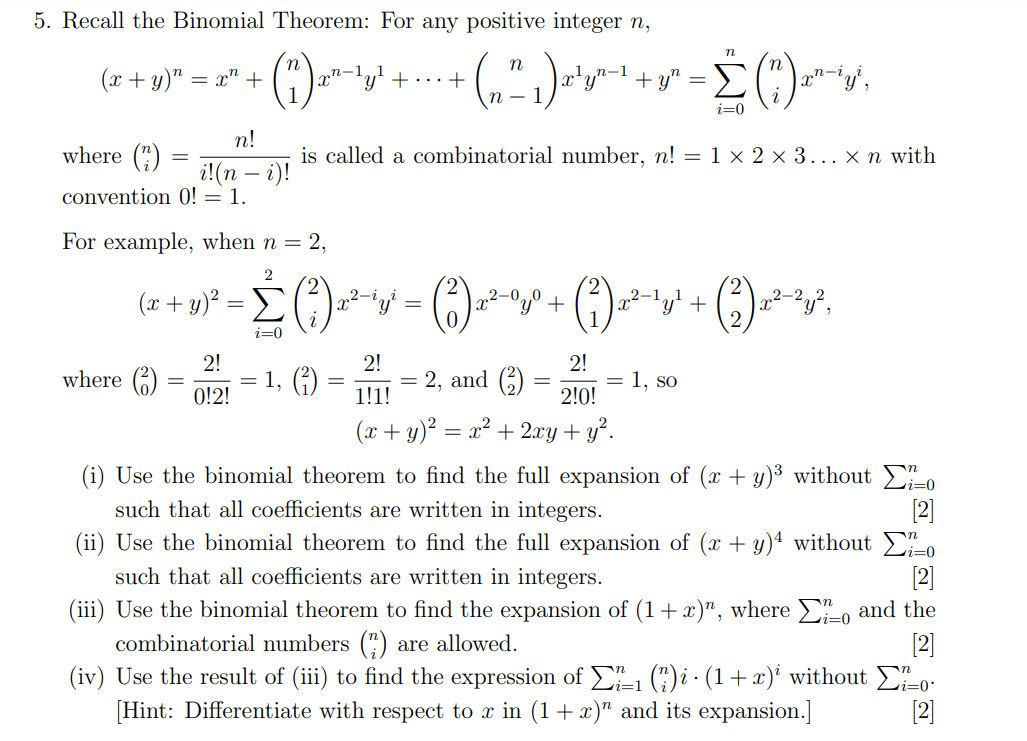
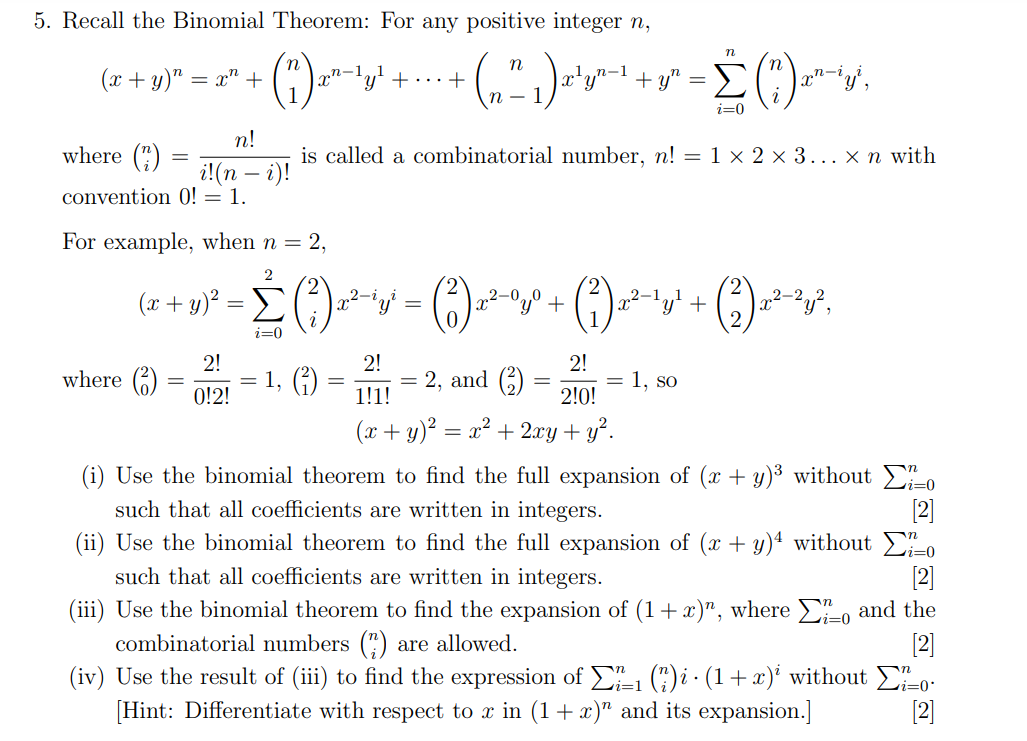
5. Recall the Binomial Theorem: For any positive integer n, ( c ty ) = ant ( " ) an -butt ... + ( n ? , ) andfun - ) (")20-', i=0 n! where (?) = i! (n - i)! is called a combinatorial number, n! = 1 x 2 x 3. .. x n with convention 0! = 1. For example, when n = 2, 2 (at y ) 2 = 2 72 - 212 , 1=0 2! 2! 2! where () = 0!2! =1, (7) 1!1! = 2, and (2) = = 1, so 2!0! ( xty)2 = x2 + 2.xy + 32. (i) Use the binomial theorem to find the full expansion of (x + y)3 without Et- such that all coefficients are written in integers. [2] (ii) Use the binomial theorem to find the full expansion of (x + y) without Zi- such that all coefficients are written in integers. [2] (iii) Use the binomial theorem to find the expansion of (1 + x)", where Et , and the combinatorial numbers (") are allowed. [2] (iv) Use the result of (iii) to find the expression of Et, (7)2 . (1 + x) without Et. [Hint: Differentiate with respect to x in (1 + x)" and its expansion.] [2]
Step by Step Solution
There are 3 Steps involved in it

Get step-by-step solutions from verified subject matter experts
 Study Help