







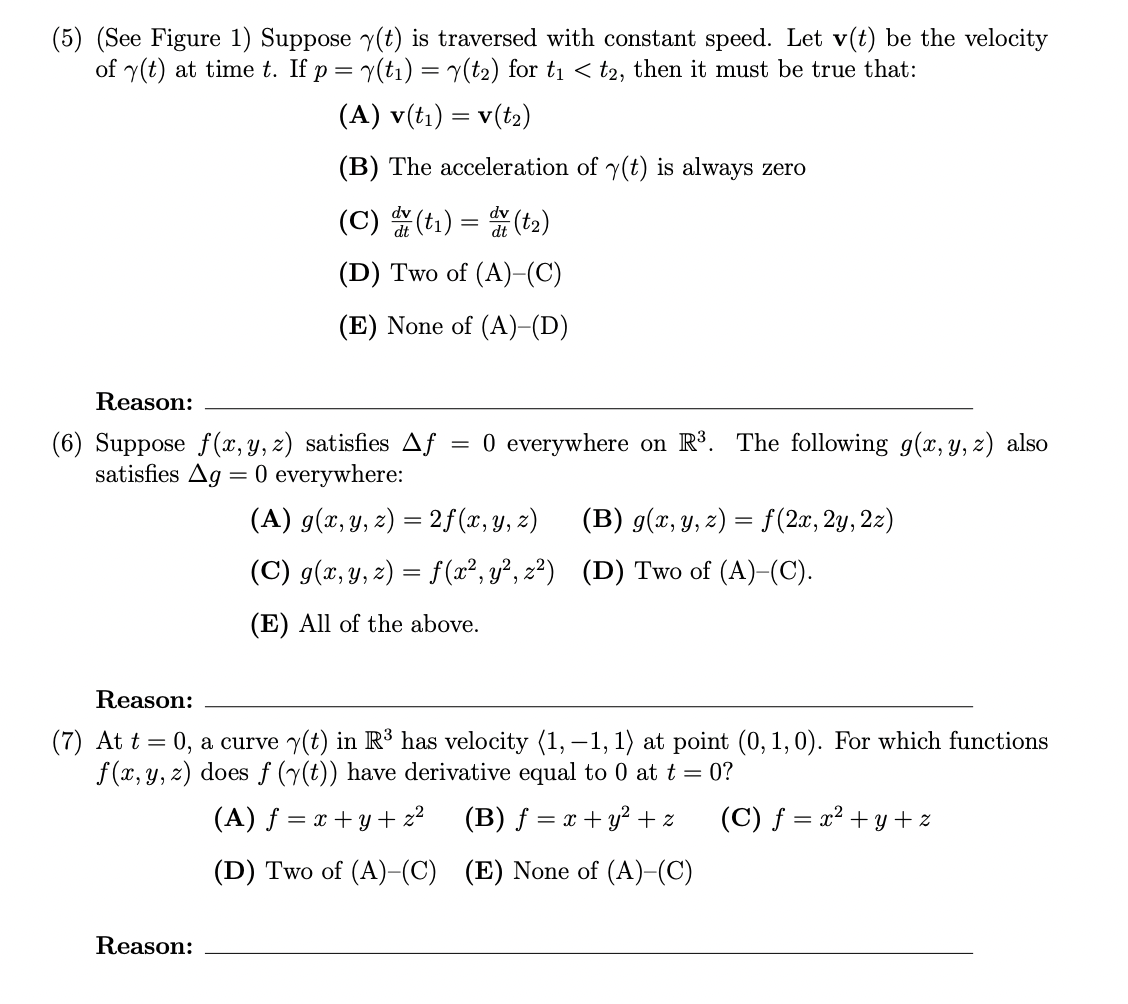
Question: ( 5 ) ( S e e Figure 1 ) Suppose ( t ) i s traversed with constant speed. Let v ( t )
Figure Suppose traversed with constant speed. Let the velocity
time for :: then must true that:
The acceleration always zero
Two
None
Reason:
Suppose satisfies everywhere The following also
satisfies everywhere:
Two
All the above.
Reason:
a curve has velocity :: point For which functions
does have derivative equal
Two
None
Reasor
Step by Step Solution
There are 3 Steps involved in it
1 Expert Approved Answer
Step: 1 Unlock

Question Has Been Solved by an Expert!
Get step-by-step solutions from verified subject matter experts
Step: 2 Unlock
Step: 3 Unlock
 Study Help