Question: 5 Select the statement that correctly describes the dependence effect derived from John Kenneth Galbraith's ideas on consumer affluence. Group of answer choices Consumers depend

5 Select the statement that correctly describes
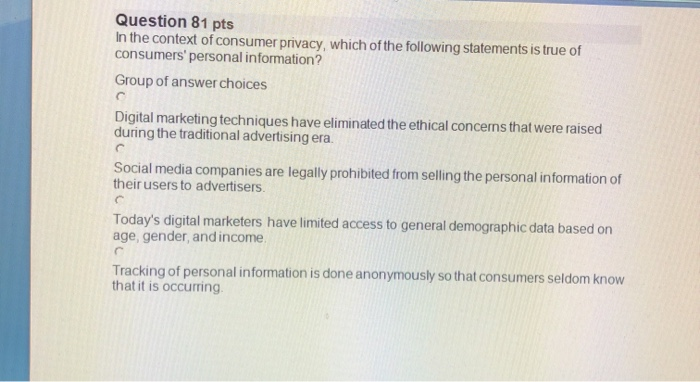
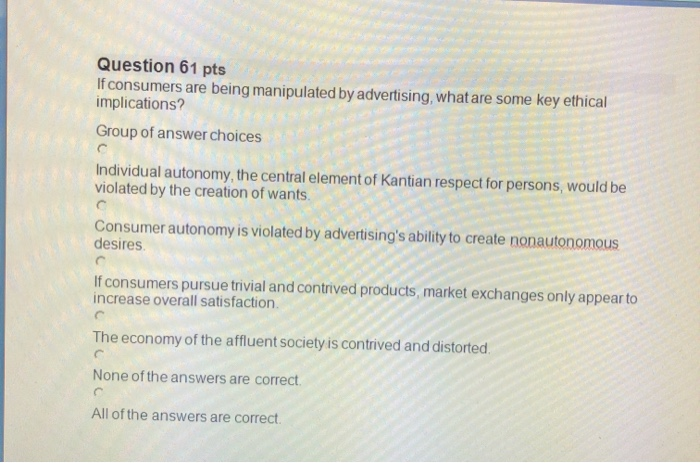
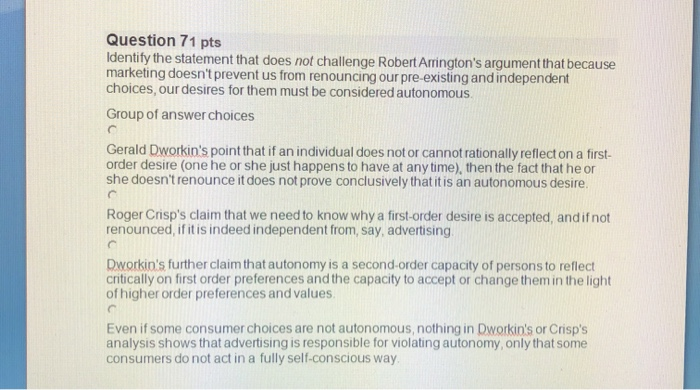
5 Select the statement that correctly describes the dependence effect derived from John Kenneth Galbraith's ideas on consumer affluence. Group of answer choices Consumers depend on the free market to learn about the products they may need and want. Supply follows and depends on demand, consumers are only getting what they want. Consumer demand depends on what producers have to sell Demand is a function of supply Advertising creates wants Owners of productive capital depend on giving consumers what they want otherwise they would lose their investment Question 61 pts If consumers are being manipulated by advertising, what are some key ethical implications? Group of answer choices Individual autonomy, the central element of Kantian respect for persons, would be violated by the creation of wants. Consumer autonomy is violated by advertising's ability to create nonautonomous desires If consumers pursue trivial and contrived products, market exchanges only appear to increase overall satisfaction. The economy of the affluent society is contrived and distorted. None of the answers are correct. All of the answers are correct Question 71 pts Identify the statement that does not challenge Robert Arrington's argument that because marketing doesn't prevent us from renouncing our pre-existing and independent choices, our desires for them must be considered autonomous Group of answer choices Gerald Dworkin's point that if an individual does not or cannot rationally reflect on a first- order desire (one he or she just happens to have at any time), then the fact that he or she doesn't renounce it does not prove conclusively that it is an autonomous desire. Roger Crisp's claim that we need to know why a first-order desire is accepted, and if not renounced ifitis indeed independent from, say, advertising Dworkin's further claim that autonomy is a second-order capacity of persons to reflect critically on first order preferences and the capacity to accept or change them in the light of higher order preferences and values Even if some consumer choices are not autonomous, nothing in Dworkin's or Crisp's analysis shows that advertising is responsible for violating autonomy, only that some consumers do not act in a fully self-conscious way Question 81 pts In the context of consumer privacy, which of the following statements is true of consumers' personal information? Group of answer choices Digital marketing techniques have eliminated the ethical concerns that were raised during the traditional advertising era. Social media companies are legally prohibited from selling the personal information of their users to advertisers. Today's digital marketers have limited access to general demographic data based on age, gender, and income Tracking of personal information is done anonymously so that consumers seldom know that it is occurring There is a question then you have to pick an answer that's it
Step by Step Solution

There are 3 Steps involved in it

1 Expert Approved Answer
Step: 1 Unlock blur-text-image

Question Has Been Solved by an Expert!

Get step-by-step solutions from verified subject matter experts

Step: 2 Unlock
Step: 3 Unlock

Students Have Also Explored These Related General Management Questions!