







Question: 5 . Sensor Reliability Using Bayesian Technique ( 3 0 Marks ) In this problem you will evaluate the effectiveness of using Bayesian approach in
Sensor Reliability Using Bayesian Technique
Marks
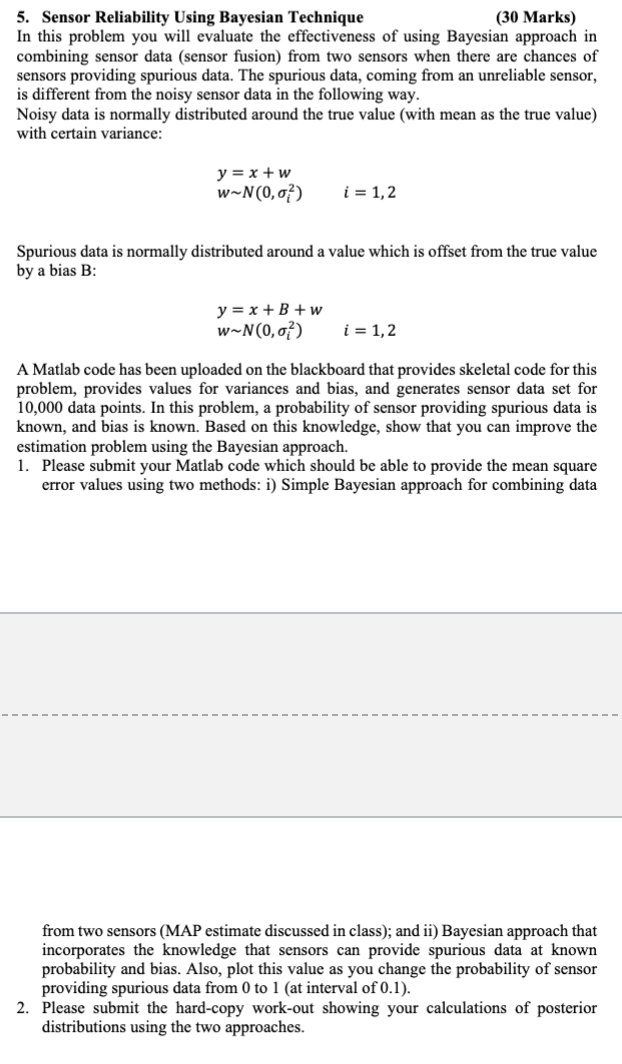
In this problem you will evaluate the effectiveness of using Bayesian approach in combining sensor data sensor fusion from two sensors when there are chances of sensors providing spurious data. The spurious data, coming from an unreliable sensor is different from the noisy sensor data in the following way.
Noisy data is normally distributed around the true value with mean as the true value with certain variance:
beginarrayl
yxw
w sim Nleftsigmairightquad i
endarray
Spurious data is normally distributed around a value which is offset from the true value by a bias B:
beginarrayll
yxBw &
w sim Nleftsigmairight & i
endarray
A Matlab code has been uploaded on the blackboard that provides skeletal code for this problem, provides values for variances and bias, and generates sensor data set for data points. In this problem, a probability of sensor providing spurious data is known, and bias is known. Based on this knowledge, show that you can improve the estimation problem using the Bayesian approach.
Please submit your Matlab code which should be able to provide the mean square error values using two methods: i Simple Bayesian approach for combining data
from two sensors MAP estimate discussed in class; and ii Bayesian approach that incorporates the knowledge that sensors can provide spurious data at known probability and bias. Also, plot this value as you change the probability of sensor providing spurious data from to at interval of
Please submit the hardcopy workout showing your calculations of posterior distributions using the two approaches.
Step by Step Solution
There are 3 Steps involved in it
1 Expert Approved Answer
Step: 1 Unlock

Question Has Been Solved by an Expert!
Get step-by-step solutions from verified subject matter experts
Step: 2 Unlock
Step: 3 Unlock
 Study Help