







Question: 5. Suppose we model a stock price process S using a stochastic volatility model: ds(t) = aS(t)dt +VY(t)S(t)dWi(t), dY (t) = BY(t)dt + oY(t)dW2(t), (6)
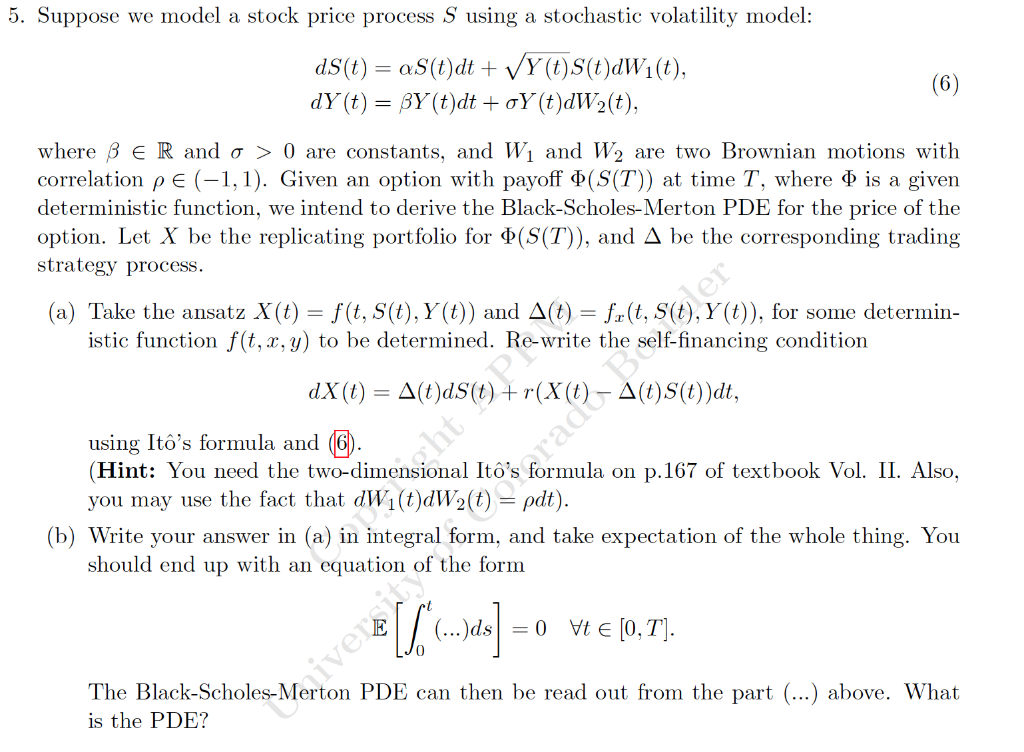
5. Suppose we model a stock price process S using a stochastic volatility model: ds(t) = aS(t)dt +VY(t)S(t)dWi(t), dY (t) = BY(t)dt + oY(t)dW2(t), (6) where B E R and o> 0 are constants, and W1 and W2 are two Brownian motions with correlation pe(-1,1). Given an option with payoff (S(T) at time T, where is a given deterministic function, we intend to derive the Black-Scholes-Merton PDE for the price of the option. Let X be the replicating portfolio for (S(T)), and A be the corresponding trading strategy process. (a) Take the ansatz X(t) = f(t, S(t), Y(t)) and Alt) = f (t, S(t), Y(t)), for some determin- istic function f(t, x,y) to be determined. Re-write the self-financing condition dX(t) = A(t)dS(t) +r(X(t) A(t)S(t))dt, using Ito's formula and (6 (Hint: You need the two-dimensional Ito's formula on p.167 of textbook Vol. II. Also, you may use the fact that dWi(t)dW2(t) = pdt). (b) Write your answer in (a) in integral form, and take expectation of the whole thing. You should end up with an equation of the form E[/c.)ds] = o (0,1); The Black-Scholes-Merton PDE can then be read out from the part (...) above. What is the PDE? 5. Suppose we model a stock price process S using a stochastic volatility model: ds(t) = aS(t)dt +VY(t)S(t)dWi(t), dY (t) = BY(t)dt + oY(t)dW2(t), (6) where B E R and o> 0 are constants, and W1 and W2 are two Brownian motions with correlation pe(-1,1). Given an option with payoff (S(T) at time T, where is a given deterministic function, we intend to derive the Black-Scholes-Merton PDE for the price of the option. Let X be the replicating portfolio for (S(T)), and A be the corresponding trading strategy process. (a) Take the ansatz X(t) = f(t, S(t), Y(t)) and Alt) = f (t, S(t), Y(t)), for some determin- istic function f(t, x,y) to be determined. Re-write the self-financing condition dX(t) = A(t)dS(t) +r(X(t) A(t)S(t))dt, using Ito's formula and (6 (Hint: You need the two-dimensional Ito's formula on p.167 of textbook Vol. II. Also, you may use the fact that dWi(t)dW2(t) = pdt). (b) Write your answer in (a) in integral form, and take expectation of the whole thing. You should end up with an equation of the form E[/c.)ds] = o (0,1); The Black-Scholes-Merton PDE can then be read out from the part (...) above. What is the PDE
Step by Step Solution
There are 3 Steps involved in it

Get step-by-step solutions from verified subject matter experts
 Study Help