







Question: .5. The J-curve effect shows , A. the initial improvement and the eventual depreciation of a country's trade balance following a currency depreciation. .B. the
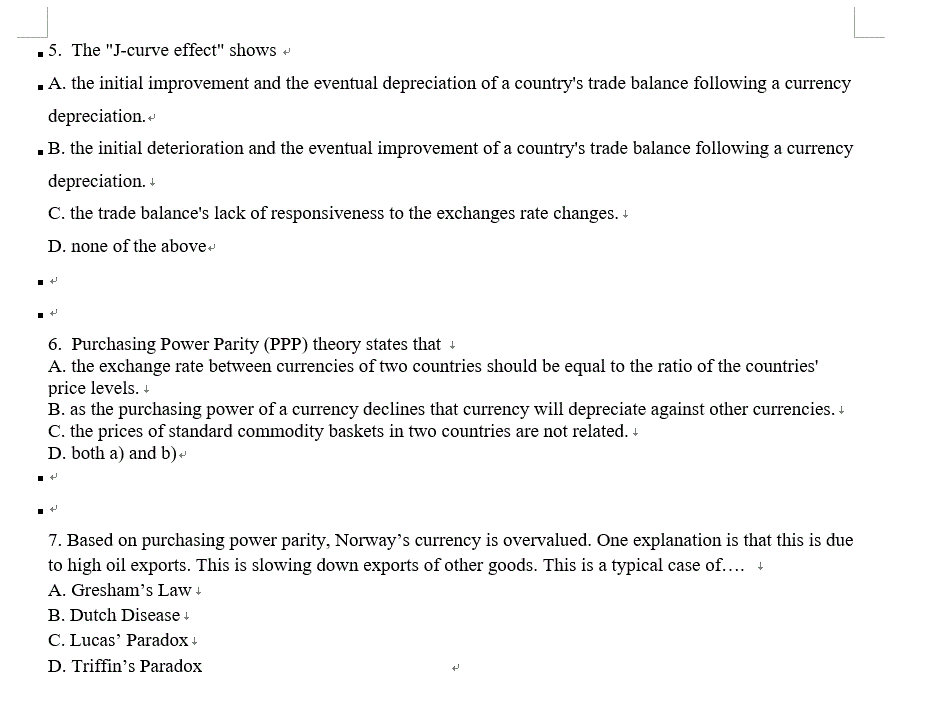
.5. The "J-curve effect" shows , A. the initial improvement and the eventual depreciation of a country's trade balance following a currency depreciation. .B. the initial deterioration and the eventual improvement of a country's trade balance following a currency depreciation. + C. the trade balance's lack of responsiveness to the exchanges rate changes. + D. none of the above- t 6. Purchasing Power Parity (PPP) theory states that + A. the exchange rate between currencies of two countries should be equal to the ratio of the countries' price levels. + B. as the purchasing power of a currency declines that currency will depreciate against other currencies. + C. the prices of standard commodity baskets in two countries are not related. + D. both a) and b)- 7. Based on purchasing power parity, Norway's currency is overvalued. One explanation is that this is due to high oil exports. This is slowing down exports of other goods. This is a typical case of.... + A. Gresham's Law + B. Dutch Disease + C. Lucas' Paradox + D. Triffin's Paradox .5. The "J-curve effect" shows , A. the initial improvement and the eventual depreciation of a country's trade balance following a currency depreciation. .B. the initial deterioration and the eventual improvement of a country's trade balance following a currency depreciation. + C. the trade balance's lack of responsiveness to the exchanges rate changes. + D. none of the above- t 6. Purchasing Power Parity (PPP) theory states that + A. the exchange rate between currencies of two countries should be equal to the ratio of the countries' price levels. + B. as the purchasing power of a currency declines that currency will depreciate against other currencies. + C. the prices of standard commodity baskets in two countries are not related. + D. both a) and b)- 7. Based on purchasing power parity, Norway's currency is overvalued. One explanation is that this is due to high oil exports. This is slowing down exports of other goods. This is a typical case of.... + A. Gresham's Law + B. Dutch Disease + C. Lucas' Paradox + D. Triffin's Paradox
Step by Step Solution
There are 3 Steps involved in it

Get step-by-step solutions from verified subject matter experts
 Study Help