







Question: 5. The multi-stage valuation model Aa Aa Consider the case of Morose Otter Hydraulic Manufacturers Inc.: Morose Otter Hydraulic Manufacturers Inc. is expected to generate
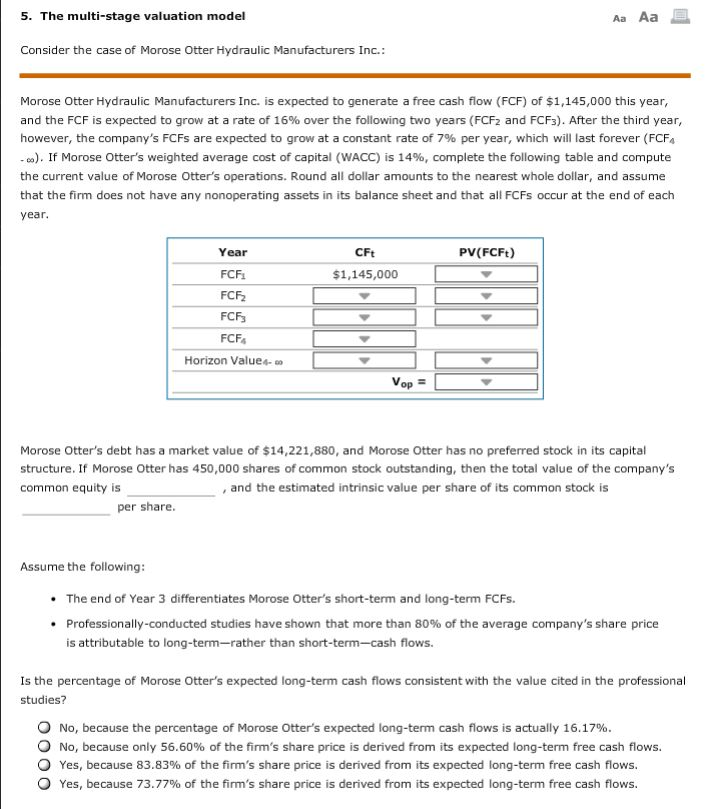
5. The multi-stage valuation model Aa Aa Consider the case of Morose Otter Hydraulic Manufacturers Inc.: Morose Otter Hydraulic Manufacturers Inc. is expected to generate a free cash flow (FCF) of $1,145,000 this year, and the FCF is expected to grow at a rate of 16% over the following two years (FCF2 and FCF3). After the third year, however, the company's FCFS are expected to grow at a constant rate of 7% per year, which will last forever (FCF, - o). If Morose Otter's weighted average cost of capital (WACC) is 14%, complete the following table and compute the current value of Morose Otter's operations. Round all dollar amounts to the nearest whole dollar, and assume that the firm does not have any nonoperating assets in its balance sheet and that all FCFS occur at the end of each year. Year CFt PV(FCFE) FCF1 $1,145,000 FCF FCF FCF Horizon Value4- Vop = Morose Otter's debt has a market value of $14,221,880, and Morose Otter has no preferred stock in its capital structure. If Morose Otter has 450,000 shares of common stock outstanding, then the total value of the company's , and the estimated intrinsic value per share of its common stock is common equity is per share. Assume the following: The end of Year 3 differentiates Morose Otter's short-term and long-term FCFS. Professionally-conducted studies have shown that more than 80% of the average company's share price is attributable to long-term-rather than short-term-cash flows. Is the percentage of Morose Otter's expected long-term cash flows consistent with the value cited in the professional studies? No, because the percentage of Morose Otter's expected long-term cash flows is actually 16.17%. No, because only 56.60% of the firm's share price is derived from its expected long-term free cash flows. Yes, because 83.83% of the firm's share price is derived from its expected long-term free cash flows. Yes, because 73.77% of the firm's share price is derived from its expected long-term free cash flows. 5. The multi-stage valuation model Aa Aa Consider the case of Morose Otter Hydraulic Manufacturers Inc.: Morose Otter Hydraulic Manufacturers Inc. is expected to generate a free cash flow (FCF) of $1,145,000 this year, and the FCF is expected to grow at a rate of 16% over the following two years (FCF2 and FCF3). After the third year, however, the company's FCFS are expected to grow at a constant rate of 7% per year, which will last forever (FCF, - o). If Morose Otter's weighted average cost of capital (WACC) is 14%, complete the following table and compute the current value of Morose Otter's operations. Round all dollar amounts to the nearest whole dollar, and assume that the firm does not have any nonoperating assets in its balance sheet and that all FCFS occur at the end of each year. Year CFt PV(FCFE) FCF1 $1,145,000 FCF FCF FCF Horizon Value4- Vop = Morose Otter's debt has a market value of $14,221,880, and Morose Otter has no preferred stock in its capital structure. If Morose Otter has 450,000 shares of common stock outstanding, then the total value of the company's , and the estimated intrinsic value per share of its common stock is common equity is per share. Assume the following: The end of Year 3 differentiates Morose Otter's short-term and long-term FCFS. Professionally-conducted studies have shown that more than 80% of the average company's share price is attributable to long-term-rather than short-term-cash flows. Is the percentage of Morose Otter's expected long-term cash flows consistent with the value cited in the professional studies? No, because the percentage of Morose Otter's expected long-term cash flows is actually 16.17%. No, because only 56.60% of the firm's share price is derived from its expected long-term free cash flows. Yes, because 83.83% of the firm's share price is derived from its expected long-term free cash flows. Yes, because 73.77% of the firm's share price is derived from its expected long-term free cash flows
Step by Step Solution
There are 3 Steps involved in it

Get step-by-step solutions from verified subject matter experts
 Study Help