



Question: ? 5 The table shows a hypothetical demand schedule for ( ? b a r ( c ) ) ( w i d e t
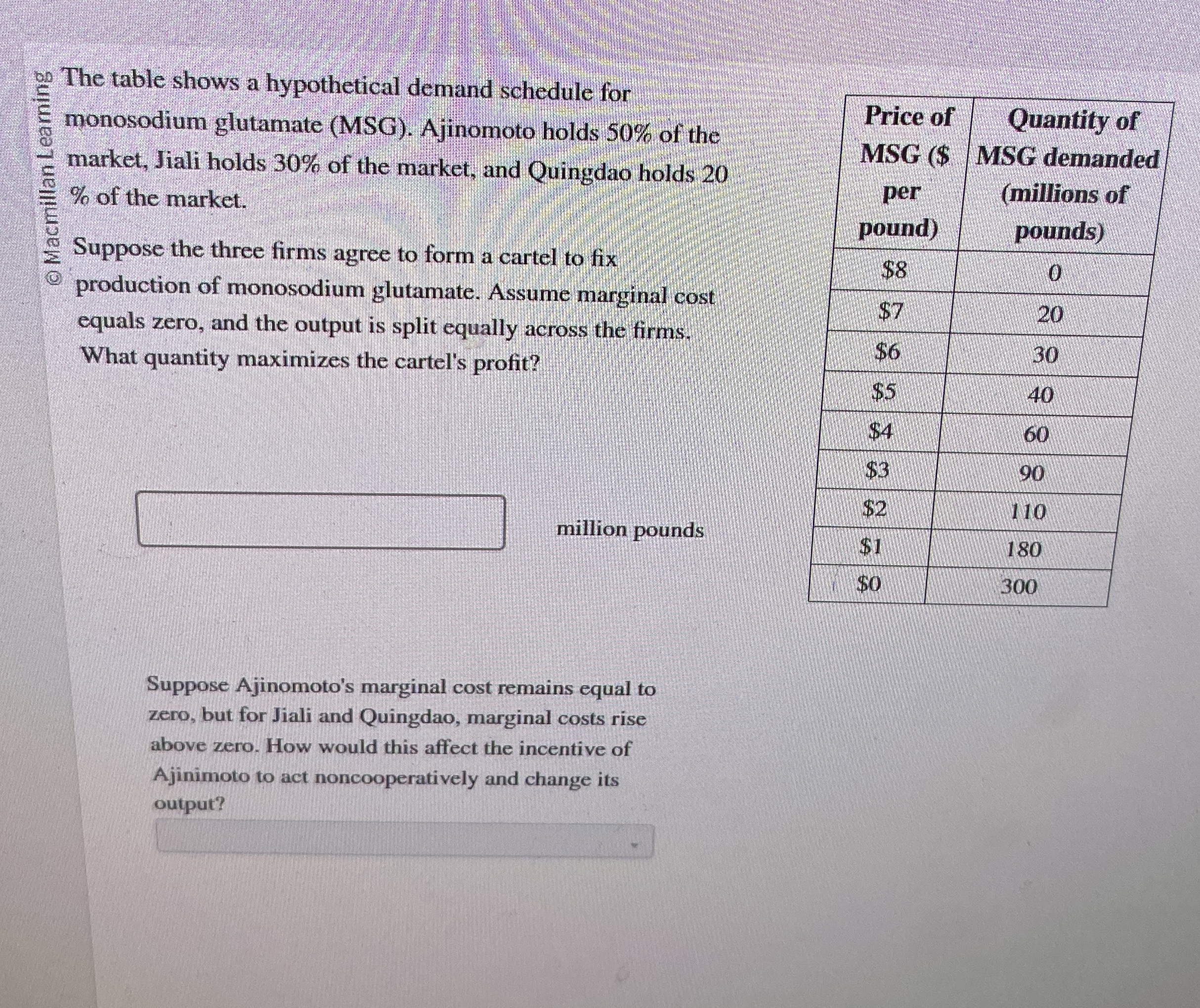
The table shows a hypothetical demand schedule for monosodium glutamate MSG Ajinomoto holds of the market, Jiali holds of the market, and Quingdao holds of the market.
Suppose the three firms agree to form a cartel to fix production of monosodium glutamate. Assume marginal cost equals zero, and the output is split equally across the firms. What quantity maximizes the cartel's profit?
tabletablePrice ofMSG $perpoundtableQuantity ofMSG demandedmillions ofpounds$$$$$$$$$
Suppose Ajinomoto's marginal cost remains equal to zero, but for Jiali and Quingdao, marginal costs rise above zero. How would this affect the incentive of Ajinimoto to act noncooperatively and change its output?
Step by Step Solution
There are 3 Steps involved in it
1 Expert Approved Answer
Step: 1 Unlock

Question Has Been Solved by an Expert!
Get step-by-step solutions from verified subject matter experts
Step: 2 Unlock
Step: 3 Unlock