







Question: 5. There are two commodities, x1 and x2, the prices of which are given by p1 > 0 and p2 > 0, respectively. 5. There
5. There are two commodities, x1 and x2, the prices of which are given by p1 > 0 and p2 > 0, respectively.
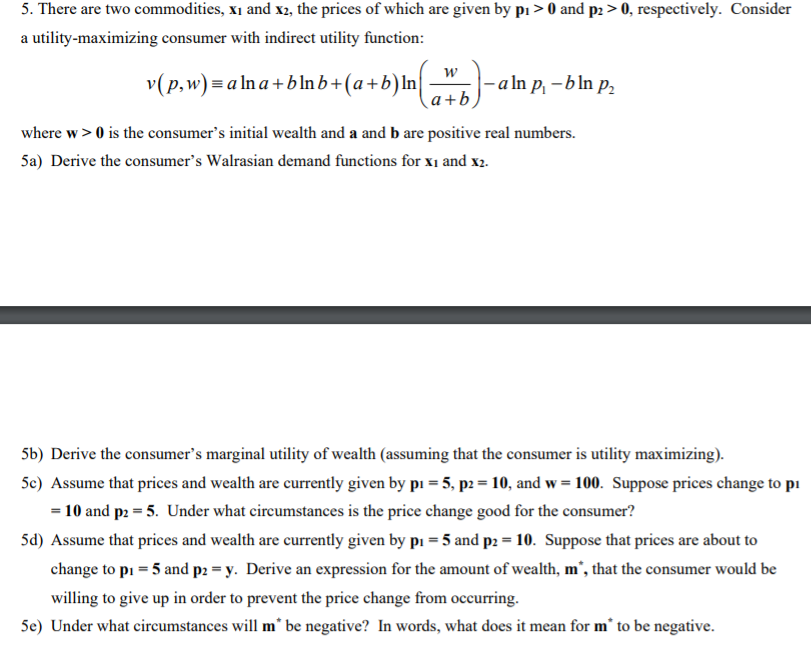
5. There are two commodities, 11 and 11, the prices of which are given by p: 3' I] and p1 3* II. respectively. Consider a utility-maximizing consumer with indirect utility function: W v(p,w)zahta+blub+(a+b)h1[ Jalnplblnpz a+b where w 3- 0 is the consumer's initial wealth and I and b are positive real numbers. 5a) Derive the consumer's Walrasian demand functions for 11 and 1:. 5h) Derive the consumer's marginal utility of wealth (assuming that the consumer is utility maximizing}. 5c) Assume that prices and wealth are currently given by pi = 5. p1 = 10. and w = 10". Suppose prices change to pi = 10 and p1 = 5. Under what circumstances is the price change good for the consumer? 5d) Assume that prices and wealth are currently given by p: = 5 and p2 = 10. Suppose that prices are about to change to p. = 5 and p: = y. Derive an expression for the amount of wealth of, that the consumer would be willing to give up in order to prevent the price change from occurring. 5e) Under what circumstances will of be negative? [n words. what does it mean for m' to be negative
Step by Step Solution
There are 3 Steps involved in it

Get step-by-step solutions from verified subject matter experts
 Study Help