







Question: 5. [Total 14 points] Suppose that you have data (X, Y/), i = 1, .., n and run a linear regression Y, = Bo +
![5. [Total 14 points] Suppose that you have data (X, Y/),](https://s3.amazonaws.com/si.experts.images/answers/2024/06/667855cc711c1_316667855cc4e295.jpg)
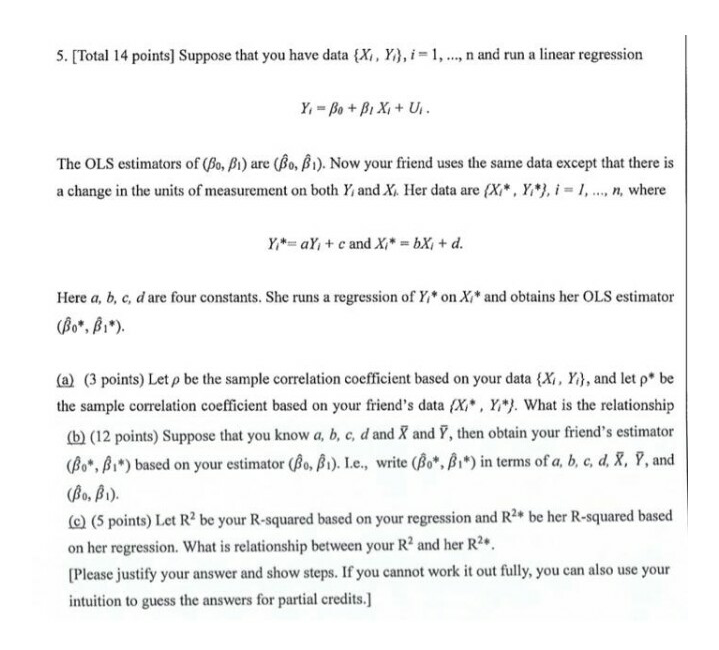
5. [Total 14 points] Suppose that you have data (X, Y/), i = 1, .., n and run a linear regression Y, = Bo + BIX + UI. The OLS estimators of (Bo, Bi) are (Bo, 1). Now your friend uses the same data except that there is a change in the units of measurement on both Y', and X. Her data are (X/* , Y,*), i = 1, .... n, where Y*= al, + c and X/* = bXi + d. Here a, b, c, d are four constants. She runs a regression of Y,* on X* and obtains her OLS estimator (Bo*, BI* ). (a) (3 points) Let p be the sample correlation coefficient based on your data {X, Y), and let p* be the sample correlation coefficient based on your friend's data /X,* , Y,*). What is the relationship (b) (12 points) Suppose that you know a, b, c, d and X and Y, then obtain your friend's estimator (Bo*, Bi*) based on your estimator (Bo, Bi). Le., write (Bo*, Bi*) in terms of a, b, c, d, X, Y, and (Bo, BI). (c) (5 points) Let R? be your R-squared based on your regression and R2* be her R-squared based on her regression. What is relationship between your R? and her R?*. [Please justify your answer and show steps. If you cannot work it out fully, you can also use your intuition to guess the answers for partial credits.]
Step by Step Solution
There are 3 Steps involved in it

Get step-by-step solutions from verified subject matter experts
 Study Help