







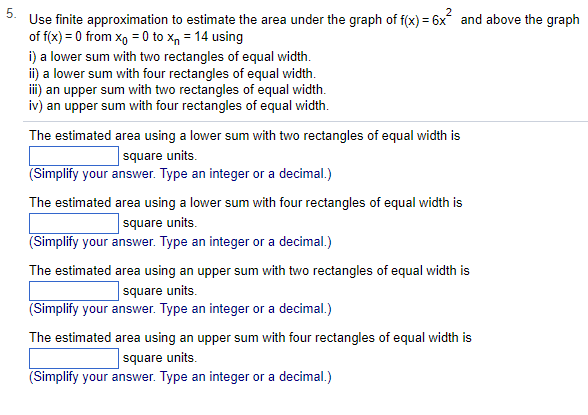
Question: 5' Use nite approximation to estimate the area under the graph of x) = 6x2 and above the graph of x): [1 from x =E|
![rectangles of equal width. ii] a lower sum with four rectangles of](https://s3.amazonaws.com/si.experts.images/answers/2024/06/666627df835ad_911666627df697ab.jpg)
![equal width. iii] an upper sum with two rectangles of equal width.](https://s3.amazonaws.com/si.experts.images/answers/2024/06/666627dfdbdcf_911666627dfc9be3.jpg)
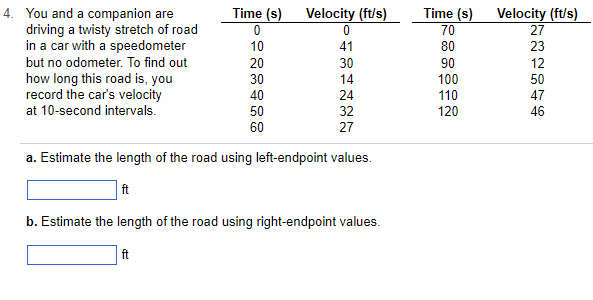
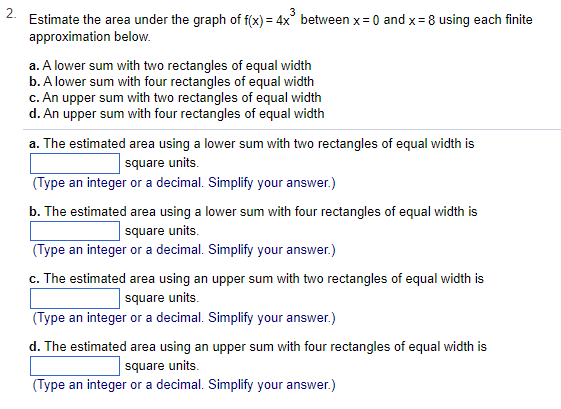
5' Use nite approximation to estimate the area under the graph of x) = 6x2 and above the graph of x): [1 from x =E| to x" =14 using i} a lower sum with two rectangles of equal width. ii] a lower sum with four rectangles of equal width. iii] an upper sum with two rectangles of equal width. iv) an upper sum with four rectangles of equal width. The estimated area using a lower sum with two rectangles of equal width is :l square units. [Simplify your answer. Type an integer or a decimal.) The estimated area using a lower sum with four rectangles of equal width is :l square units. [Simplify your answer. Type an integer or a decimal.) The estimated area using an upper sum with two rectangles of equal width is :l square units. [Simplify your answer. Type an integer or a decimal.) The estimated area using an upper sum with four rectangles of equal width is :l square units. [Simplify your answer. Type an integer or a decimal.) 4. You and a companion are Time (s) Velocity (ft/s) Time (s) Velocity (ft/s) driving a twisty stretch of road 0 0 70 27 in a car with a speedometer 10 41 80 23 but no odometer. To find out 20 30 90 12 how long this road is, you 30 14 100 50 record the car's velocity 40 24 110 47 at 10-second intervals. 50 32 120 46 60 27 a. Estimate the length of the road using left-endpoint values. ft b. Estimate the length of the road using right-endpoint values. ft2. Estimate the area under the graph of f(x) = 4x" between x = 0 and x = 8 using each finite approximation below. a. A lower sum with two rectangles of equal width b. A lower sum with four rectangles of equal width c. An upper sum with two rectangles of equal width d. An upper sum with four rectangles of equal width a. The estimated area using a lower sum with two rectangles of equal width is square units. (Type an integer or a decimal. Simplify your answer.) b. The estimated area using a lower sum with four rectangles of equal width is square units. (Type an integer or a decimal. Simplify your answer.) c. The estimated area using an upper sum with two rectangles of equal width is square units. (Type an integer or a decimal. Simplify your answer.) d. The estimated area using an upper sum with four rectangles of equal width is square units. (Type an integer or a decimal. Simplify your answer.)
Step by Step Solution
There are 3 Steps involved in it

Get step-by-step solutions from verified subject matter experts
 Study Help