







Question: 50 G(s) = (s + 1)(s + 2)(8 + 10) 8) Design a phase-lag compensator with the form: S + 2 C(s) = Klass+p With
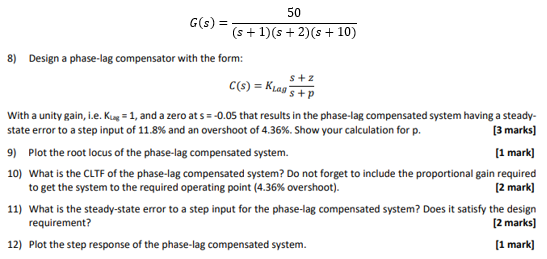
50 G(s) = (s + 1)(s + 2)(8 + 10) 8) Design a phase-lag compensator with the form: S + 2 C(s) = Klass+p With a unity gain, i.e. Kung = 1, and a zero at s=-0.05 that results in the phase-lag compensated system having a steady- state error to a step input of 11.8% and an overshoot of 4.36%. Show your calculation for p. [3 marks) 9) Plot the root locus of the phase-lag compensated system. [1 mark] 10) What is the CLTF of the phase-lag compensated system? Do not forget to include the proportional gain required to get the system to the required operating point (4.36% overshoot). [2 mark] 11) What is the steady-state error to a step input for the phase-lag compensated system? Does it satisfy the design requirement? [2 marks] 12) Plot the step response of the phase-lag compensated system. [1 mark] 50 G(s) = (s + 1)(s + 2)(8 + 10) 8) Design a phase-lag compensator with the form: S + 2 C(s) = Klass+p With a unity gain, i.e. Kung = 1, and a zero at s=-0.05 that results in the phase-lag compensated system having a steady- state error to a step input of 11.8% and an overshoot of 4.36%. Show your calculation for p. [3 marks) 9) Plot the root locus of the phase-lag compensated system. [1 mark] 10) What is the CLTF of the phase-lag compensated system? Do not forget to include the proportional gain required to get the system to the required operating point (4.36% overshoot). [2 mark] 11) What is the steady-state error to a step input for the phase-lag compensated system? Does it satisfy the design requirement? [2 marks] 12) Plot the step response of the phase-lag compensated system. [1 mark]
Step by Step Solution
There are 3 Steps involved in it

Get step-by-step solutions from verified subject matter experts
 Study Help