







Question: 50 points Save Answer A QUESTION 8 Match the algorithm to its description Bubble Sort Insertion Sort Selection Sort Shell Sort Merge Sort Quick Sort
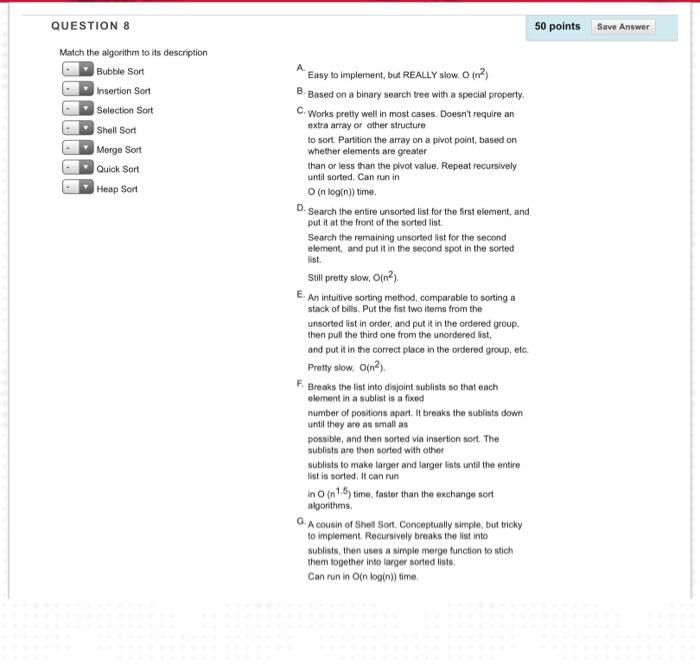
50 points Save Answer A QUESTION 8 Match the algorithm to its description Bubble Sort Insertion Sort Selection Sort Shell Sort Merge Sort Quick Sort Heap Sort US Easy to implement, but REALLY slow. O (2) B Based on a binary search tree with a special property C. Works pretty well in most cases. Doesn't require an extra array or other structure to sort. Partition the array on a pivot point, based on whether elements are greater than or less than the pivot value. Repeat recursively until sorted. Can fun in O in login}) time D. Search the entire unsorted list for the first element, and put it at the front of the sorted list Search the remaining unsorted list for the second element, and put it in the second spot in the sorted Still pretty slow, On) E. An intuitive sorting method, comparable to sorting a stack of bills. Put the fist two items from the unsorted list in order and put it in the ordered group. then pull the third one from the unordered list, and put it in the correct place in the ordered group, etc. Pretty slow, Ona). F. Breaks the listinto disjoint sublists so that each element in a sublist is a fixed number of positions apart. It breaks the sublists down until they are as small as possible, and then sorted via insertion sort. The sublists are then sorted with other Sublists to make larger and larger lists until the entire list is sorted. It can run in o (n 1.5 time, faster than the exchange sort algorithms. G. A cousin of Shell Sort. Conceptually simple, but tricky to implement. Recursively breaks the listinto sublists, then uses a simple merge function to stich them together into larger sorted lists. Can run in Oin log(n) time
Step by Step Solution
There are 3 Steps involved in it

Get step-by-step solutions from verified subject matter experts
 Study Help