







Question: 5.2 Text Problem 5.61 in 7th Ed or 5.49 in 8th Ed. A long cylinder of 30-mm diameter, initially at a uni- form temperature of
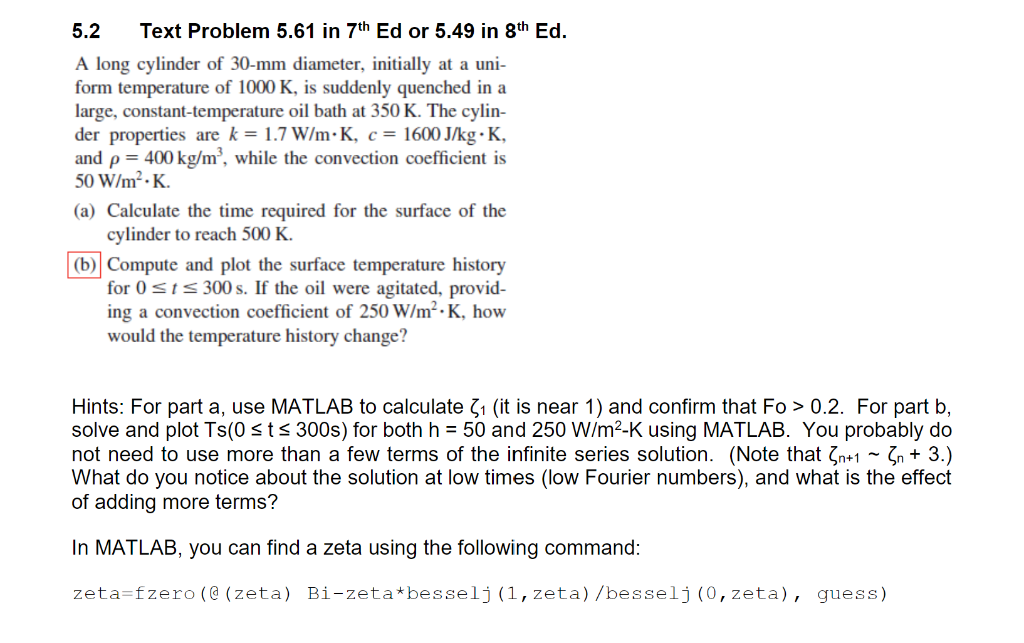
5.2 Text Problem 5.61 in 7th Ed or 5.49 in 8th Ed. A long cylinder of 30-mm diameter, initially at a uni- form temperature of 1000 K, is suddenly quenched in a large, constant-temperature oil bath at 350 K. The cylin- der properties are k = 1.7 W/m.K, c = 1600 J/kg.K, and p = 400 kg/m', while the convection coefficient is 50 W/m.K. (a) Calculate the time required for the surface of the cylinder to reach 500 K. (b) Compute and plot the surface temperature history for 0 st 5 300 s. If the oil were agitated, provid- ing a convection coefficient of 250 W/m.K, how would the temperature history change? Hints: For part a, use MATLAB to calculate 51 (it is near 1) and confirm that Fo > 0.2. For part b, solve and plot Ts(Osts 300s) for both h = 50 and 250 W/m2 K using MATLAB. You probably do not need to use more than a few terms of the infinite series solution. (Note that Sn+1 ~ Sn + 3.) What do you notice about the solution at low times (low Fourier numbers), and what is the effect of adding more terms? In MATLAB, you can find a zeta using the following command: zeta=fzero (@(zeta) Bi-zeta*besselj(1, zeta) /besselj (0, zeta), guess)
Step by Step Solution
There are 3 Steps involved in it

Get step-by-step solutions from verified subject matter experts
 Study Help