







Question: 5.3 As defined in Chapter 3, a utility function is homothetic if any straight line through the origin cuts all indifference curves at points of
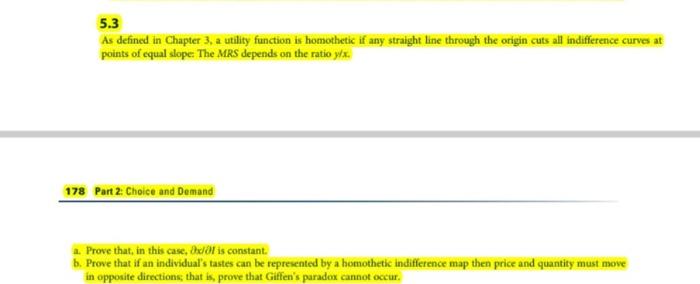
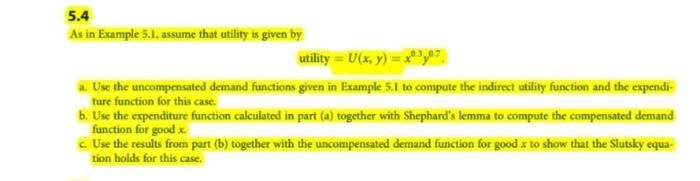
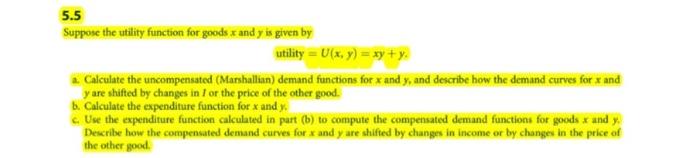
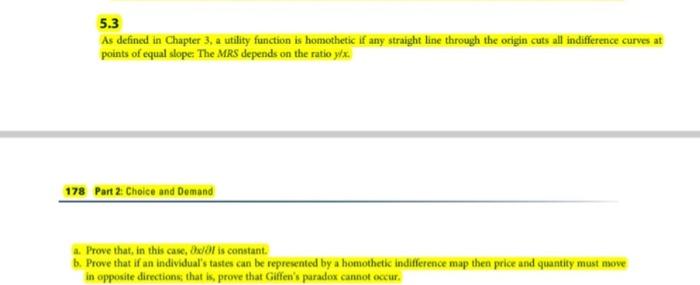
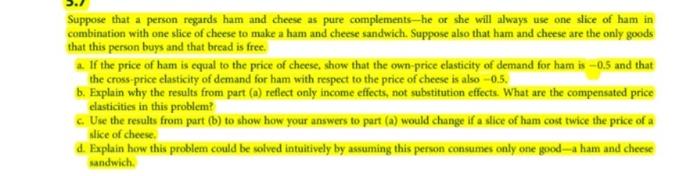

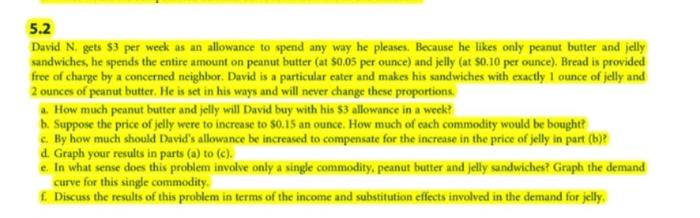
5.3 As defined in Chapter 3, a utility function is homothetic if any straight line through the origin cuts all indifference curves at points of equal slope: The MRS depends on the ratio y/x. 78 Part 2. Choice and Demand a. Prove that, in this case, OxdOI is constant. b. Prove that if an individual's tastes can be represented by a homothetic indifference map then price and quantity must move In oppodite Afirections, that is, prove that Giffen's paradox cannot occur. 5.8 Show that the share of income spent on a good x is sx=4hth, where E is total expenditure. As defined in Chapter 3, a utility function is homothetic if any straight line through the origin cuts all indifference curves at points of equal slope: The MRS depends on the ratio y/x. 8 Part 2: Choice and Demand . Prove that, in this case, Dx/OH is constant. b. Prove that if an individual's tastes can be represented by a homothetic indifference map then price and quantity must move In opporite firections, that is, prove that Giffen's puradox cannot occur. Suppose that a person regards ham and cheese as pure complements-he or she will always use one slice of ham in combination with one stice of cheese to make a ham and cheese sandwich. Suppose also that ham and cheese are the only goods that this person buys and that bread is free. a. If the price of ham is equal to the price of cheese, show that the own-price elasticity of demand for ham is -0.5 and that the cross-price elasticity of demand for ham with respect to the price of cheese is also -0.5 . b. Explain why the results from part (a) reflect only income effects, not substitution effects. What are the compensated price elasticities in this problem? c. Use the results from part (b) to show how your answers to part (a) would change if a slice of ham cost twice the price of a slice of cheese. d. Explain how this problem could be solved intuitively by assuming this person consumes only one good-a ham and cheese sandwich. As in Example 5.1, assume that utility is given by utility=U(x,y)=x0.3y0.7. a. Use the uncompensated demand functions given in Fxample 5.1 to compute the indirect utility function and the expenditure function for this case. b. Use the expenditure function calculated in part (a) together with Shephard's lemma to compute the compensated demand function for good x. c. Use the results from part (b) together with the uncompensated demand function for good x to show that the Slutsky equation holds for this case. David N. gets $3 per week as an allowance to spend any way he pleases. Because he likes only peanut butter and jelly sandwiches, he spends the entire amount on peanut butter (at $0.05 per ounce) and jelly (at $0.10 per ounce). Bread is provided free of charge by a concerned neighbor. David is a particular eater and makes his sandwiches with exactly 1 ounce of jelly and 2 ounces of peanut butter. He is set in his ways and will never change these proportions. a. How much peanut butter and jelly will David buy with his $3 allowance in a week? b. Suppose the price of jelly were to increase to 50.15 an ounce. How much of each commodity would be bought? c. By how much should David's allowance be increased to compensate for the increase in the price of jelly in part (b)? d. Graph your results in parts (a) to (c). e. In what sense does this problem involve only a single commodity, peanut butter and jelly sandwiches? Graph the demand curve for this single commodity. f. Discuss the results of this problem in terms of the income and substifution effects involved in the demand for jelly, 5.5 Suppose the utility function for goods x and y is given by utility=U(x,y)=xy+y. a. Calculate the uncompensated (Marshallian) demand functions for x and y, and describe how the demand curves for x and y are shifted by changes in t or the price of the other good. b. Calculate the expenditure function for x and x. c. Use the expenditure function calculated in part (b) to compute the compensated demand functions for goods x and y. Describe how the compensated demand curves for x and y are shifted by changes in income or by changes in the price of the other good
Step by Step Solution
There are 3 Steps involved in it

Get step-by-step solutions from verified subject matter experts
 Study Help