





Question: 5.3 Taylor Tool Life Model Development for Turning G2 Gray Iron In the worksheet entitled G2 Gray Iron you will find flank wear data taken
5.3 Taylor Tool Life Model Development for
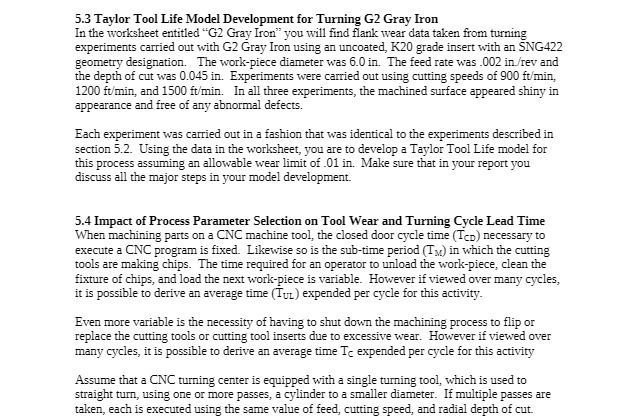
5.3 Taylor Tool Life Model Development for Turning G2 Gray Iron In the worksheet entitled "G2 Gray Iron" you will find flank wear data taken from turning experiments carried out with G2 Gray Iron using an uncoated, K20 grade insert with an SNG422 geometry designation. The work-piece diameter was 6.0 in. The feed rate was .002 in /rev and the depth of cut was 0.045 in. Experiments were carried out using cutting speeds of 900 ft/min, 1200 ft/min, and 1500 ft/min. In all three experiments, the machined surface appeared shiny in appearance and free of any abnormal defects. Each experiment was carried out in a fashion that was identical to the experiments described in section 5.2. Using the data in the worksheet, you are to develop a Taylor Tool Life model for this process assuming an allowable wear limit of .01 in. Make sure that in your report you discuss all the major steps in your model development. 5.4 Impact of Process Parameter Selection on Tool Wear and Turning Cycle Lead Time When machining parts on a CNC machine tool, the closed door cycle time (Top) necessary to execute a CNC program is fixed. Likewise so is the sub-time period (Ty) in which the cutting tools are making chips. The time required for an operator to unload the work-piece, clean the fixture of chips, and load the next work-piece is variable. However if viewed over many cycles, it is possible to derive an average time (Tu) expended per cycle for this activity. Even more variable is the necessity of having to shut down the machining process to flip or replace the cutting tools or cutting tool inserts due to excessive wear. However if viewed over many cycles, it is possible to derive an average time To expended per cycle for this activity Assume that a CNC turning center is equipped with a single turning tool, which is used to straight turn, using one or more passes, a cylinder to a smaller diameter. If multiple passes are taken, each is executed using the same value of feed, cutting speed, and radial depth of cut

Step by Step Solution

There are 3 Steps involved in it

1 Expert Approved Answer
Step: 1 Unlock blur-text-image

Question Has Been Solved by an Expert!

Get step-by-step solutions from verified subject matter experts

Step: 2 Unlock
Step: 3 Unlock

Students Have Also Explored These Related Law Questions!