







Question: 5.3a Exercises ANSWER THE QUESTIONS 1. How should a compound proposition be characterized if all the truth values under the proposition's main logical operator are
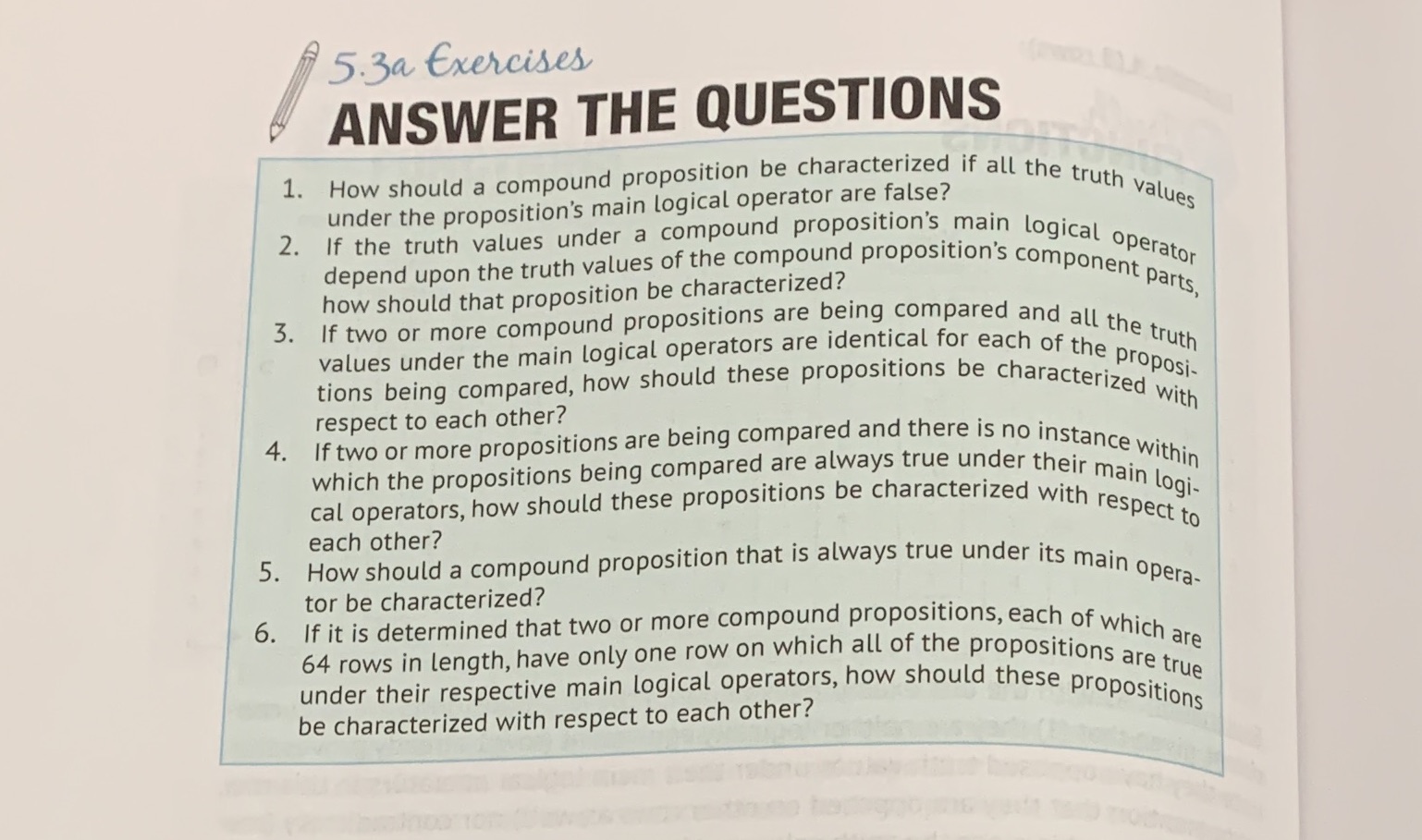
5.3a Exercises ANSWER THE QUESTIONS 1. How should a compound proposition be characterized if all the truth values under the proposition's main logical operator are false? 2. If the truth values under a compound propositions main logical operator depend upon the truth values of the compound propositions component parts how should that proposition be characterized? 3. If two or more compound propositions are being compared and all the truth values under the main logical operators are identical for each of the proposi tions being compared, how should these propositions be characterized with respect to each other? 4. 1 IT two or more propositions are being compared and there is no instance within which the propositions being compared are always true under their main logi- cal operators, how should these propositions be characterized with respect to each other? 5. How should a compound proposition that is always true under its main opera- tor be characterized? 6. If it is determined that two or more compound propositions, each of which are 64 rows in length, have only one row on which all of the propositions are true under their respective main logical operators, how should these propositions be characterized with respect to each other
Step by Step Solution
There are 3 Steps involved in it

Get step-by-step solutions from verified subject matter experts
 Study Help