



Question: 55. The production cost report is the document that summarizes the manufacturing activity that takes place in a process department for a given period of
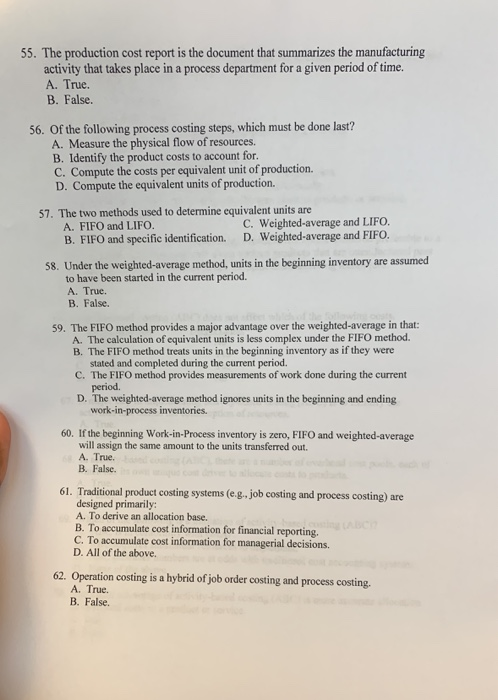
55. The production cost report is the document that summarizes the manufacturing activity that takes place in a process department for a given period of time. A. True. B. False. 56. Of the following process costing steps, which must be done last? A. Measure the physical flow of resources. B. Identify the product costs to account for. C. Compute the costs per equivalent unit of production. D. Compute the equivalent units of production. 57. The two methods used to determine equivalent units are C. Weighted-average and LIFO. D. A. FIFO and LIFO. B. FIFO and specific identification. Weighted-average and FIFO. 58. Under the weighted-average method, units in the beginning inventory are assumed to have been started in the current period. A. True. B. False. 59. The FIFO method provides a major advantage over the weighted-average in that: A. The calculation of equivalent units is less complex under the FIFO method. B. The FIFO method treats units in the beginning inventory as if they were stated and completed during the current period. C. The FIFO method provides measurements of work done during the current period. D. The weighted-average method ignores units in the beginning and ending work-in-process inventories. 60. If the beginning Work-in-Process inventory is zero, FIFO and weighted-average will assign the same amount to the units transferred out. A. True. B. False. 61. Traditional product costing systems (e.g. job costing and process costing) are designed primarily: A. To derive an allocation base. B. To accumulate cost information for financial reporting C. To accumulate cost information for managerial decisions. D. All of the above. 62. Operation costing is a hybrid of job order costing and process costing. A. True. B. False
Step by Step Solution
There are 3 Steps involved in it

Get step-by-step solutions from verified subject matter experts