



Question: 5:53 Cancel Reply Send 202170-EBKN-101-BFF-BJ-VC-15... Discussion Question: Provide an example of each product class? And define each item on the right. This is Slide 23
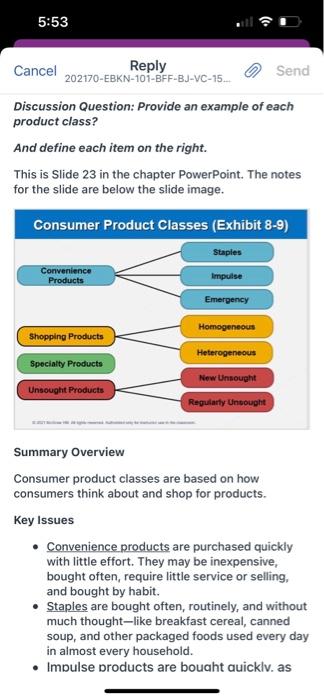
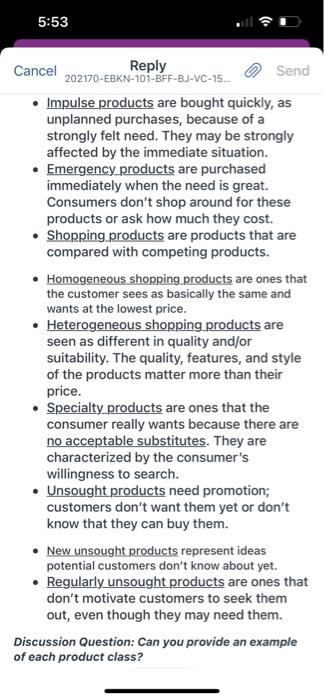
5:53 Cancel Reply Send 202170-EBKN-101-BFF-BJ-VC-15... Discussion Question: Provide an example of each product class? And define each item on the right. This is Slide 23 in the chapter PowerPoint. The notes for the slide are below the slide image. Consumer Product Classes (Exhibit 8-9) Staples Convenience Products Impulse Emergency Homogeneous Shopping Products Specialty Products Heterogeneous New Unnought Unsought Products Regularly Uneought Summary Overview Consumer product classes are based on how consumers think about and shop for products. Key Issues . Convenience products are purchased quickly with little effort. They may be inexpensive, bought often, require little service or selling, and bought by habit. Staples are bought often, routinely, and without much thought-like breakfast cereal, canned soup, and other packaged foods used every day in almost every household. Impulse products are bought auickly as 5:53 Cancel Reply Send 202170-EBKN-101-BFF-BJ-VC-15... Impulse products are bought quickly, as unplanned purchases, because of a strongly felt need. They may be strongly affected by the immediate situation. Emergency products are purchased immediately when the need is great. Consumers don't shop around for these products or ask how much they cost. Shopping products are products that are compared with competing products. Homogeneous shopping products are ones that the customer sees as basically the same and wants at the lowest price. Heterogeneous shopping products are seen as different in quality and/or suitability. The quality, features, and style of the products matter more than their price. Specialty products are ones that the consumer really wants because there are no acceptable substitutes. They are characterized by the consumer's willingness to search. Unsought products need promotion; customers don't want them yet or don't know that they can buy them. New unsought products represent ideas potential customers don't know about yet. Regularly unsought products are ones that don't motivate customers to seek them out, even though they may need them. Discussion Question: Can you provide an example of each product class? 5:53 Cancel Reply Send 202170-EBKN-101-BFF-BJ-VC-15... Discussion Question: Provide an example of each product class? And define each item on the right. This is Slide 23 in the chapter PowerPoint. The notes for the slide are below the slide image. Consumer Product Classes (Exhibit 8-9) Staples Convenience Products Impulse Emergency Homogeneous Shopping Products Specialty Products Heterogeneous New Unnought Unsought Products Regularly Uneought Summary Overview Consumer product classes are based on how consumers think about and shop for products. Key Issues . Convenience products are purchased quickly with little effort. They may be inexpensive, bought often, require little service or selling, and bought by habit. Staples are bought often, routinely, and without much thought-like breakfast cereal, canned soup, and other packaged foods used every day in almost every household. Impulse products are bought auickly as 5:53 Cancel Reply Send 202170-EBKN-101-BFF-BJ-VC-15... Impulse products are bought quickly, as unplanned purchases, because of a strongly felt need. They may be strongly affected by the immediate situation. Emergency products are purchased immediately when the need is great. Consumers don't shop around for these products or ask how much they cost. Shopping products are products that are compared with competing products. Homogeneous shopping products are ones that the customer sees as basically the same and wants at the lowest price. Heterogeneous shopping products are seen as different in quality and/or suitability. The quality, features, and style of the products matter more than their price. Specialty products are ones that the consumer really wants because there are no acceptable substitutes. They are characterized by the consumer's willingness to search. Unsought products need promotion; customers don't want them yet or don't know that they can buy them. New unsought products represent ideas potential customers don't know about yet. Regularly unsought products are ones that don't motivate customers to seek them out, even though they may need them. Discussion Question: Can you provide an example of each product class
Step by Step Solution
There are 3 Steps involved in it

Get step-by-step solutions from verified subject matter experts