


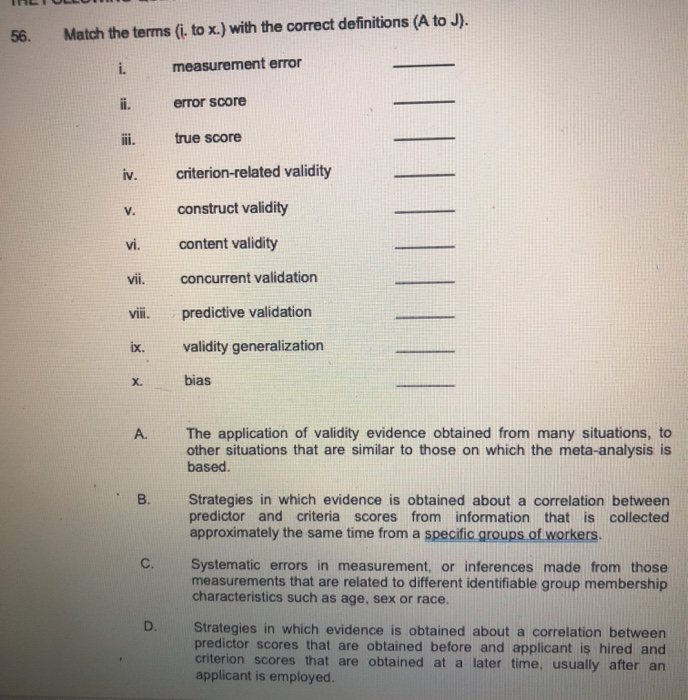
Question: 56. Match the terms (i. to x.) with the correct definitions (A to J). i. measurement error error score iii. true score iv. criterion-related validity
56. Match the terms (i. to x.) with the correct
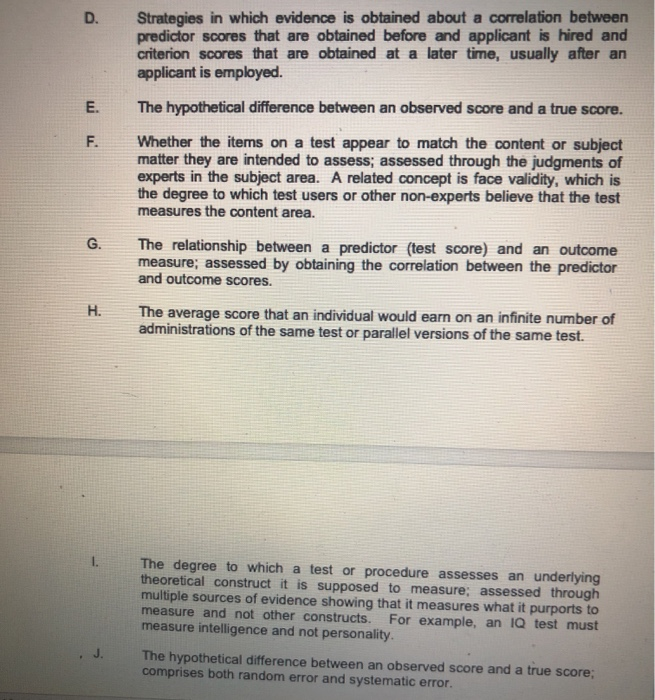
56. Match the terms (i. to x.) with the correct definitions (A to J). i. measurement error error score iii. true score iv. criterion-related validity v. construct validity vi. content validity vii. concurrent validation viii. predictive validation ix. validity generalization X. bias A. The application of validity evidence obtained from many situations, to other situations that are similar to those on which the meta-analysis is based. B Strategies in which evidence is obtained about a correlation between predictor and criteria scores from information that is collected approximately the same time from a specific groups of workers. C. Systematic errors in measurement, or inferences made from those measurements that are related to different identifiable group membership characteristics such as age, sex or race. D. Strategies in which evidence is obtained about a correlation between predictor scores that are obtained before and applicant i hired and criterion scores that are obtained at a later time, usually after an applicant is employed. D. Strategies in which evidence is obtained about a correlation between predictor scores that are obtained before and applicant is hired and criterion scores that are obtained at a later time, usually after an applicant is employed. E. The hypothetical difference between an observed score and a true score. F. Whether the items on a test appear to match the content or subject matter they are intended to assess; assessed through the judgments of experts in the subject area. A related concept is face validity, which is the degree to which test users or other non-experts believe that the test measures the content area. G. The relationship between a predictor (test score) and an outcome measure; assessed by obtaining the correlation between the predictor and outcome scores. The average score that an individual would earn on an infinite number of administrations of the same test or parallel versions of the same test. H. 1. The degree to which a test or procedure assesses an underlying theoretical construct it is supposed to measure; assessed through multiple sources of evidence showing that it measures what it purports to measure and not other constructs. For example, an IQ test must measure intelligence and not personality. The hypothetical difference between an observed score and a true score; comprises both random error and systematic error

Step by Step Solution

There are 3 Steps involved in it

1 Expert Approved Answer
Step: 1 Unlock blur-text-image

Question Has Been Solved by an Expert!

Get step-by-step solutions from verified subject matter experts

Step: 2 Unlock
Step: 3 Unlock

Students Have Also Explored These Related General Management Questions!