







Question: 5-7. John Doe, whose current and probable future contracts for the sale of the clay on his land are described in Problem 5-6, is in
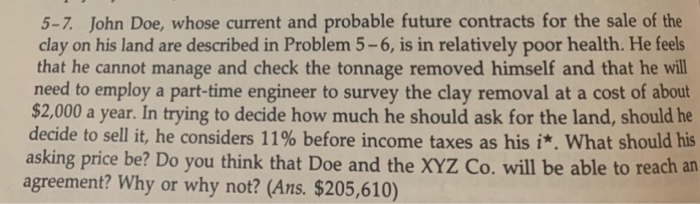
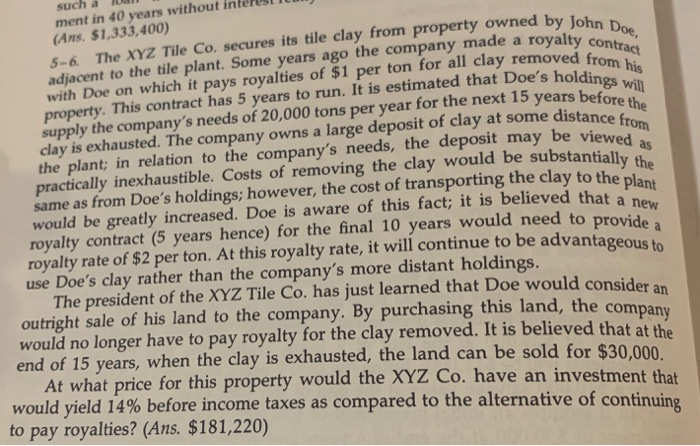
5-7. John Doe, whose current and probable future contracts for the sale of the clay on his land are described in Problem 5-6, is in relatively poor health. He feels that he cannot manage and check the tonnage removed himself and that he will need to employ a part-time engineer to survey the clay removal at a cost of about $2,000 a year. In trying to decide how much he should ask for the land, should he decide to sell it, he considers 11% before income taxes as his i*. What should his asking price be? Do you think that Doe and the XYZ Co. will be able to reach an agreement? Why or why not? (Ans. $205,610) 5-6. The XYZ Tile Co. secures its tile clay from property owned by John Doe, adjacent to the tile plant. Some years ago the company made a royalty contract pays royalties of $1 per ton for all clay removed from his supply the company's needs of 20,000 tons per year for the next 15 years before the property. This contract has 5 years to run. It is estimated that Doe's holdings will clay is exhausted. The company owns a large deposit of clay at some distance from such ment in 40 years without in (Ans. $1,333,400) with Doe on which the plant; in relation to the company's needs, the deposit may be viewed as practically inexhaustible. Costs of removing the clay would be substantially the same as from Doe's holdings; however, the cost of transporting the clay to the plant would be greatly increased. Doe is aware of this fact; it is believed that a new royalty contract (5 years hence) for the final 10 years would need to provide a royalty rate of $2 per ton. At this royalty rate, it will continue to be advantageous to use Doe's clay rather than the company's more distant holdings. The president of the XYZ Tile Co. has just learned that Doe would consider an outright sale of his land to the company. By purchasing this land, the company would no longer have to pay royalty for the clay removed. It is believed that at the end of 15 years, when the clay is exhausted, the land can be sold for $30,000. At what price for this property would the XYZ Co. have an investment that would yield 14% before income taxes as compared to the alternative of continuing to pay royalties? (Ans. $181,220)
Step by Step Solution
There are 3 Steps involved in it

Get step-by-step solutions from verified subject matter experts
 Study Help