







Question: 5A. Apply best fit allocation algorithm for the processes shown below with the available blocks of 5M given sizes which are in order. The block
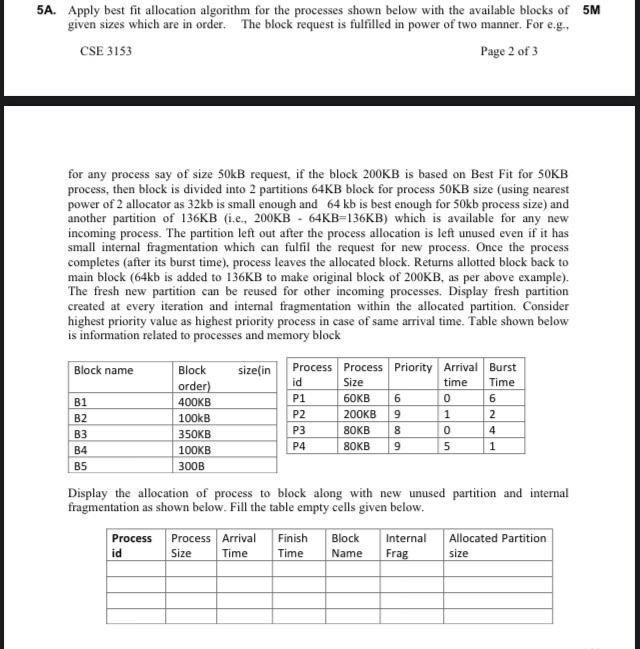
5A. Apply best fit allocation algorithm for the processes shown below with the available blocks of 5M given sizes which are in order. The block request is fulfilled in power of two manner. For e.g., CSE 3153 Page 2 of 3 for any process say of size SokB request, if the block 200KB is based on Best Fit for SOKB process, then block is divided into 2 partitions 64KB block for process 50KB size (using nearest power of 2 allocator as 32kb is small enough and 64 kb is best enough for 50kb process size) and another partition of 136KB (i.e., 200KB - 64KB=136KB) which is available for any new incoming process. The partition left out after the process allocation is left unused even if it has small internal fragmentation which can fulfil the request for new process. Once the process completes (after its burst time). process leaves the allocated block. Returns allotted block back to main block (64kb is added to 136KB to make original block of 200KB, as per above example). The fresh new partition can reused for other incoming processes. Display fresh partition created at every iteration and intemal fragmentation within the allocated partition. Consider highest priority value as highest priority process in case of same arrival time. Table shown below is information related to processes and memory block Block name size in B1 B2 B3 B4 B5 Block order) 400KB 100kB 350KB 100KB 300B Process Process Priority Arrival Burst id Size time Time P1 60KB 6 0 6 P2 200KB 9 1 2 P3 80KB 8 0 4 P4 80KB 9 5 1 Display the allocation of process to block along with new unused partition and internal fragmentation as shown below. Fill the table empty cells given below. Process id Process Arrival Size Time Finish Time Block Name Internal Frag Allocated Partition size
Step by Step Solution
There are 3 Steps involved in it

Get step-by-step solutions from verified subject matter experts
 Study Help