


Question: 5h 58m QUESTION RESOURCE(S) TEST RESOURCE(S) Tools NR 13 Q 100% Q Tools Numerical Response Use the following information to answer numerical-response questions 13 and
5h 58m QUESTION RESOURCE(S) TEST RESOURCE(S)
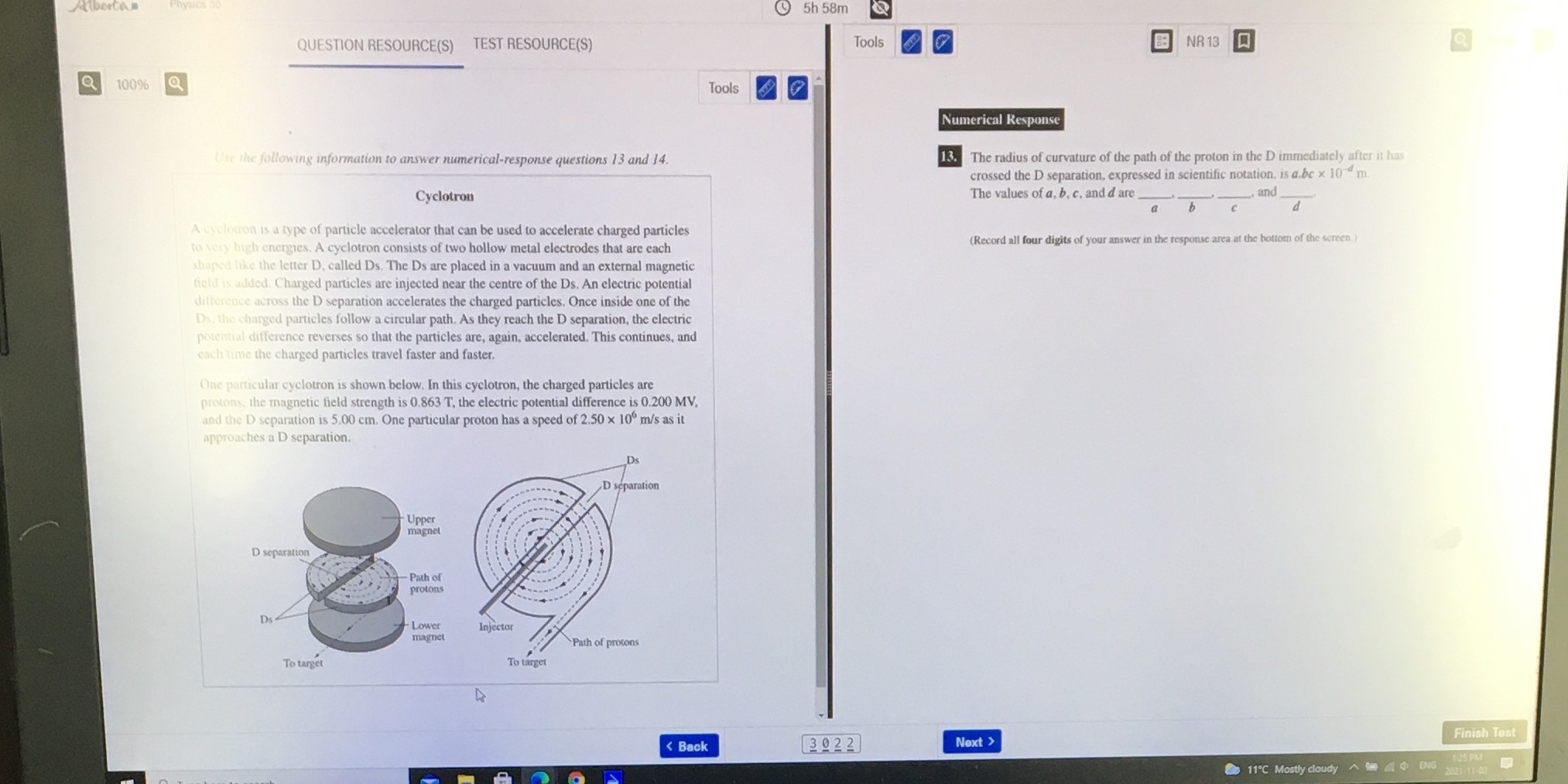
5h 58m QUESTION RESOURCE(S) TEST RESOURCE(S) Tools NR 13 Q 100% Q Tools Numerical Response Use the following information to answer numerical-response questions 13 and 14. 13. The radius of curvature of the path of the proton in the D immediately after it has crossed the D separation, expressed in scientific notation, is a.be x 10 m Cyclotron The values of a, b, c. and d are _ and A cyclotron is a type of particle accelerator that can be used to accelerate charged particles to very high energies. A cyclotron consists of two hollow metal electrodes that are each (Record all four digits of your answer in the response area at the bottom of the screen.) shaped like the letter D. called Ds. The Ds are placed in a vacuum and an external magnetic field is added. Charged particles are injected near the centre of the Ds. An electric potential difference across the D separation accelerates the charged particles. Once inside one of the Ds. the charged particles follow a circular path. As they reach the D separation, the electric potential difference reverses so that the particles are, again, accelerated. This continues, and each time the charged particles travel faster and faster. One particular cyclotron is shown below. In this cyclotron, the charged particles are protons, the magnetic field strength is 0.863 T, the electric potential difference is 0.200 MV. and the D separation is 5.00 cm. One particular proton has a speed of 2.50 x 10 m/s as it approaches a D separation. D separation Upper magnet D separation Path of protons Lower Injector magnet Path of protons To target To target Next > Finish Test

Step by Step Solution

There are 3 Steps involved in it

1 Expert Approved Answer
Step: 1 Unlock blur-text-image

Question Has Been Solved by an Expert!

Get step-by-step solutions from verified subject matter experts

Step: 2 Unlock
Step: 3 Unlock

Students Have Also Explored These Related Mathematics Questions!